
Data centers used about 4.7% of U.S. electricity in 2024 and could reach roughly 12% by 2030. National overall electricity demand growth is real but modest, at 1 to 3 percent a year. The U.S. has a decentralized electricity system, and data center driven demand is driving up demand much more in certain regions.
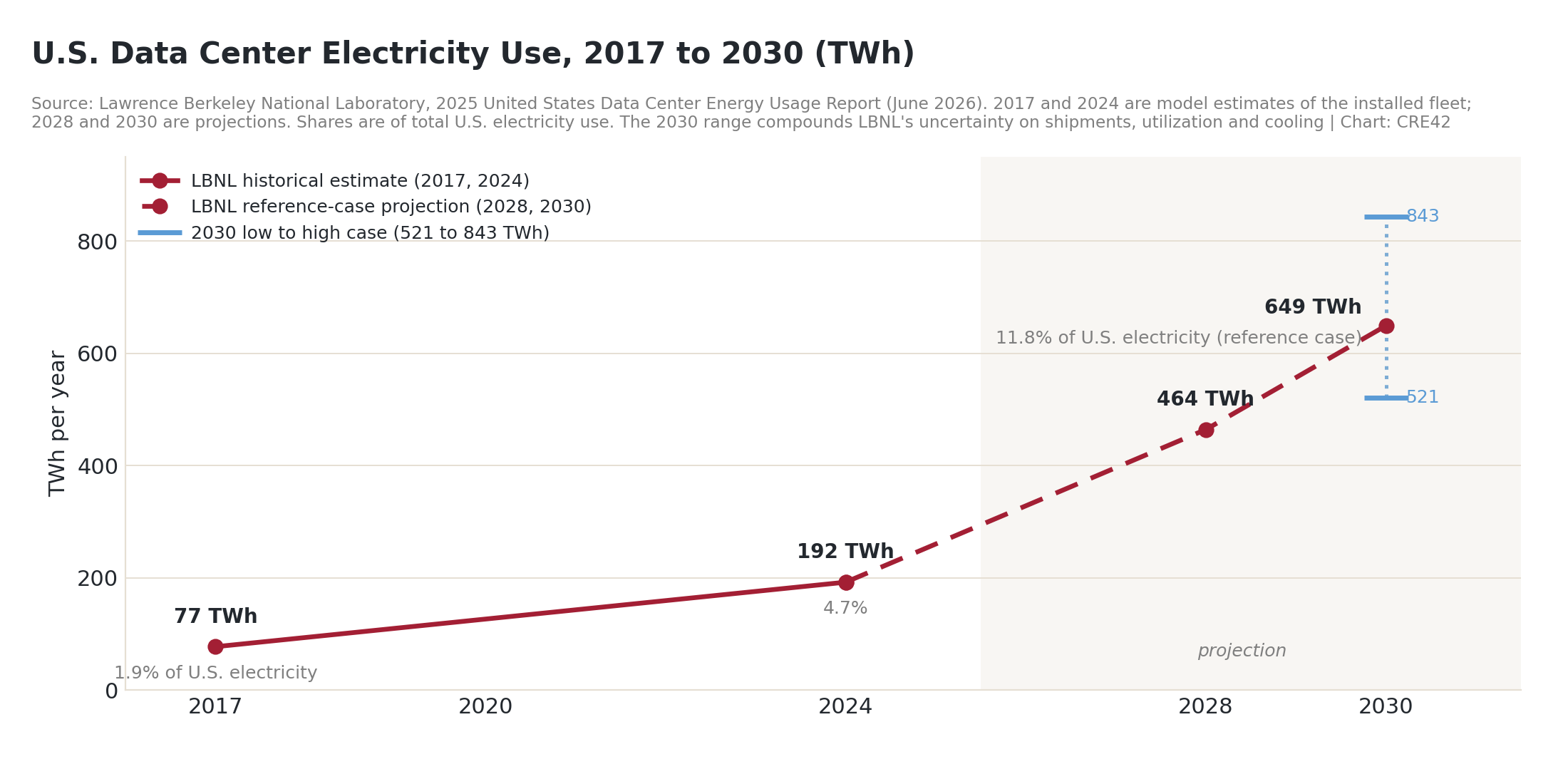
U.S. Data Center Electricity Use, 2017 to 2030 (TWh) | Source: Lawrence Berkeley National Laboratory, 2025 United States Data Center Energy Usage Report (June 2026)
- Lawrence Berkeley National Laboratory (LBNL) builds its estimates from the installed base of servers, storage, network and cooling equipment, so 2017 and 2024 are model estimates and 2028 and 2030 are projections. The reference case is LBNL’s base case; the 2030 range compounds its uncertainty about server shipments, how hard the servers run, and cooling efficiency.[1]
- Data centers used 192 TWh in 2024, 4.7% of U.S. electricity, up from 1.9% in 2017. The reference case reaches 649 TWh in 2030, 11.8% of the total, with a range of 9.5% to 15.3%.[1]
- For scale, U.S. utility-scale generation was 4,430 TWh in 2025. On LBNL’s reading of the grid planners’ forecasts, data centers account for about a third of all U.S. load growth from 2024 to 2030; electrification, manufacturing and population account for the rest.[2]
- Total U.S. demand grew 2.6% in 2025 and about 1% in the first half of 2026 (a mild winter cut residential use by 1.7% while the services sector, which includes data centers, grew 3%). The IEA forecasts 1.8% for 2026 and 3.0% for 2027.[3]
- Those rates are large against the recent past. U.S. net generation was 4,055 TWh in 2005 and 4,010 TWh in 2020: fifteen years of essentially no growth, as efficiency gains absorbed population and economic growth. It then rose to 4,430 TWh in 2025, about 2% a year. Growth of 2 to 3 percent a year is a rate the system had not planned or built for in a generation.[2]
There Is No National Grid
Electricity is not traded nationally. The lower 48 states form three interconnections (Eastern, Western and Texas) that exchange very little power with one another, and within them the planning is done by regional grid operators and utilities. NERC, the body that assesses reliability, evaluates 23 separate areas and publishes no national total, because a surplus in California or the Southeast does nothing for a data center in Virginia or Ohio. The map below is NERC’s own summary of where planned resources fall short of the planning standard in the next five years.
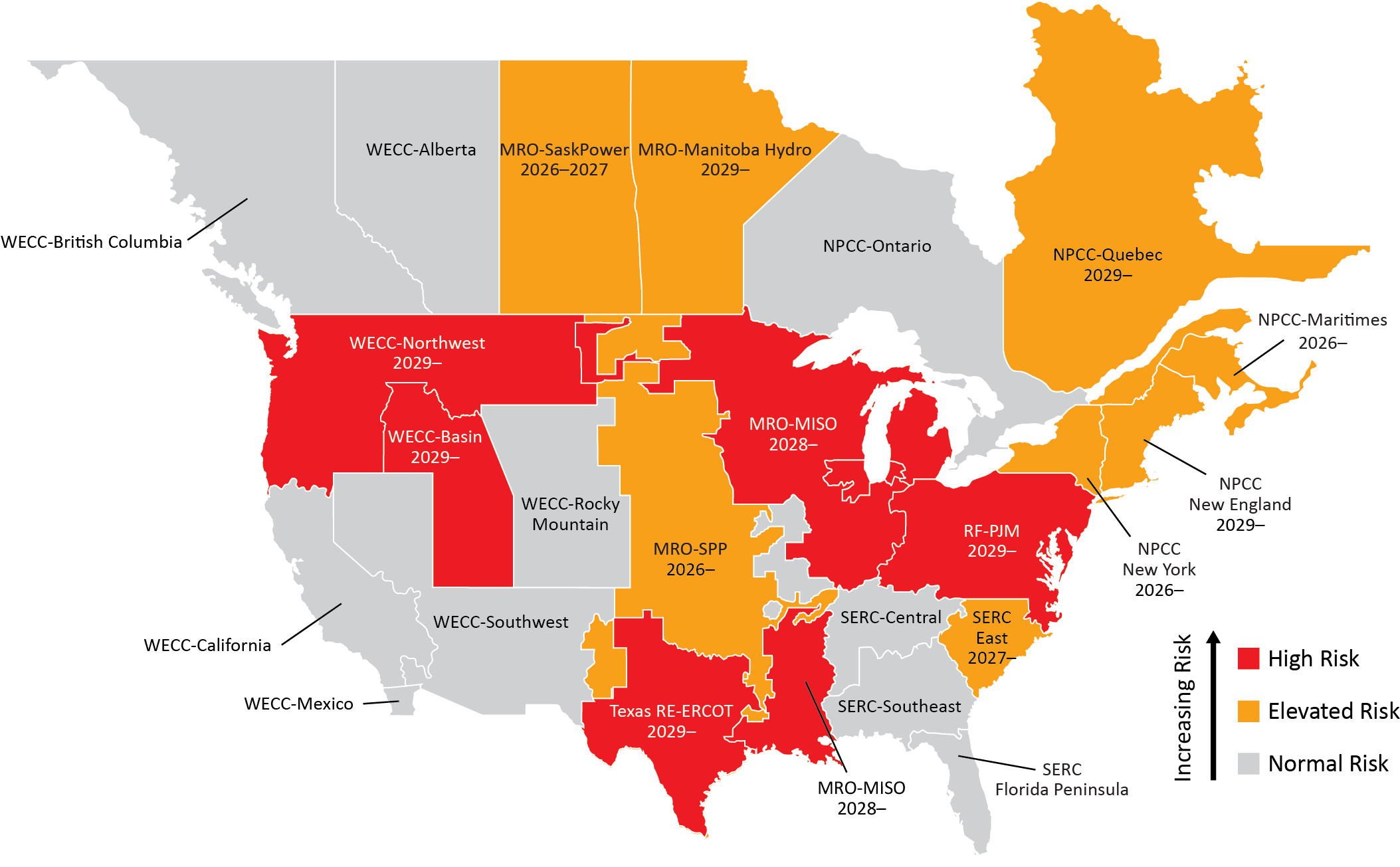
Risk Area Summary, 2026 to 2030 | Source: NERC, 2025 Long-Term Reliability Assessment, Figure 1 (January 2026). Red: planned resources fall short of established criteria in the next five years. Orange: targets are met but shortfalls appear in extreme conditions. Reproduced with attribution.[4]
- NERC’s aggregate across all areas: summer peak demand rises by more than 224 GW over ten years, 69% above the 132 GW projected a year earlier, and winter peak by 245 GW. New data centers account for most of the increase.[4]
- The three largest data center markets sit in three different high-risk areas: Northern Virginia and Ohio in PJM, Texas in ERCOT, and the upper Midwest in MISO. Each has its own planners, its own capacity market or reserve rules, and its own shortfall date.
Regional Peak Demand vs. Resources
A grid has to carry more capacity than its expected peak, because on the peak day some plants are down, the weather runs hotter than forecast, and wind and solar produce less than their nameplate. That cushion is the reserve margin: resources minus peak demand, as a share of peak demand. Each region sets a reference margin, the cushion its planners say is needed to keep supply shortfalls to about one event in ten years.[5] The chart compares each region’s peak demand with the resources it can count on (existing plants plus those under construction), and with demand grossed up by the reference margin: below the gray line the region is short of its own standard, below the red line it is short of demand itself.
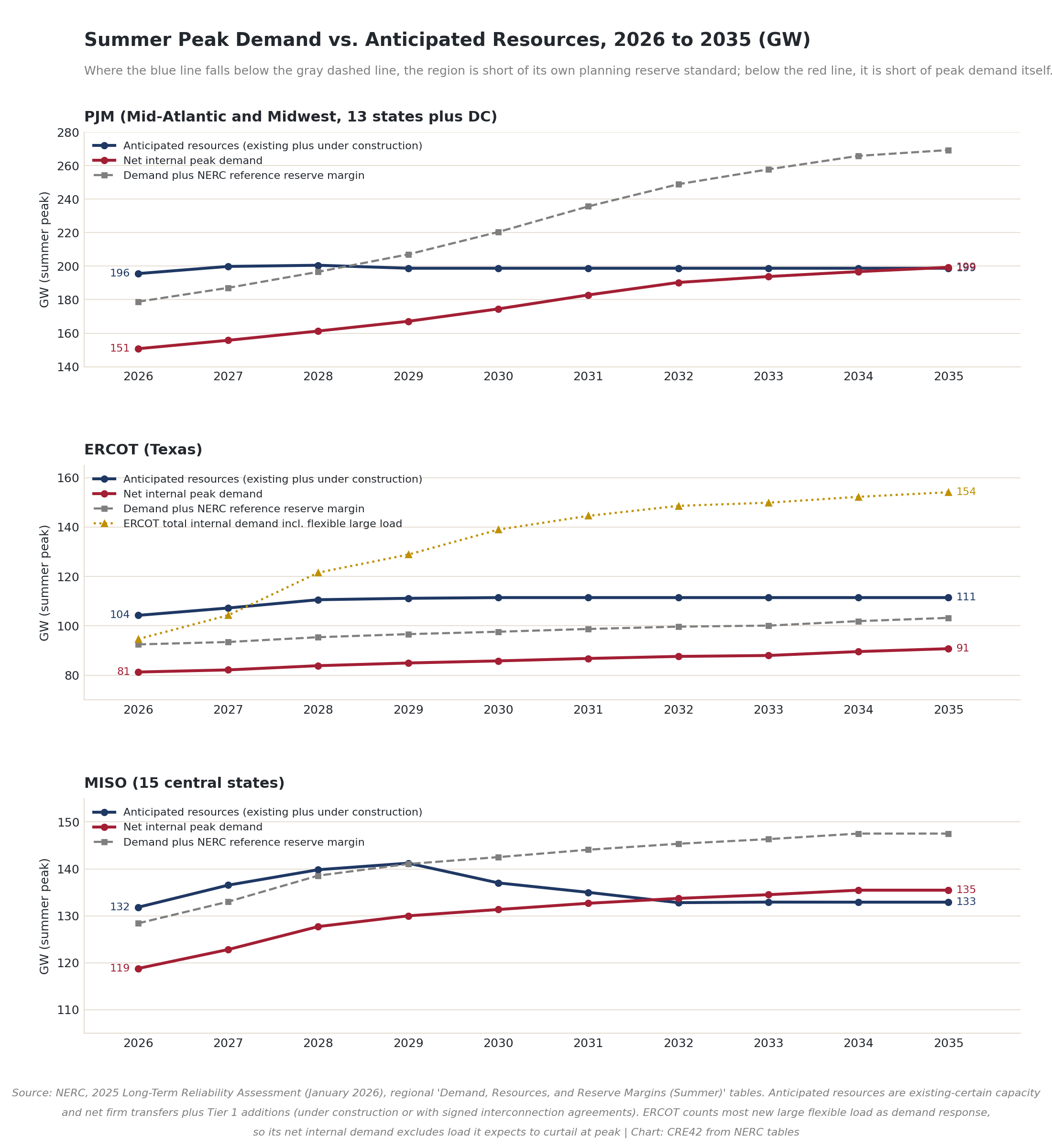
Summer Peak Demand vs. Anticipated Resources, 2026 to 2035 (GW) | Source: NERC, 2025 Long-Term Reliability Assessment, regional summer tables; chart: CRE42
- PJM. Peak demand rises from 151 GW in 2026 to 199 GW in 2035 while anticipated resources stay between 196 and 201 GW. PJM falls below its reference margin in 2029 and, by 2035, its resources fall just short of peak demand itself. The gray line climbs faster than demand because PJM is raising its reference margin from 18.6% to 35.1% as it moves to counting solar, wind and batteries at what they deliver on a peak afternoon rather than at nameplate.[4]
- MISO. Demand grows modestly, from 119 GW to 135 GW, but existing capacity falls from 126 GW to 107 GW on retirements. MISO drops below its 8.5% reference margin in 2030 and below demand itself from 2032.[4]
- ERCOT. Texas expects total peak demand to grow from 95 GW to 154 GW by 2035, the fastest of any region, and most of it is large flexible load: data centers and other big customers that ERCOT expects to be able to curtail at peak under the state’s 2025 large-load law. Counted that way, the demand ERCOT plans against rises only from 81 GW to 91 GW and the reserve margin stays above the 13.75% standard in every year. The gap between the two demand lines, 13 GW in 2026 and 63 GW in 2035, is load the grid is counting on being able to switch off.[4]
The Price Signal
PJM is the largest U.S. grid operator, serving about 67 million people from Virginia to Illinois, and it runs the clearest market test of the balance between supply and demand: a capacity auction in which generators are paid to be available three years ahead. The clearing price is what the region pays for a reliable megawatt.
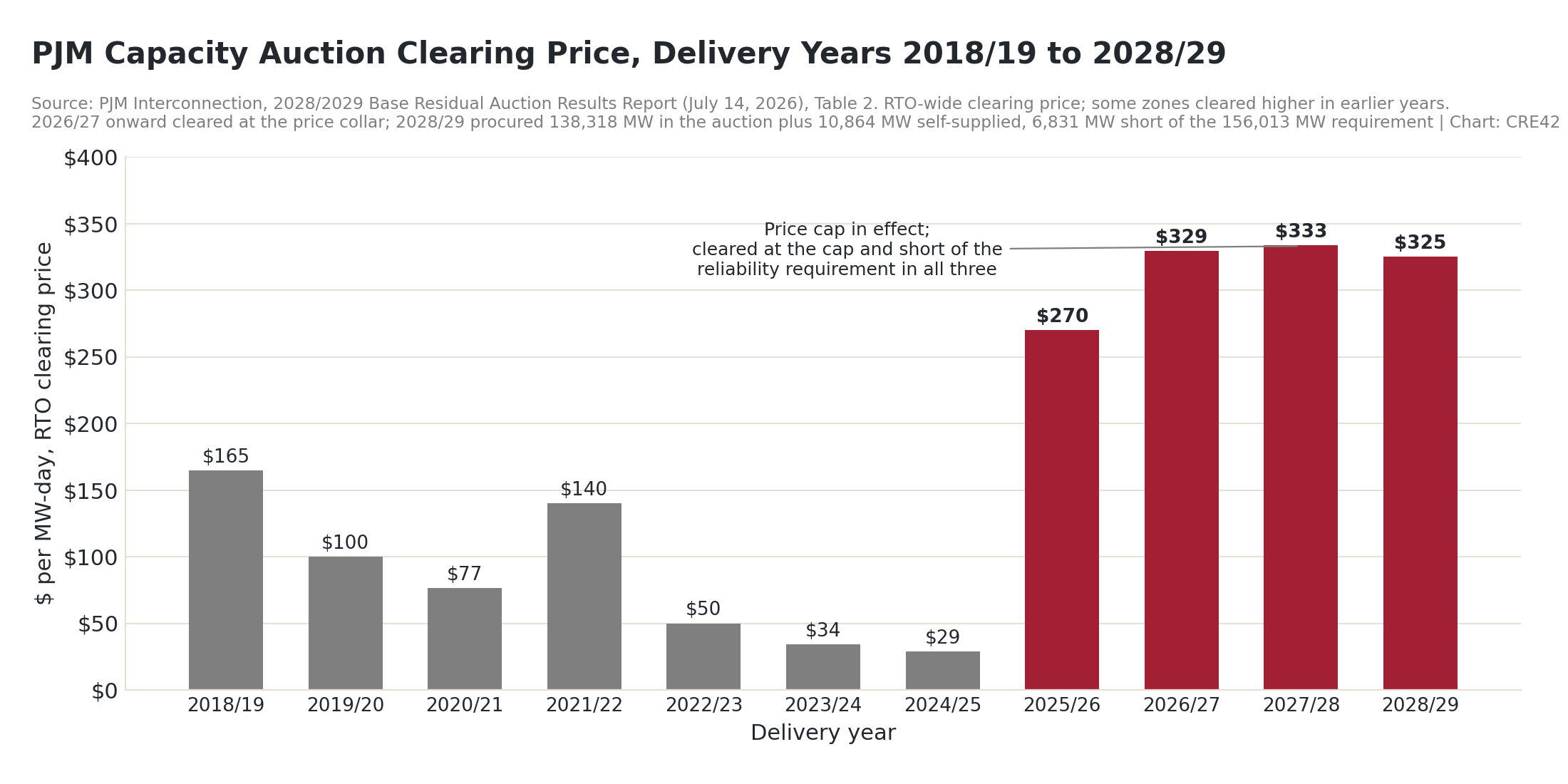
PJM Capacity Auction Clearing Price, Delivery Years 2018/19 to 2028/29 | Source: PJM Interconnection, 2028/2029 Base Residual Auction Results Report (July 14, 2026)
- The clearing price went from $29 per MW-day for 2024/25 to $270 for 2025/26, then to a negotiated cap of about $325 to $333, where it has stayed. The auctions have come up short of the region’s reliability requirement in three consecutive auctions and cleared at the price cap; the July 2026 auction for 2028/29 procured 138,318 MW, which with 10,864 MW of self-supplied capacity left the region 6,831 MW short of its 156,013 MW requirement, at a cost of $16.4 billion.[6]
- PJM’s independent market monitor attributes the increase to data center load: including it in the last three auctions raised customer bills by $20.0 billion even with the cap in place, and would have raised them by $46.4 billion without it.[7]
- Capacity charges flow into retail bills across the region. U.S. retail electricity prices rose 6.9% in 2025, more than double headline inflation, and utilities requested a record $31 billion of rate increases that year.[8]
What Is Actually Being Built
The supply response is large on paper and small in the ground. Global Energy Monitor counts 378 GW of gas-fired capacity in development in August 2026, up from 252 GW in January, with 189 GW tied directly to data centers and 122 GW in Texas alone. The gas fleet in service is 516 GW, so the pipeline equals 73% of everything now running. What was actually connected in the past twelve months was 7.5 GW.
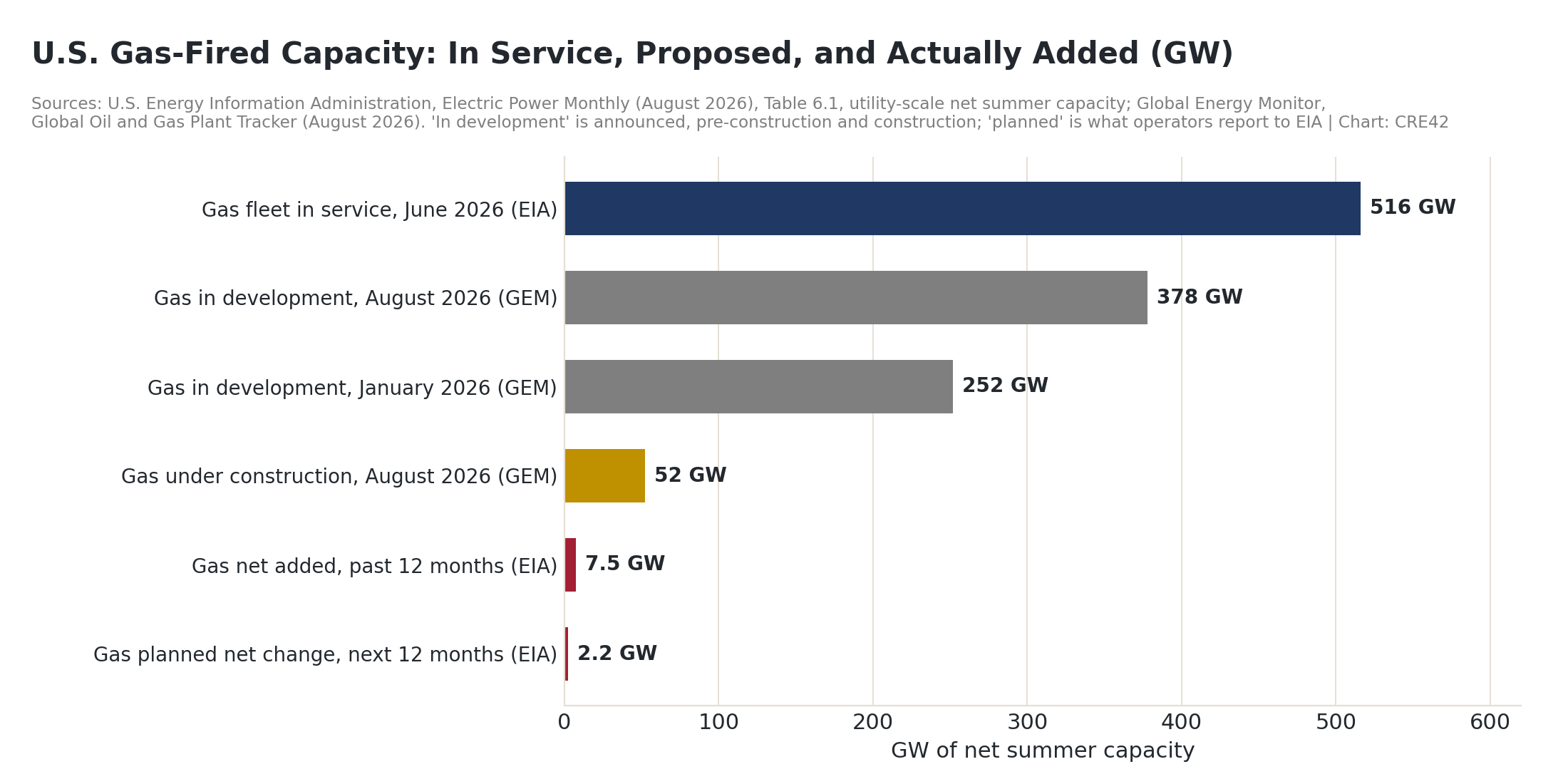
U.S. Gas-Fired Capacity: In Service, Proposed, and Actually Added (GW) | Sources: EIA, Electric Power Monthly, Table 6.1 (August 2026); Global Energy Monitor, Global Oil and Gas Plant Tracker (August 2026)
- A development pipeline is a list of proposals, not a construction schedule. The 52 GW under construction is the comparable figure; about 45 GW of projects had their start dates pushed back in the first half of 2026 on turbine and engine supply constraints.[9]
- EIA’s operator-reported plans add a net 2.2 GW of gas over the next twelve months (7.7 GW of additions less 5.6 GW of retirements). The additions actually arriving are solar (28 GW in the past twelve months, 44 GW planned) and batteries (18 GW, 23 GW planned); coal retired 4 GW.[10]
- Not everyone reads the demand side at face value. Utilities analyst Andy DeVries argues that utilities are planning against announced data center load rather than contracted load and may overbuild, with ratepayers carrying the cost of idle plant. EIA cut its forecast of Texas 2027 load growth from 14% to 6% in August 2026 after the state paused new data center approvals, which is the first case of a policy action feeding straight into a federal demand forecast.[11]
Nameplate capacity is not delivered energy
“Nameplate” is what a plant can produce under ideal conditions. The capacity factor is what it produces over a year as a share of nameplate. At 2025 factors, 100 MW of solar delivers about the annual energy of 42 MW of combined-cycle gas; the nameplate figures in the chart above and in EIA’s addition tables have to be read through these ratios.[12]
| Technology | Capacity factor, 2024 | Capacity factor, 2025 | Meaning |
|---|---|---|---|
| Nuclear | 90.8% | 91.0% | Runs nearly around the clock |
| Natural gas combined cycle | 60.5% | 58.4% | Dispatchable; runs when economic |
| Coal | 42.6% | 48.7% | Rose in 2025 as retirements were deferred |
| Conventional hydro | 34.6% | 35.3% | Seasonal |
| Wind | 34.3% | 34.2% | About a third of nameplate |
| Solar photovoltaic | 23.2% | 24.4% | About a quarter of nameplate |
| Natural gas turbine (peaker) | 13.9% | 14.1% | Runs at peak only |
Source: EIA, Electric Power Monthly (August 2026), Tables 6.07.A and 6.07.B.
Headwinds: The Grid Pushes Back
The ERCOT numbers above describe a bargain: Texas will connect very large loads on the condition that it can turn them off. In August 2026 the bargain got harder in two states at once, and the polling suggests it will get harder elsewhere.
Texas. On August 3, 2026 Governor Abbott directed ERCOT and the Public Utility Commission to pause new data center interconnection approvals until each project is verified and audited on its power and water use, tax incentives, community mitigation and ownership. The audit covers the 250 to 300 projects in ERCOT’s “Batch Zero” interconnection study, roughly 90% of them data centers, with about 200 GW of requested load, more than twice ERCOT’s all-time peak. ERCOT said the review would take several months. The state’s Senate Bill 6, signed in June 2025, had already given ERCOT the authority to curtail large loads in emergencies that underlies the flexible-load accounting in the NERC chart.[13]
Pennsylvania. On August 18, 2026 Governor Shapiro signed Executive Order 2026-05. For any data center above 25 MW it removes eligibility for the state’s permit fast-track program, requires proof of local zoning approval before state environmental permits are reviewed, requires an agreement to the administration’s GRID requirements (energy affordability, transparency, workforce and environmental protection), mandates annual energy and water reporting, and directs a Special Counsel for Energy Affordability to press the utility commission for tariffs that keep data center grid costs off other customers and for rules that curtail data centers before any other customer in an emergency. The order’s preamble cites the market monitor’s finding that data centers were responsible for $29.4 billion, or 46%, of PJM capacity costs across the last four auctions.[14]
Public opinion and local action. The Annenberg Public Policy Center’s national survey of June to July 2026 found 61% of Americans opposed to a data center in their community, up from 49% in February to March, with majorities across parties; a Public First/ITIF survey released August 26 ranked data centers last of ten development types, at 26% support and 46% opposition, behind power plants and highways. Data Center Watch, an industry-adjacent tracker, counted 75 projects worth about $130 billion of announced value blocked or delayed in the first quarter of 2026, about equal to all of 2025, with moratorium bills in 14 states.[15]
For a developer or investor the consequences are practical. Interconnection is now a political approval as well as an engineering one; the cost of new generation and grid upgrades is moving onto the developer; and an already-entitled, already-powered site is worth more than it was a year ago relative to a greenfield one. The regional map, not the national total, is where those judgments have to be made.
What to Watch For in 2026 and Beyond
Sources to Track Data Center Power Demand and Grid Capacity in 2026:
| Source | Report / Series | Frequency | Notes |
|---|---|---|---|
| NERC | Long-Term Reliability Assessment; Summer and Winter Reliability Assessments | Annual (December/January); seasonal (May, November) | Regional demand, resources and reserve margins; the only common basis across regions |
| PJM Interconnection | Base Residual Auction results; annual load forecast | Auctions annually (compressed schedule through 2026); forecast in January | Clearing price, cleared MW vs. reliability requirement; price collar terms |
| Monitoring Analytics | PJM State of the Market report | Quarterly | Data center share of capacity costs |
| ERCOT | Long-term load forecast; large-load interconnection queue; Batch Zero notices | Annual forecast; queue monthly | Requested vs. approved large load; audit status |
| U.S. EIA | Electric Power Monthly, Tables 6.1 (capacity changes) and 6.07 (capacity factors); Short-Term Energy Outlook | Monthly | What actually connected; state-level demand forecast revisions |
| Lawrence Berkeley National Laboratory | United States Data Center Energy Usage Report | Irregular (2016, 2024, 2026 editions) | Sector-level consumption estimate and projection |
| IEA | Electricity report (February) and Mid-Year Update (July) | Semi-annual | U.S. demand growth actuals and forecasts |
| Global Energy Monitor | Global Oil and Gas Plant Tracker, U.S. briefs | Semi-annual | Gas pipeline by status; data center-tied share; NGO tracker compiled from filings |
| Annenberg Public Policy Center | AI and data center opinion surveys | Irregular | Local opposition trend |
[1] Lawrence Berkeley National Laboratory, 2025 United States Data Center Energy Usage Report (June 2026), Table 2 and Figure 1: 2024 use 192 TWh (4.7% of U.S. consumption); 2017 use 1.9%; 2028 reference 464 TWh; 2030 reference 649 TWh (11.8%) with a range of 521 to 843 TWh (9.5% to 15.3%). The 2017 TWh figure is derived from the stated 1.9% share and EIA 2017 generation. LBNL tabulates only the published points; intermediate years are not reported. eta-publications.lbl.gov ↩
[2] U.S. Energy Information Administration, Electric Power Monthly (August 2026), Table 1.1: utility-scale net generation 4,429.5 TWh in 2025 and 4,009.8 TWh in 2020; Monthly Energy Review, Table 7.2a: 4,055.4 TWh in 2005. Data center share of load growth: LBNL 2025 report, reading the NERC 2025 LTRA demand forecast (non-data-center load growth about 926 TWh, 24%, 2024 to 2030). eia.gov ↩
[3] International Energy Agency, Electricity Mid-Year Update 2026 (July 2026): U.S. demand +2.6% in 2025, about +1% in the first half of 2026 (residential -1.7%, services +3%), forecast +1.8% for 2026 and +3.0% for 2027, with data centres named as the main driver. iea.org ↩
[4] North American Electric Reliability Corporation, 2025 Long-Term Reliability Assessment (January 2026): Figure 1 (risk map); executive summary (aggregate summer peak demand growth of more than 224 GW over ten years, 69% above the prior year’s 132 GW; winter 245 GW); regional “Demand, Resources, and Reserve Margins (Summer)” tables for PJM, Texas RE-ERCOT and MISO. Anticipated resources on the chart are existing-certain capacity and net firm transfers plus Tier 1 additions, which reproduces NERC’s anticipated reserve margin within 0.05 percentage points for the three regions shown. NERC is the FERC-certified Electric Reliability Organization, not a government agency. nerc.com ↩
[5] NERC defines the anticipated reserve margin as anticipated resources less net internal demand, as a percentage of net internal demand, and the reference margin level as the target established by each assessment area, generally corresponding to a one-day-in-ten-years loss-of-load expectation. Reference margins in 2026: PJM 18.6% (rising to 35.1% by 2035), ERCOT 13.75%, MISO 8.1% (8.5% from 2028). Net internal demand is total internal demand less demand response. ↩
[6] PJM Interconnection, 2028/2029 Base Residual Auction Results Report (July 14, 2026), Table 2 and p. 1: RTO clearing prices by delivery year; 138,318 MW procured in the auction plus 10,864 MW committed under the Fixed Resource Requirement, 149,182 MW in total, 6,831 MW below the 156,013 MW reliability requirement; reserve margin procured 14.7%, 5.3 points below target; total cost about $16.4 billion. The 2026/27 through 2028/29 auctions cleared at the price collar PJM adopted in 2025 in settlement of a complaint by Pennsylvania’s governor, since extended. pjm.com ↩
[7] Monitoring Analytics, State of the Market Report for PJM, Second Quarter 2026, Section 1: inclusion of data center load in the last three Base Residual Auctions increased customers’ bills by $20.04 billion with the maximum price in place; $46.43 billion without it. monitoringanalytics.com ↩
[8] Goldman Sachs Research, “Higher Electricity Prices and the Consumer Impact” (February 12, 2026): U.S. electricity prices +6.9% in 2025 against 2.9% headline inflation; utilities requested $31 billion of rate increases in 2025, more than twice the 2024 level. ↩
[9] Global Energy Monitor, “U.S. gas power proposals tied to data centers nearly double in six months” (August 2026): 378 GW in development (announced, pre-construction and construction) vs. 252 GW in January 2026; 189 GW tied to data centers; 67 GW of reciprocating engines; 52 GW under construction; 122 GW in Texas (77 GW data center-tied); about 45 GW with start dates delayed in the first half of 2026. GEM is a non-governmental tracker compiled from regulatory filings. globalenergymonitor.org ↩
[10] U.S. Energy Information Administration, Electric Power Monthly (August 2026), Table 6.1, utility-scale net summer capacity as of June 2026: natural gas 516.1 GW in service, +7.5 GW net over the past twelve months, planned +7.7 GW additions and -5.6 GW retirements over the next twelve; solar 164.6 GW, +28.1 GW past twelve months, +43.6 GW planned; batteries 51.7 GW, +17.9 GW, +22.8 GW planned; coal 168.2 GW, -4.0 GW, -5.3 GW planned. Planned figures are operator reports on Form EIA-860M. eia.gov ↩
[11] Andy DeVries (CreditSights), Bloomberg Odd Lots, “The Utilities Analyst Who Says the Data Center Demand Story Doesn’t Add Up” (February 2026). U.S. Energy Information Administration, Short-Term Energy Outlook (August 2026), p. 12: Texas 2027 electricity load growth forecast cut from 14% to 6% following the August 3, 2026 approval pause. eia.gov ↩
[12] U.S. Energy Information Administration, Electric Power Monthly (August 2026), Tables 6.07.A and 6.07.B, annual capacity factors for 2024 and 2025. The solar-to-gas equivalence is 24.4% divided by 58.4%. eia.gov ↩
[13] Office of the Texas Governor, “Governor Abbott Directs Comprehensive Data Center Audit” (August 3, 2026), letter to ERCOT and the PUCT; ERCOT market notice M-A080326-01, “Update Regarding Batch Zero Timelines and Processes” (August 2026); Texas Senate Bill 6 (2025). Batch Zero scope (250 to 300 projects, about 200 GW, roughly 90% data centers) as reported by ERCOT to the PUCT in August 2026. gov.texas.gov; ercot.com ↩
[14] Commonwealth of Pennsylvania, Executive Order 2026-05, “Protecting Pennsylvania Consumers from Data Center Impacts” (August 18, 2026), Sections 1 to 3 and preamble. pa.gov ↩
[15] Annenberg Public Policy Center, “Opposition to Local Data Centers Rises Sharply” (August 2026; survey of 1,320 U.S. adults, June 16 to July 19, 2026): 61% oppose, up from 49% in February to March 2026. Public First / Information Technology and Innovation Foundation survey released August 26, 2026: data centers 26% support, 46% oppose, last of ten development types. Data Center Watch (10a Labs), Q1 2026 report: 75 projects, about $130 billion of announced value, blocked or delayed; moratorium bills in 14 states; dollar totals are announced project values, not spending. annenbergpublicpolicycenter.org; datacenterwatch.org ↩
Companion workbook. data-centers-demand-vs-supply.xlsx: LBNL and EIA demand series, NERC LTRA 2025 regional tables for all 23 assessment areas, PJM auction results, demand growth, capacity factors, gas capacity, GW-to-TWh conversion, and a Source Index tab. Related pages: Measuring the Data Center Construction Boom and the Data Centers overview.
Sources
- Lawrence Berkeley National Laboratory, 2025 United States Data Center Energy Usage Report (June 2026). eta-publications.lbl.gov
- North American Electric Reliability Corporation, 2025 Long-Term Reliability Assessment (January 2026). nerc.com
- PJM Interconnection, 2028/2029 Base Residual Auction Results Report (July 14, 2026). pjm.com
- Monitoring Analytics, State of the Market Report for PJM, Second Quarter 2026. monitoringanalytics.com
- U.S. Energy Information Administration, Electric Power Monthly (August 2026), Tables 1.1, 6.1, 6.07.A and 6.07.B; Short-Term Energy Outlook (August 2026). eia.gov
- International Energy Agency, Electricity Mid-Year Update 2026 (July 2026). iea.org
- Global Energy Monitor, Global Oil and Gas Plant Tracker, U.S. research brief (August 2026). globalenergymonitor.org
- Goldman Sachs Research, “Higher Electricity Prices and the Consumer Impact” (February 12, 2026).
- Office of the Texas Governor, data center audit directive (August 3, 2026); ERCOT market notice M-A080326-01 (August 2026); Commonwealth of Pennsylvania, Executive Order 2026-05 (August 18, 2026).
- Annenberg Public Policy Center (August 2026); Public First / ITIF (August 26, 2026); Data Center Watch, Q1 2026 report.
- Bloomberg Odd Lots, interview with Andy DeVries, CreditSights (February 2026).
Methodology & Data Notes
Data center electricity use. LBNL’s figures are bottom-up estimates built from shipments and installed stock of servers, storage, network equipment and cooling, with assumptions on utilization and power usage effectiveness; they are not metered totals. LBNL states its shares against total U.S. electricity consumption, so the 2024 share reads 4.7% on that basis and about 4.5% against utility-scale generation alone. This page uses LBNL’s stated shares. The March 2026 version of this page combined a McKinsey demand forecast with a CRE42 supply construction; both are retired. The superseded forecasts (McKinsey, IEA 2025, EPRI, Goldman Sachs, BCG, LBNL 2024) are kept on the workbook’s DC Demand Forecasts tab for comparison.
NERC regional tables. Total internal demand is the forecast summer peak; net internal demand subtracts demand response and other controllable load, and is the basis for reserve margins. Anticipated resources are existing-certain capacity and net firm transfers plus Tier 1 additions (under construction or with signed interconnection agreements). NERC does not print an anticipated-resources row; the workbook derives it and checks it against NERC’s published anticipated reserve margin (within 0.05 percentage points for PJM, ERCOT and MISO). Prospective resources, which add proposed Tier 2 and Tier 3 projects, are carried in the workbook but not charted. ERCOT classifies most new large flexible load as demand response; its total and net internal demand are both shown for that reason. NERC publishes no national total; the workbook’s NERC tab carries all 23 assessment areas.
PJM auctions. Prices are the RTO-wide clearing price in dollars per megawatt-day of unforced capacity; some zones cleared higher in earlier auctions. The shortfall is measured after adding capacity that utilities self-supply under the Fixed Resource Requirement to what the auction procured. The compressed auction schedule (four auctions between mid-2025 and mid-2026) was PJM’s catch-up after earlier delays.
Capacity in service and in development. EIA Table 6.1 counts utility-scale generators of 1 MW and above by net summer capacity; “planned” figures are operator reports, which have a high completion rate within the twelve-month window. Global Energy Monitor’s pipeline is compiled from regulatory filings and announcements and includes behind-the-meter projects at data centers; it is a tracker, not an official series, and its status categories (announced, pre-construction, construction) are GEM’s own.
Opposition and state action. The Texas directive and ERCOT notice were saved as browser prints whose text did not extract cleanly; the figures quoted are as reported by ERCOT to the PUCT and in contemporaneous coverage, and the primary documents are linked. Data Center Watch is operated by 10a Labs, an industry-adjacent firm, and its dollar totals are announced project values; it is used because no other running series on blocked projects exists.