
U.S. Multifamily Supply Cycle: Boom, Bust, Construction Cliff
U.S. Multifamily Net Deliveries (2001–2026)
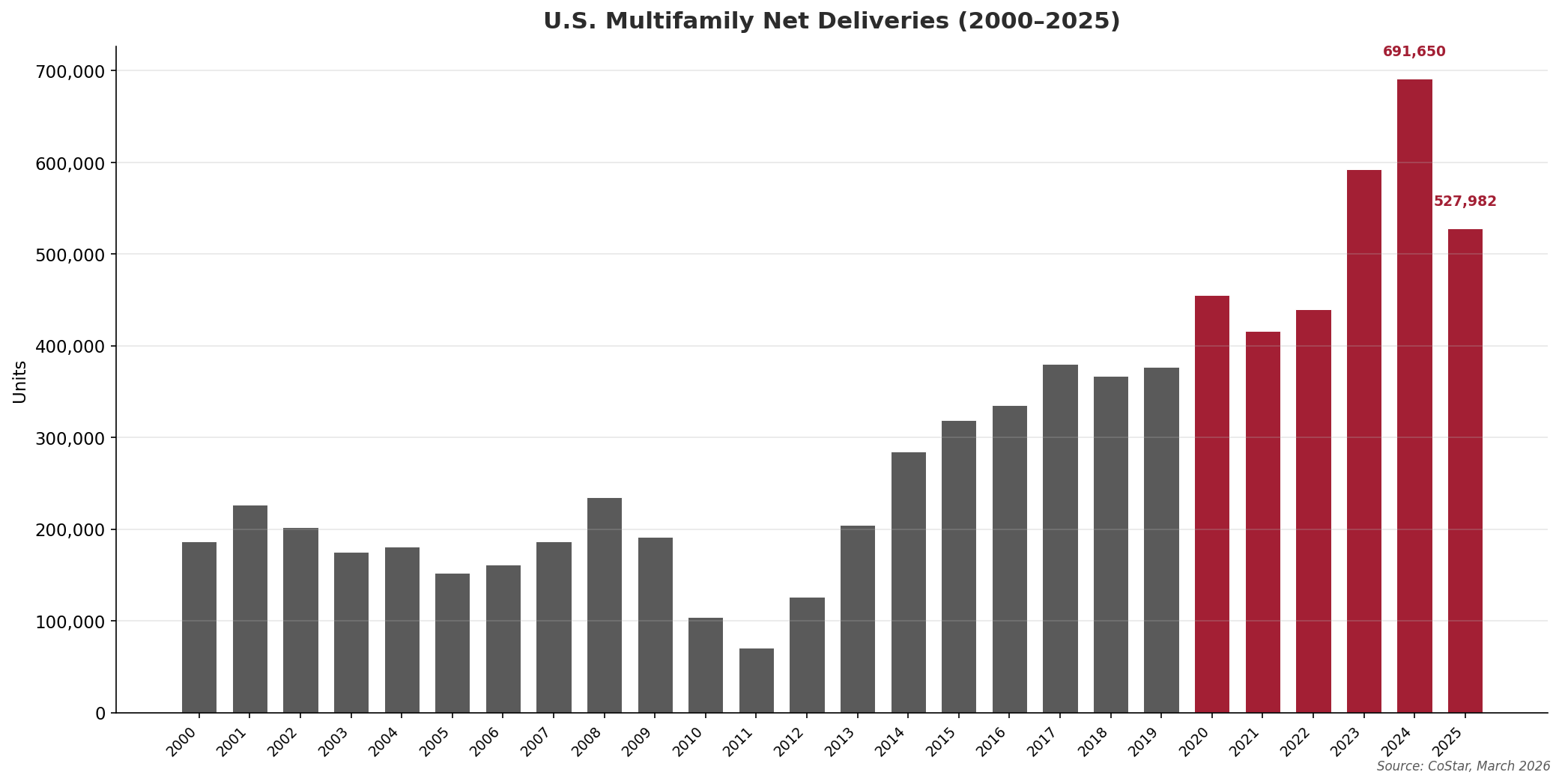
Source: CoStar, Q2 2026; 2026 annualized from first-half figures.
U.S. Multifamily Construction Starts (2001–2026)
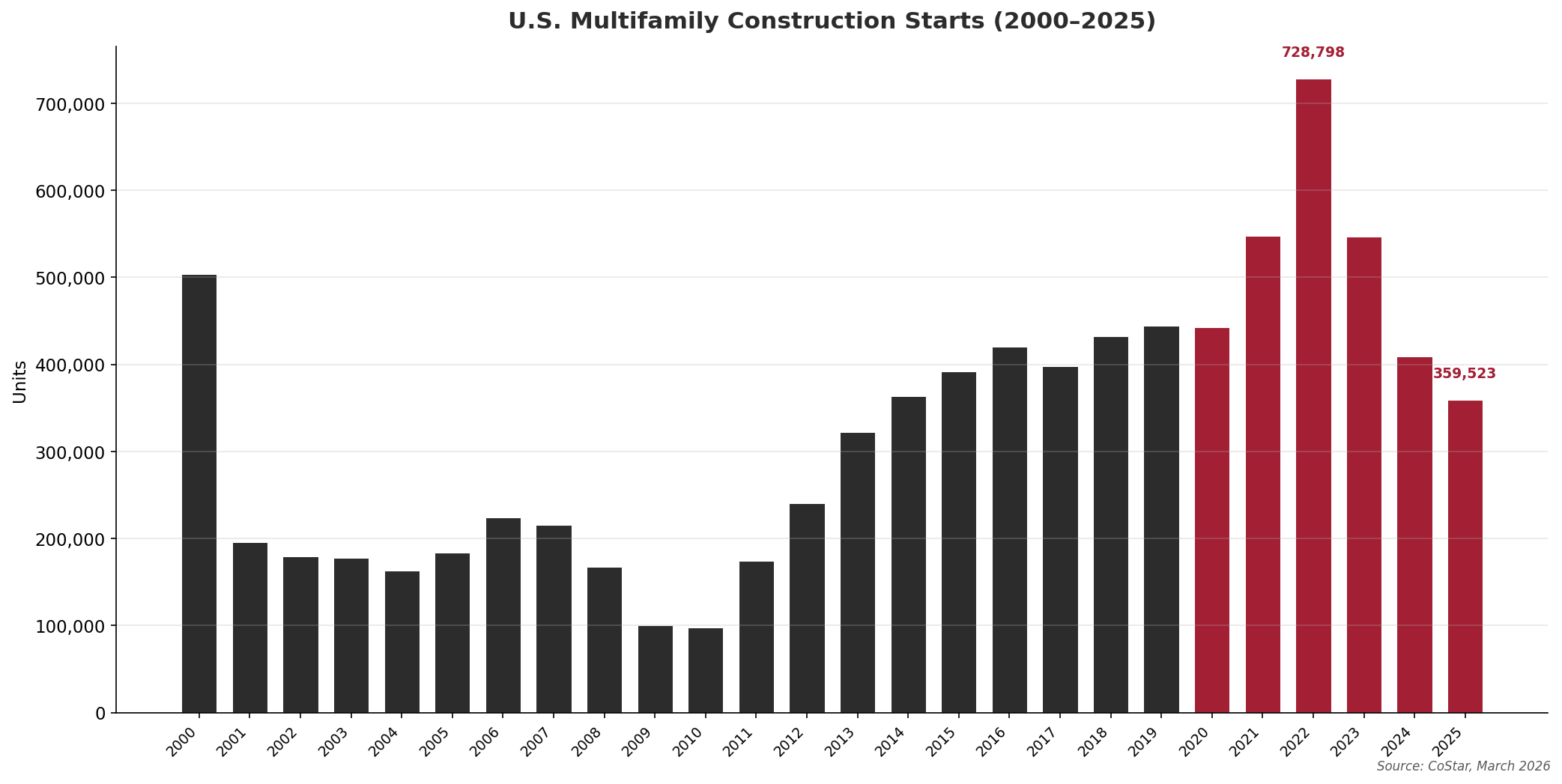
Source: CoStar, Q2 2026; 2026 annualized from first-half figures.
U.S. MF Vacancy Rate & Annual Rent Growth (2001–2026)
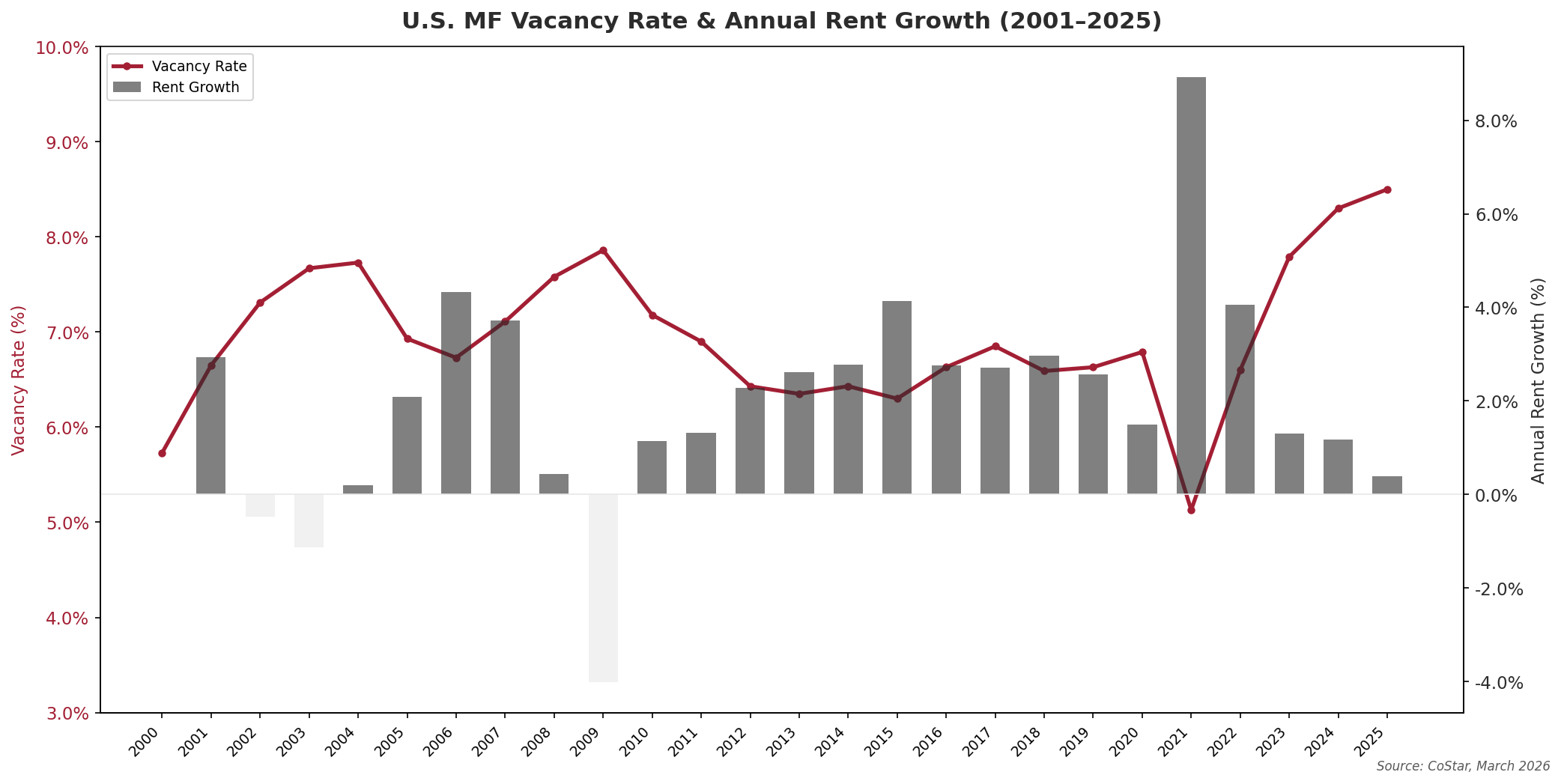
Source: CoStar, Q2 2026; the 2026 point is the Q2 2026 reading.
U.S. MF Deliveries vs. Construction Starts (Prior 2-Year Average)
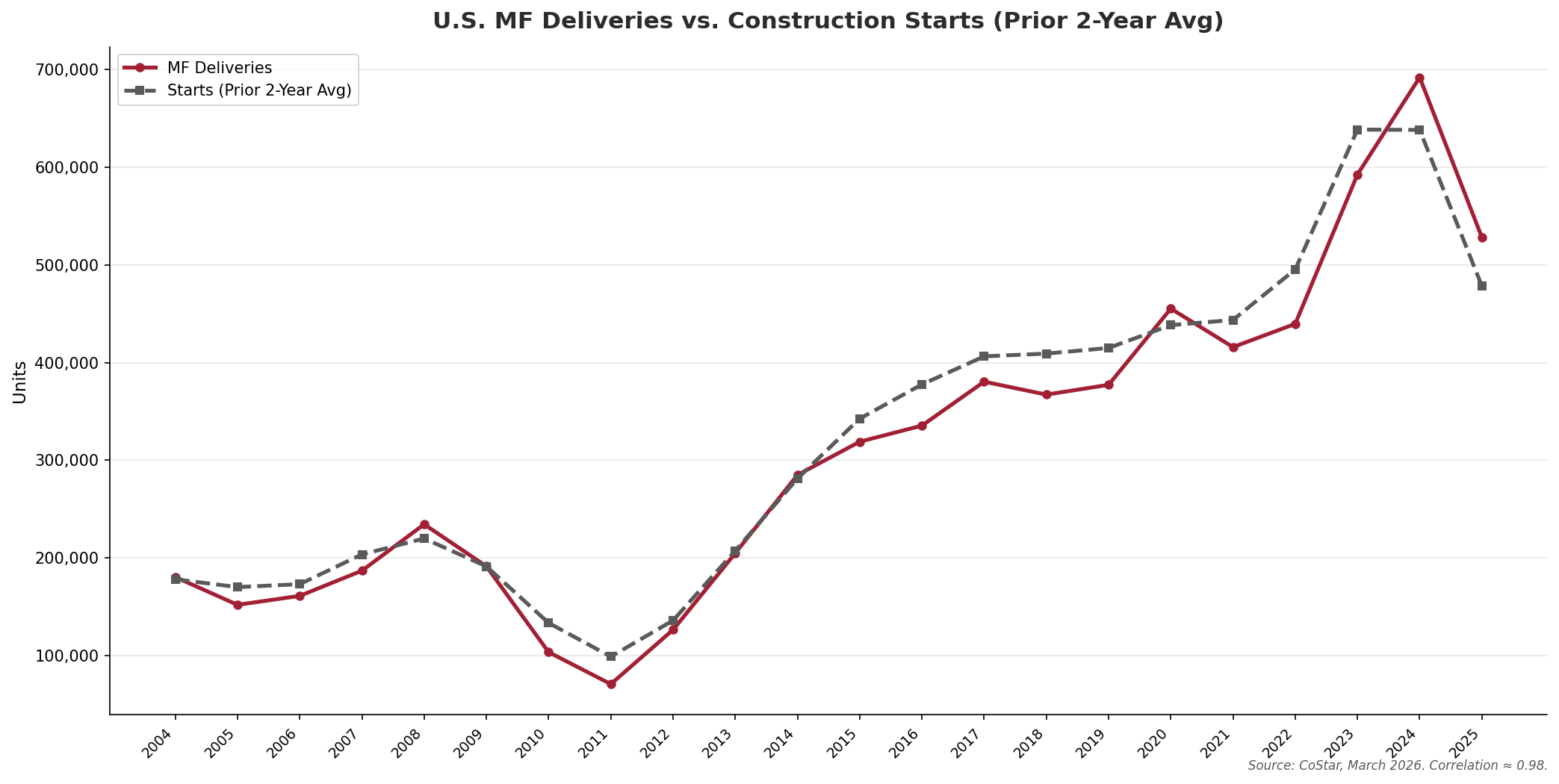
Source: CoStar, Q2 2026; 2026 annualized from first-half figures. Correlation between annual deliveries and prior 2-year average starts (2004–2025) ≈ 0.99.
Key Observations
Context & Discussion
The Post-Pandemic MF Supply Boom
The 2020–2024 apartment construction boom was the largest sustained period of multifamily supply growth in at least 25 years. From 2020 through 2024, U.S. builders delivered approximately 2.6 million net new apartment units, compared to roughly 1.8 million during the preceding five-year period (2015–2019).[1] The boom was fueled by a convergence of factors: pandemic-era fiscal stimulus and historically low interest rates made construction financing widely available; rapid domestic migration (especially of young adults in their prime rental years) to Sun Belt metros created a surge in rental demand; and rising home prices pushed would-be buyers into the rental market. The post-pandemic U.S. MF supply boom was dominated by southern growth MSAs; see U.S. Multifamily Regional Divergence for details.
MF Construction Slow Down
The combination of high construction costs, elevated borrowing rates, soft rents (mainly due to supply shock), and wider cap rates has made new ground-up multifamily development unprofitable in a majority of U.S. markets. Multifamily construction starts peaked at 733,000 units in 2022 and have since fallen to about 425,000 in both 2024 and 2025, a 42% decline.[1] The standard construction period for a multifamily building is approximately two years, meaning today’s depressed starts will flow through to completions in 2027–2028. CoStar’s forward estimates project deliveries falling to approximately 418,000 units in 2026, 342,000 in 2027, and 286,000 in 2028, bringing completions back to and then below the 2015–2019 annual average of approximately 356,000 units.[1] The near-perfect correlation (r ≈ 0.99) between annual deliveries and the prior two-year average of construction starts provides a high degree of confidence in these projections.
Absorption Strength vs. Supply Headwinds
Net absorption has been historically strong, 537,000 units in 2024 and 455,000 in 2025, but was not sufficient to offset peak-cycle deliveries. The result was steadily rising vacancy, from 5.1% at the 2021 trough to a peak of 8.5% at the end of 2025.[1] Rent growth has followed the expected pattern, decelerating from 8.8% in 2021 to 0.5% in 2025. The vacancy-rent growth relationship has been remarkably consistent over the full 25-year data series: periods of rising vacancy compress rents, which in turn discourage new starts, eventually constraining supply and allowing vacancy to tighten. The first half of 2026 marks that inflection point: deliveries fell below absorption (227,000 against 289,000 units), national vacancy eased from 8.5% to 8.1%, and rent growth ticked up to 0.8%. With starts running well below the 2022–2023 pace, the pipeline points to continued vacancy compression through 2027–2028, market by market as the oversupplied Sun Belt metros work through their remaining pipelines.
What to Watch in 2026
Supply absorption continues in oversupplied growth markets but opinions range with respect to when oversupplied high-growth markets will achieve stabilization (“stabilization” is a subjective measure but generally 90–92% occupancy). Domestic migration to warmer and more affordable MSAs continues as boomers retire and young adults seek reasonable living costs, driven by the large millennial and boomer generations. This dynamic may recede going forward as overall U.S. population growth has recently slowed due to reduced immigration and delayed family formation. We will continue to track net migration, interest rates, family formation metrics, MF construction starts, SF permits, and cost of living disparities (mainly home prices) between mature and growth metros to identify trends as the southern oversupply absorption story unfolds.
Sources to Track U.S. Multifamily Supply in 2026:
| Source | Next Release | Date | Notes |
|---|---|---|---|
| U.S. Census Bureau | New Residential Construction | Monthly, mid-month | Monthly starts and completions by structure type and region[3] |
| CoStar | Quarterly national and MSA-level update | Ongoing (subscription) | Most granular source for deliveries, starts, absorption, and vacancy by submarket |
| FRED (Census/HVS) | Q3 2026 Total Housing Units | Expected late October 2026 | Quarterly total U.S. housing inventory (SF + MF); currently shows 149.5M units as of Q2 2026[2] |
Notes
[1] CoStar. U.S. Multifamily National Historical Data (Q2 2026, exported August 26, 2026). costar.com. Quarterly data for net delivered units, construction starts, net absorption, vacancy rate, asking rent, and rent growth for the U.S. multifamily market, Q1 2000 through Q2 2026, rolled up to calendar years by CRE42. The 2026–2028 delivery projections quoted in the text are CoStar’s Base Case forecast rows from the same export; forecast figures appear in the prose only and are excluded from every chart, table, and the companion workbook. ↩
[2] U.S. Census Bureau. Housing Inventory Estimate: Total Housing Units in the United States (ETOTALUSQ176N). Q2 2026: 149,454 thousand units (updated July 28, 2026). fred.stlouisfed.org ↩
[3] U.S. Census Bureau and U.S. Department of Housing and Urban Development. New Residential Construction (monthly release). census.gov/construction/nrc ↩
Companion workbook. multifamily-national-supply-cycle.xlsx: CoStar quarterly data (Q1 2000 through Q2 2026), annual roll-up, deliveries-vs-starts analysis and native charts. CoStar, Q2 2026.
Methodology & Data Notes
Data Source & Period
All national multifamily data sourced from CoStar’s U.S. Multifamily National Historical dataset, exported August 26, 2026, with the series cut at Q2 2026 (June 30, 2026). CoStar reports quarterly; CRE42 rolls the quarters up to calendar years, taking year-end readings for inventory, vacancy, asking rent, rent growth, and under-construction figures and four-quarter sums for deliveries, starts, and absorption. The 2026 H1 figures quoted in the text are the first two quarters of 2026; the charts plot 2026 as an annualized point (first-half deliveries, starts, and absorption doubled, with vacancy, rent, and pipeline as of Q2 2026), and the workbook carries both rows. CoStar’s forward estimates (through 2031) are cited in the text where noted but are not carried into the charts or the workbook. The 2000 construction-starts figure includes a 352,000-unit opening-stock artifact in CoStar’s first quarter, so the charts begin in 2001. “Net Delivered Units” subtracts demolished units from gross deliveries. “Construction Starts” represents the number of units where ground was broken in each calendar year. “Net Absorption” represents the change in occupied units over the period.
Starts-to-Deliveries Correlation
The correlation of approximately 0.99 is calculated between annual net delivered units and the simple average of construction starts from the two preceding calendar years (e.g., 2025 deliveries correlated with the average of 2023 and 2024 starts), for the calendar years 2004 through 2025; the 2026 point (annualized from the first half) is charted for continuity but excluded from the correlation. The two-year lag reflects the typical construction timeline for multifamily projects. This methodology is consistent with the approach used in the MIT Center for Real Estate Fall 2025 multifamily case study.
Vacancy & Rent Growth
Vacancy rate represents the percentage of total inventory units that are vacant at period end. Annual rent growth represents year-over-year change in market asking rent per unit. Both metrics are reported at the national level and reflect the full CoStar-tracked multifamily universe (approximately 20.9 million units as of Q2 2026).