
U.S. Multifamily Regional Divergence: South vs. Supply-Constrained Markets
Among U.S. multifamily markets with 50,000+ units, the South accounted for 48% (169,600 of 355,000) of total U.S. units delivered in the trailing twelve months through June 2026 (Q2 2026).[1] The U.S. South’s inventory-weighted average vacancy now stands at 10.6%, compared to 4.3% in the Northeast, 7.1% in the West, and 7.6% in the Midwest. Eighteen of 31 major Southern markets are currently experiencing negative year-over-year rent growth.[1]
At the tightest end of the spectrum, New York (2.9% vacancy), San Jose (3.5%), San Francisco (3.7%), and Providence (4.1%) reflect chronic supply constraints, regulatory barriers to new construction, and persistent demand from high-income employment centers.[1] These markets are posting 3–11% rent growth while fast growing Sun Belt markets like Sarasota (16.4% vacancy, –3.4% rent growth), San Antonio (15.3%, –3.3%), and Austin (12.3%, –2.3%) continue to absorb (at varying pace) new excess unit supply.[1]
Multifamily Market Explorer: All 394 CoStar Metros (Q2 2026)
Narrow the table by inventory size and Census region, sort on any column, and tick one market or several to chart their deliveries, absorption, vacancy, and construction pipeline since 2016, combined or side by side. The table opens on all 394 metros, largest first, with the three largest charted; the regional charts and commentary below cover the 75 markets with 50,000+ units.[3]
MF Deliveries by Census Region: Trailing 12 Months (Q2 2026)
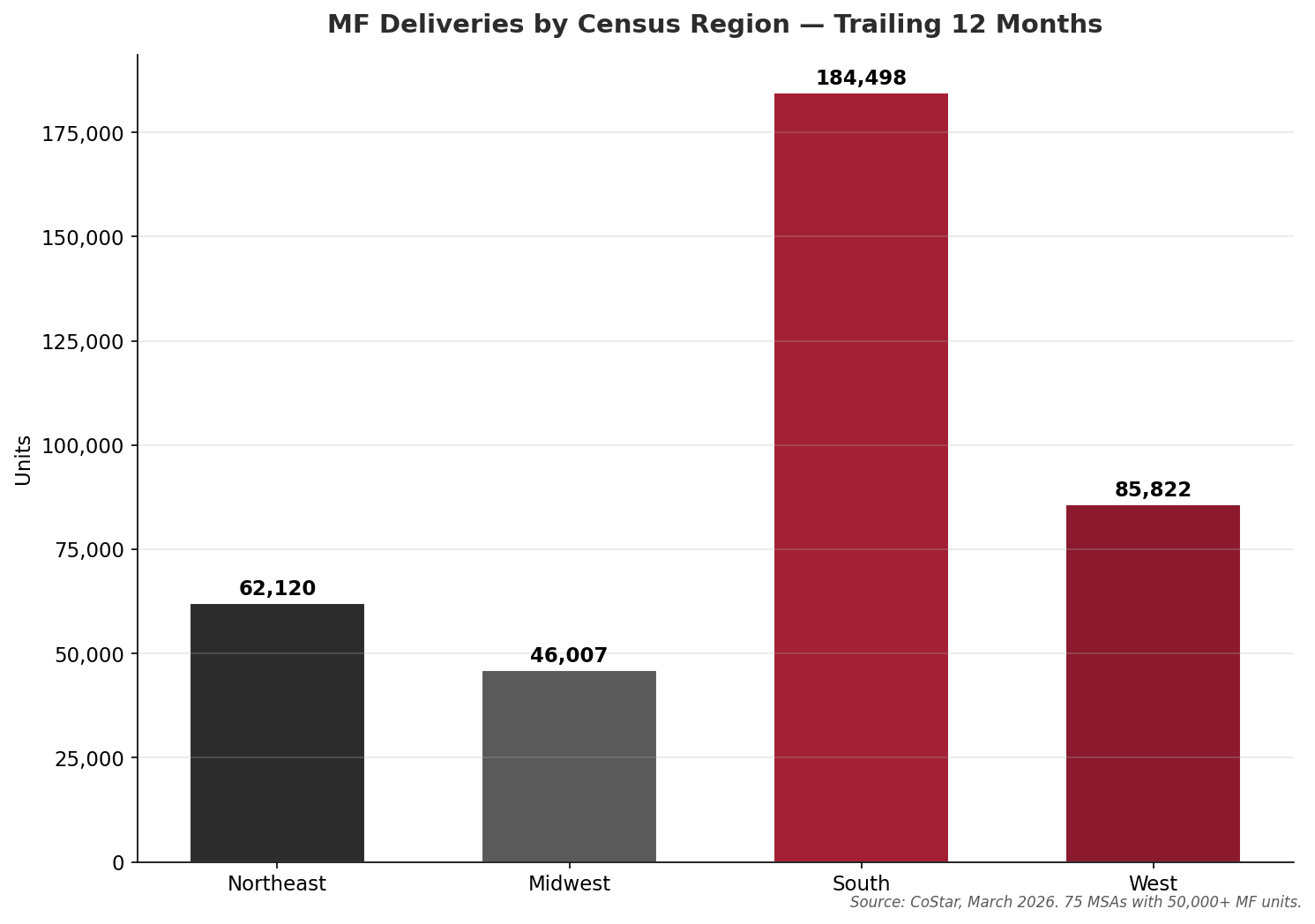
Source: CoStar, Q2 2026. 75 MSAs with 50,000+ multifamily units, grouped by Census region.
MF Vacancy Rate by Census Region: Inventory-Weighted (Q2 2026)
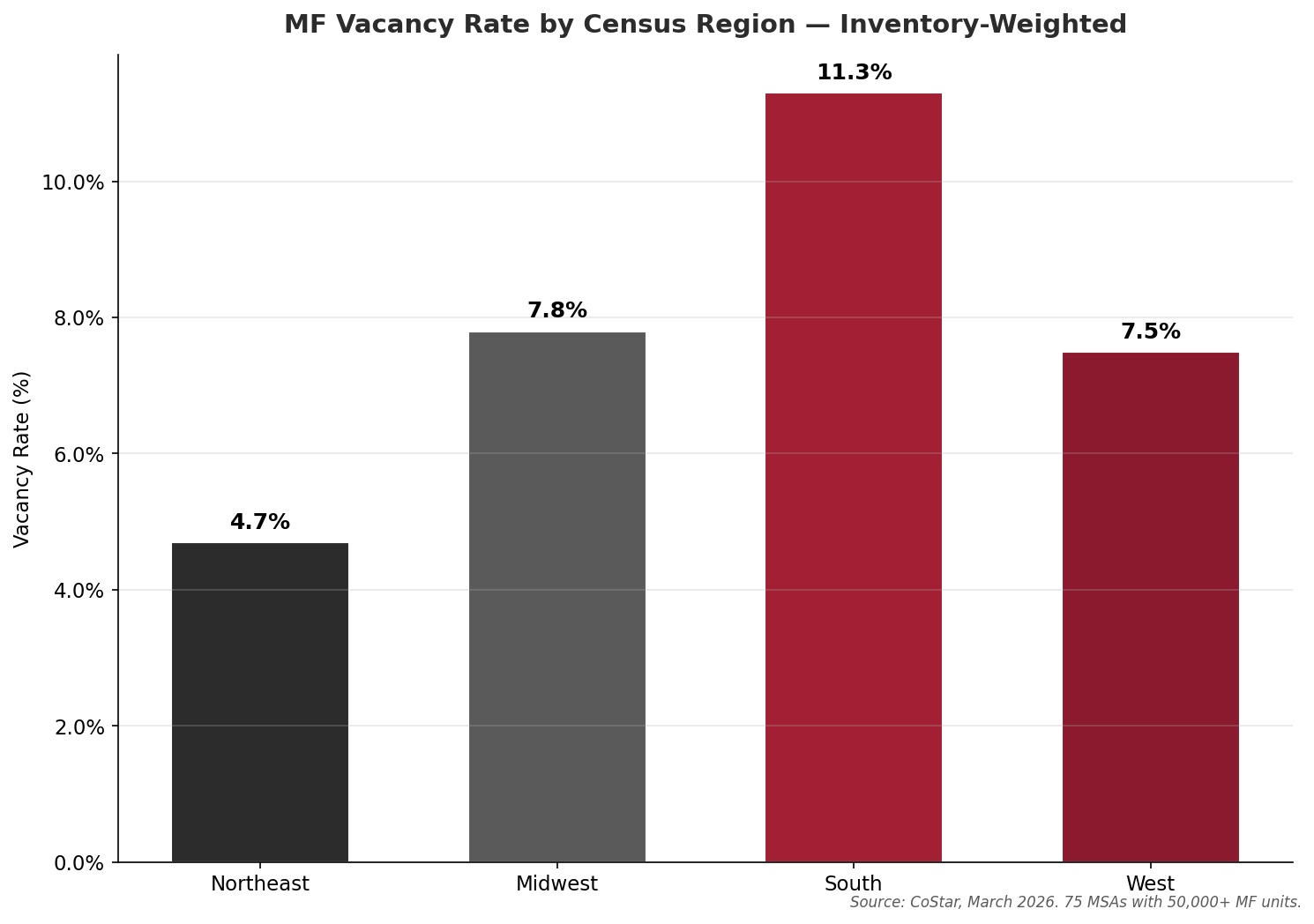
Source: CoStar, Q2 2026. Weighted by inventory units across 75 MSAs with 50,000+ multifamily units.
Markets with Negative Rent Growth by Census Region (Q2 2026)
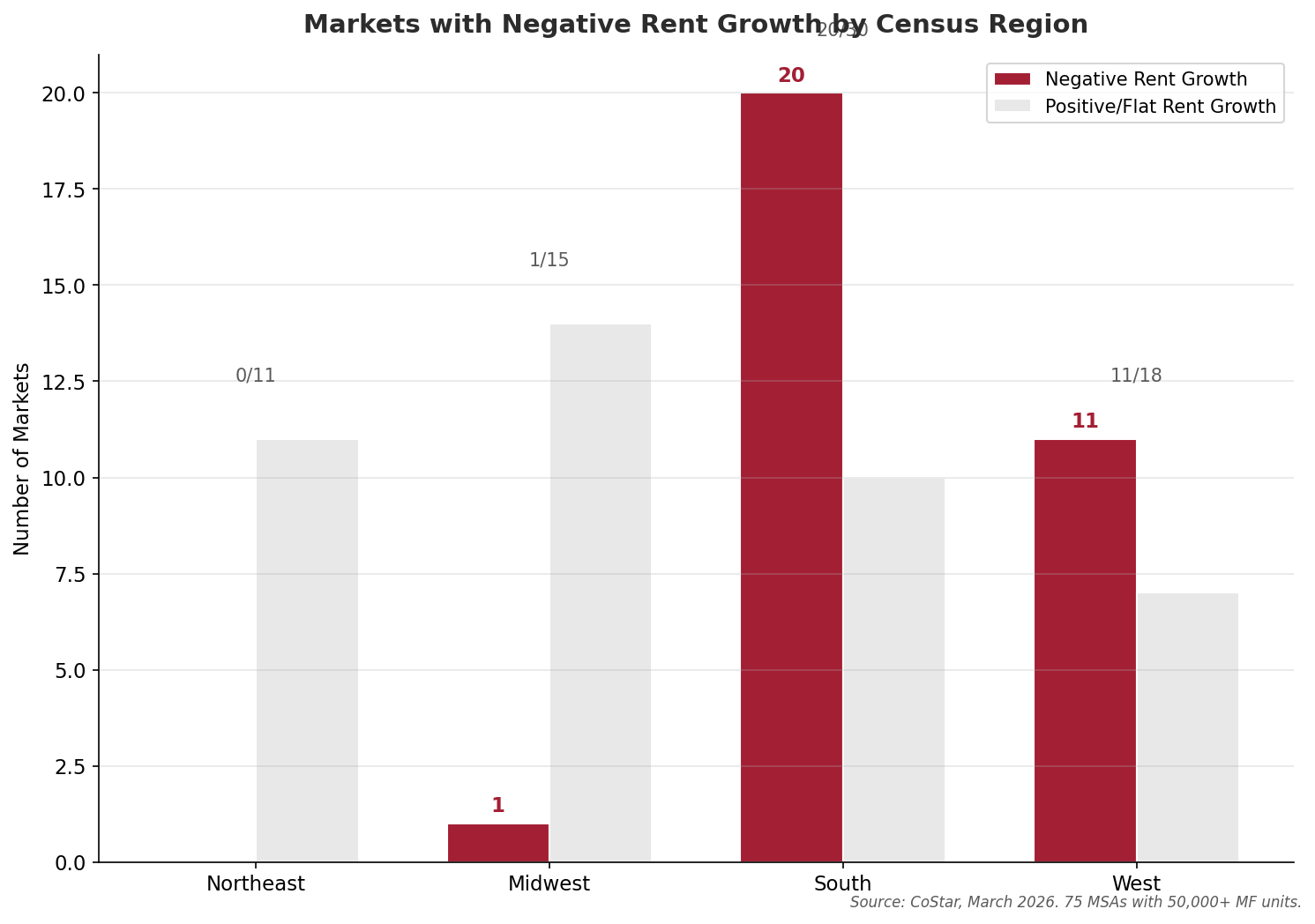
Source: CoStar, Q2 2026. 75 MSAs with 50,000+ multifamily units.
Key Observations
Context & Discussion
Growth Metro Supply Wave
Rapid post-pandemic domestic migration to Sun Belt metros triggered a developer response of historic proportions. Rents in markets like Austin, Nashville, Charlotte, and DFW surged 10–15% in 2021 alone as hundreds of thousands of new residents arrived from expensive coastal cities.[1] Low regulatory barriers, abundant land, and widely available low-rate construction financing enabled developers to break ground at an extraordinary pace. Texas, Florida, and the Carolinas led the way; Dallas–Fort Worth delivered 28,400 multifamily units in the trailing twelve months through June 2026, matched only by New York, with Phoenix (21,000), Houston (16,200), and Charlotte (14,900) next.[1]
Why the Northeast Did Not
Boston, New York, and other Northeastern metros face structural barriers to new construction that have no near-term resolution. Land is constrained and expensive. Building codes designed to reduce energy use and carbon emissions add to construction costs beyond those imposed by the cold climate itself. Transaction costs are elevated by permitting fees, utility connection charges, and mandatory affordable housing set-asides. Community resistance to new density—particularly in established neighborhoods—adds timeline risk and political uncertainty. Because rents and development costs are generally high, affordable unit requirements can create significant operating deficits, forcing developers to build increasingly high-end market-rate product to compensate, which in turn fuels further community opposition.[1] The result: Northeastern markets have maintained vacancy rates below 5% and continue to post positive rent growth even as the rest of the country absorbs a supply glut.
For-Sale Housing Inventory Pricing and Inventory
The regional divergence in multifamily markets is mirrored in for-sale housing inventory. Following the rapid interest rate increases of 2022, the “lock-in effect”—where homeowners with low pandemic-era mortgage rates (often near 3%) are unable or unwilling to sell and take on a new mortgage at 6%+—has kept existing home inventory suppressed in the Northeast and Midwest while Sun Belt and Mountain West markets have seen inventory return to or exceed pre-pandemic levels.[2] As of July 2026, 16 states and D.C. had active for-sale inventory above pre-pandemic 2019 levels, while nationally, inventory remained 9% below July 2019. The build-up has stalled, however: national active listings of 1.13 million were up only 2.1% year over year (about 23,500 homes), against 24.7% growth a year earlier, and Florida’s listings were down 14% year over year, the first sign of the Sun Belt for-sale overhang beginning to clear.[2] Many of the same Sun Belt MSAs experiencing high multifamily vacancy are also seeing elevated for-sale inventory (despite the lock-in effect), creating a dual overhang that is compressing both rents and home prices in these markets.
What to Watch in 2026
The regional divergence story will be shaped by several factors: absorption velocity in oversupplied Southern markets (particularly Texas and Florida), the pace of starts recovery by region, the trajectory of for-sale housing inventory, and potential policy changes including zoning reform at the local level or federal housing incentives. Chronically under-supplied states and municipalities have seen a resurgent “YIMBY” (Yes In My Back Yard) movement in recent years, inspiring hopes for increased future supply, but countervailing political forces (e.g., rent control and SFR ownership and development constriction proposals) will likely mitigate or eliminate potential supply gains in mature MSAs as they have for decades. We will continue to track net migration, interest rates, family formation metrics, MF construction starts, SF permits, and cost of living disparities (mainly home prices) between mature and growth metros to identify trends as the southern oversupply absorption story unfolds.
Sources to Track U.S. Multifamily Regional Dynamics in 2026:
| Source | Next Release | Date | Notes |
|---|---|---|---|
| CoStar | Quarterly MSA-level multifamily update | Ongoing (subscription) | Vacancy, rents, deliveries, starts, and absorption for 395 MSAs |
| ResiClub / Realtor.com | Monthly state-level active inventory | Monthly | Tracks for-sale inventory vs. pre-pandemic 2019 levels by state and metro |
| U.S. Census Bureau | New Residential Construction by Region | TBD (delayed) | Monthly starts and completions by Census region (SF + MF combined) |
Notes
[1] CoStar. U.S. Multifamily Market Data, All MSAs (as of Q2 2026; quarterly history 2016 Q1 through 2026 Q2, exported August 2026). costar.com. Includes trailing-twelve-month data for all 394 CoStar metros; the regional charts and commentary use the 75 MSAs with 50,000+ multifamily inventory units. Regional aggregations by CRE42 using Census region definitions (Northeast, Midwest, South, West). Vacancy rates are inventory-weighted. ↩
[2] Lance Lambert, ResiClub analysis of Realtor.com data. National active housing market inventory growth slows: by state (August 6, 2026; July 2026 data). resiclubanalytics.com. Active listings of 1,126,252 on July 31, 2026, +2.1% year over year (+23,465 homes, versus +218,514 the year before) and 9.1% below July 2019; 16 states plus D.C. above July 2019 levels; Florida –14% year over year. ↩
[3] Flow figures on this page (deliveries, absorption, construction starts) are trailing twelve months to June 30, 2026, unless a chart or table says otherwise; stocks and rates (inventory, vacancy, under construction, asking rent, occupancy, cap rate) are the Q2 2026 quarter-end readings. Vacant units in the explorer table are vacancy rate times inventory, since CoStar’s multifamily export reports no vacant-unit count. ↩
Companion workbook. multifamily-regional-divergence.xlsx: regional summary, 75-market detail, all 394 metros at Q2 2026, and the 2016–Q2 2026 annual history behind the market explorer. CoStar, Q2 2026.
Methodology & Data Notes
Data Source & Regional Classification
Market-level data sourced from CoStar’s U.S. Multifamily dataset as of Q2 2026 (quarter ended June 30, 2026), the same vintage as the national supply cycle page. The dataset includes 394 metros; the regional charts filter to the 75 MSAs with multifamily inventory of 50,000+ units (Huntsville, Alabama, crossed the threshold this quarter), representing approximately 16.4 million of the national total of 20.9 million multifamily units (~78% coverage), while the market explorer carries all 394. Markets were assigned to Census regions (Northeast, Midwest, South, West) by CRE42 based on the primary state of each MSA. Washington, D.C. and Baltimore are classified as South per Census convention.
Weighted Averages
Regional vacancy rates are calculated as inventory-weighted averages: the sum of (vacancy rate × inventory units) for all markets in the region, divided by total regional inventory units. Regional cap rates are calculated as asset-value-weighted averages using the same approach. This methodology ensures that larger markets exert proportionally greater influence on regional averages.
Market Explorer
Table values are CoStar figures at Q2 2026; “TTM” columns are the trailing twelve months to June 30, 2026. Net delivered units are gross deliveries less demolitions; vacant units are vacancy rate times inventory. The chart plots each calendar year 2016–2025 as the trailing twelve months to Q4 (so deliveries and absorption are full-year flows, and vacancy and the pipeline are year-end readings), plus the trailing twelve months to Q2 2026. The aggregate chart combines ticked markets by summing units and recomputing vacancy, occupancy, and the pipeline share on the combined inventory, with asking rent inventory-weighted; the comparison chart draws one line per market, up to five, on the chosen metric. Both series and the chart’s inputs are on the All Metros Q2 2026 and Annual History tabs of the companion workbook.
For-Sale Housing Data
For-sale housing inventory data referenced from ResiClub’s monthly analysis of Realtor.com active listings. “Pre-pandemic levels” refers to active listing counts from the corresponding month of 2019. The 16 states reported above pre-pandemic levels as of July 2026 are Alabama, Arizona, Arkansas, Colorado, Florida, Hawaii, Idaho, Nebraska, North Carolina, Oklahoma, Oregon, South Carolina, Tennessee, Texas, Utah, and Washington, plus the District of Columbia.