
Climate Change: Data Summary & Overview
This section summarizes for the reader key high-level data related to climate change, highlighting some of the standout data points and providing a brief history of climate milestones.
Atmospheric CO₂ and Global Surface Temperature (1880–2025)
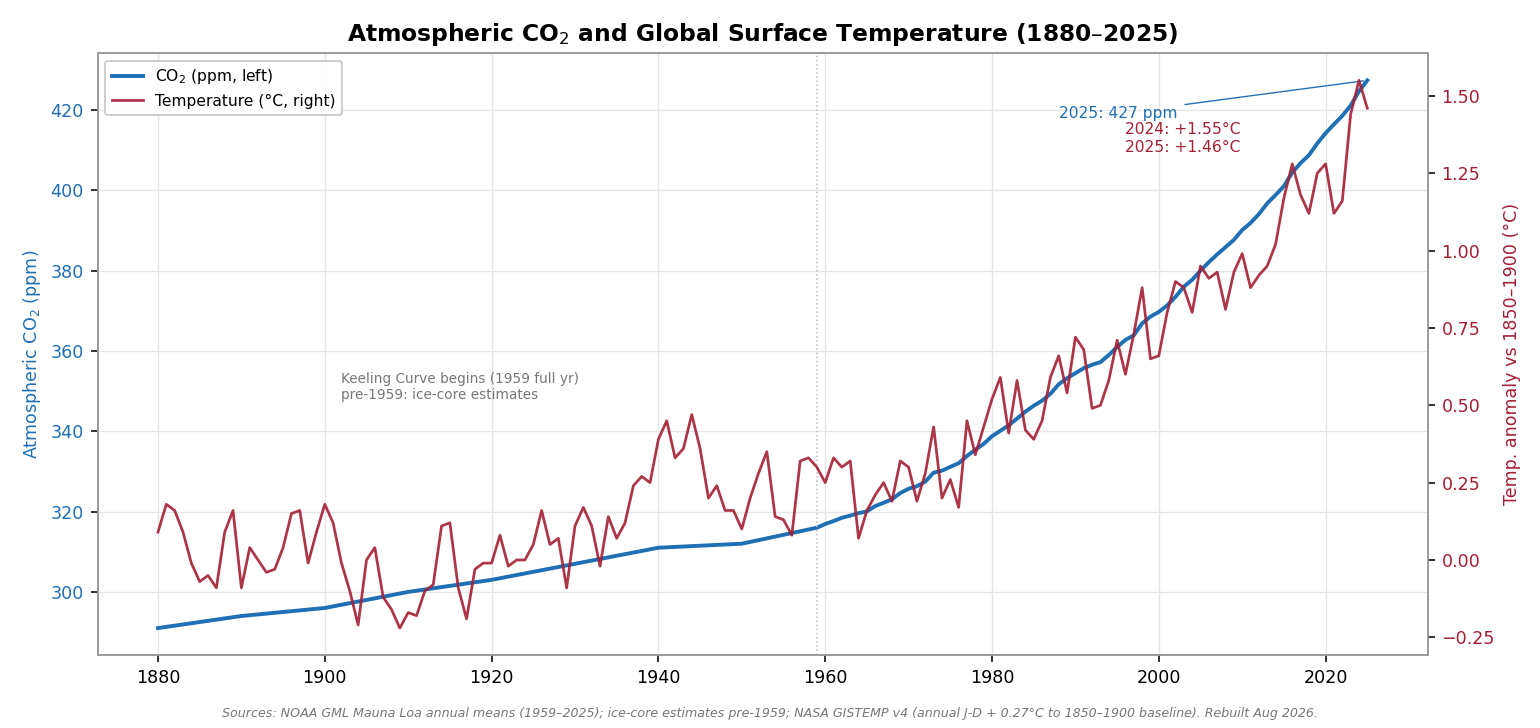
Figure 1. Atmospheric CO₂ concentration (blue, left axis) and global surface temperature (red, right axis) from 1880 to 2025. CO₂ is now ~52% above pre-industrial levels and at the highest concentration in at least 800,000 years of ice core records. The rate of CO₂ increase is approximately 100 times faster than natural increases observed during ice age transitions.
*Baseline = pre-industrial average (1850–1900). Temperature: NASA GISTEMP v4 adjusted to pre-industrial reference. CO₂: NOAA Global Monitoring Lab (Mauna Loa annual means; ice-core estimates pre-1959).
▸ Select here for a brief history of Earth’s climate
The table below places current climate observations in geological context. Earth’s climate has varied dramatically over its 4.5-billion-year history, but the current rate of change in atmospheric CO₂ and temperature is far outside the range observed in ice core and geological records.
| Time Period | Event / Era | Temp vs. Today | Key Facts |
|---|---|---|---|
| 4.5 billion years ago | Earth forms | Much hotter | Molten surface; gradual cooling over hundreds of millions of years |
| 720–635 Mya | Snowball Earth | 30–50°C colder | Sea ice may have reached near the equator; most severe glaciations in Earth history |
| ~55 Mya | PETM | 5–8°C warmer | Rapid warming from massive CO₂/methane release; closest analog to current rate of change |
| ~2.5 Mya–present | Ice age cycles | ±4–7°C | ~100 glacial periods driven by orbital cycles; CO₂ varied 180–280 ppm, never exceeding 300 ppm |
| ~20,000 years ago | Last Glacial Maximum | 5–7°C colder | Ice sheets to NYC/Chicago/Stockholm; 4–7°C warming over ~5,000 years to exit |
| ~1750 CE | Industrial Revolution | Baseline | CO₂ at ~280 ppm; fossil fuel combustion begins |
| 2024 CE | Warmest year on record | +1.5°C | CO₂ at 425 ppm (Mauna Loa); ~50% above pre-industrial; rate of increase ~100x natural |
Sources: NOAA NCEI Paleoclimatology; NASA Earth Observatory; EPICA ice core data (Lüthi et al., 2008); NASA GISTEMP v4.
Key Observations
Ice Sheet Mass Change: Greenland & Antarctica
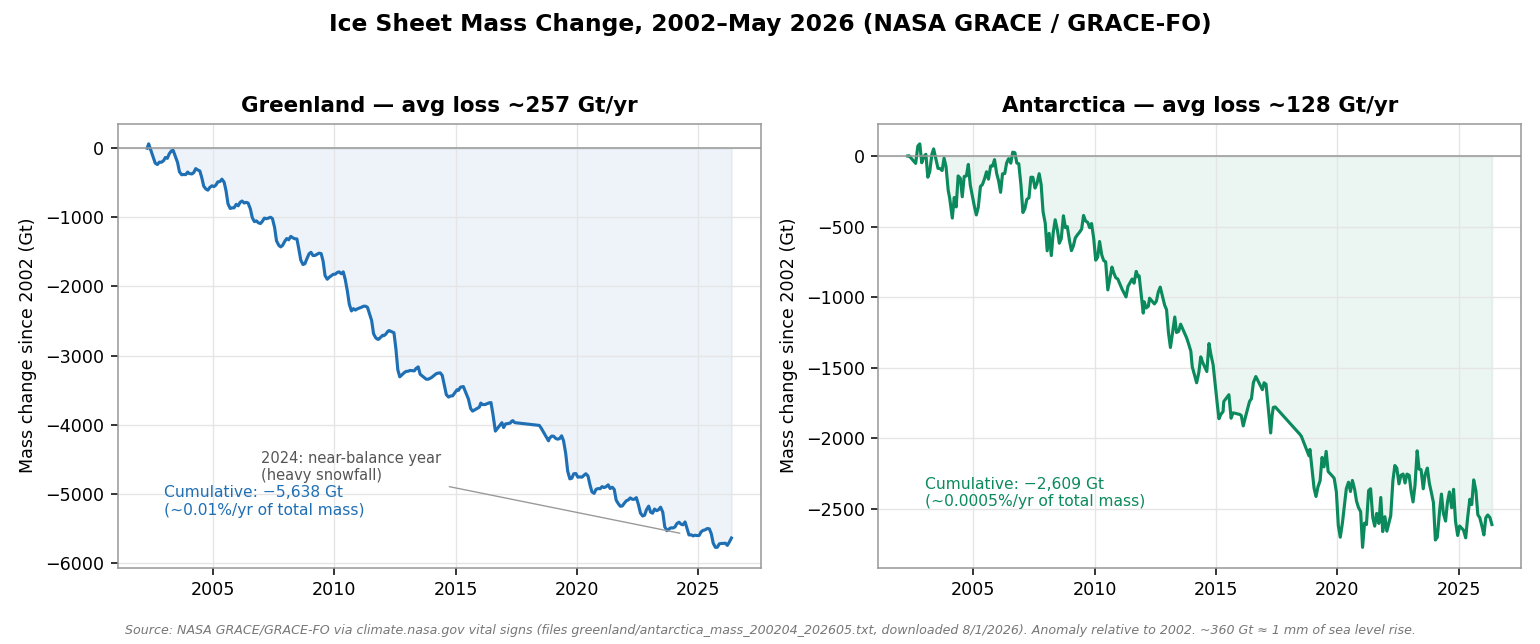
Figure 2. Ice sheet mass change measured by the GRACE and GRACE-FO gravity satellites, 2002–May 2026, relative to 2002. Roughly 360 Gt of land-ice melt equals 1 mm of sea level rise. Source: NASA GRACE/GRACE-FO.[5]
Context & Discussion
The policy debate on climate change has shifted over the last 10–20 years. In broad terms we have gone from “believers vs. deniers” to “climate urgency” advocates vs. “climate realists” or “anti-alarmists.” Serious mainstream experts now advocating for less stringent de-carbonization policies generally accept global warming, as the trend has become statistically difficult to dispute. Their argument has evolved away from “climate denial” and toward the more reasonable assertion that we need an open discussion about how to confront a warming earth, and that forced reduction of fossil fuels and subsidized renewable energy production may not be the most efficient and equitable manner to confront and adjust to rising temperatures.
The Case for Urgency
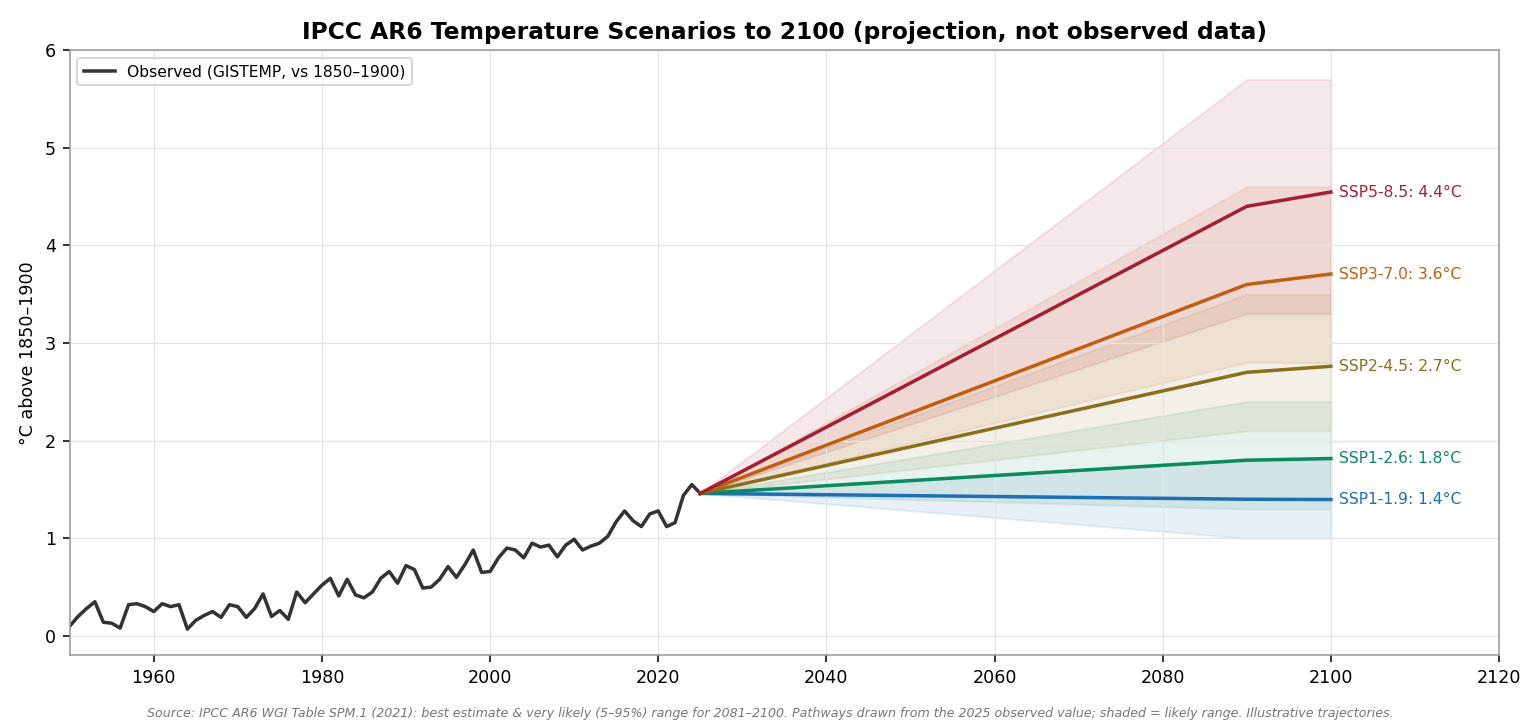
IPCC* AR6 temperature scenarios (2021), drawn from observed GISTEMP data through 2025. This is a projection chart, not observed data. It illustrates the urgency argument that near-term emissions choices determine long-term outcomes across a wide range. Shaded bands show the likely (5th–95th percentile) range for each pathway. Source: IPCC AR6 WGI, Table SPM.1.
▸ What is the IPCC?
The Intergovernmental Panel on Climate Change (IPCC) is a United Nations body established in 1988 to assess the science of climate change. It does not conduct original research; instead, it synthesizes and evaluates thousands of peer-reviewed studies in multi-year assessment cycles. Reports are produced by three working groups covering the physical science, impacts/adaptation, and mitigation.
Why it matters: IPCC assessment reports are the closest thing to an official scientific consensus on climate change. They directly inform international negotiations (the Paris Agreement targets are based on IPCC findings) and are cited by governments, courts, and investors worldwide.
Why it’s controversial: The Summary for Policymakers, which is the most widely read section of each report, requires line-by-line approval by government delegates - a political process that critics on the urgency side argue waters down the science, and critics on the moderate side argue introduces political bias toward alarmism. The underlying scientific chapters are more nuanced than the summaries. Both sides cite the IPCC selectively to support their positions.
Global surface temperatures have risen approximately 1.5°C above the pre-industrial baseline, atmospheric CO₂ is at the highest level in at least 800,000 years, and the rate of increase is roughly 100 times faster than anything in the ice core record.[1][2] The urgency argument holds that these are not simply data points on a gradual trend - they represent a system approaching thresholds beyond which changes become self-reinforcing and irreversible. Ice sheets do not melt linearly; they can destabilize once warming ocean water reaches their undersides.[5] Permafrost contains an estimated 1,500 gigatons of carbon - nearly twice what is currently in the atmosphere - and warming is beginning to thaw it.[7] The Amazon rainforest, the world’s largest terrestrial carbon sink, is losing absorption capacity as deforestation reduces forest cover.[8] Reduced Arctic ice cover creates a feedback loop: ice reflects approximately 80% of sunlight back to space, while open water absorbs approximately 90% - meaning less ice leads to more warming, which leads to less ice.[6]
The costs of climate inaction - estimated at 5–20% of global GDP under high-warming scenarios - dwarf the costs of aggressive near-term action (1–2% of GDP), particularly when the analysis accounts for the possibility of catastrophic tail risks that standard economic models tend to smooth away.[9] The IPCC’s Sixth Assessment Report concluded that limiting warming to 1.5°C requires reaching net-zero CO₂ emissions by approximately 2050, a timeline that demands immediate and substantial policy intervention.[10] The core argument is not that catastrophe is certain, but that the probability is high enough and the consequences irreversible enough to justify treating it as urgent.
▸ Key voices on this side
James Hansen - Former NASA GISS Director
- Put climate change on the public agenda with his 1988 Congressional testimony; widely considered the most influential climate scientist of the past 40 years
- Argues climate sensitivity is higher than IPCC central estimates, meaning we get more warming per unit of CO₂ than standard models project
- Has argued multi-meter sea level rise is possible within a century from ice sheet dynamics
Michael Mann - Climate scientist, U. of Pennsylvania
- Created the “hockey stick” temperature reconstruction showing current warming is unprecedented in at least 1,000 years
- Argues fossil fuel interests have shifted from denial to delay - “the new climate war is about inactivism”
- Key works: The New Climate War (2021); Our Fragile Moment (2023)
Katherine Hayhoe - Climate scientist, Texas Tech
- Effective communicator who frames climate as a risk management issue rather than a partisan cause
- Emphasizes that climate impacts disproportionately hit lower-income communities and developing nations
- Key work: Saving Us (2021)
Nicholas Stern - Economist, London School of Economics
- His 2006 Stern Review argued costs of inaction (5–20% of GDP) vastly exceed costs of action (1–2% of GDP)
- Used a low discount rate (valuing future generations nearly as much as the present), directly challenging Nordhaus’s gradualist approach
- Critics argued his discount rate was ethically motivated rather than market-based; Stern responded that market rates are inappropriate for irreversible, multi-generational risks
IPCC - United Nations (institutional voice)
- Consensus body: thousands of scientists, multi-year assessment cycles, line-by-line government approval of summaries
- AR6 (2021–2023) concluded human influence on climate is “unequivocal” and limiting 1.5°C requires net-zero CO₂ by ~2050
- Criticized from both sides: urgency advocates say it understates tail risks; moderates say the Summary for Policymakers is politically influenced
The Case for Manageable Risk
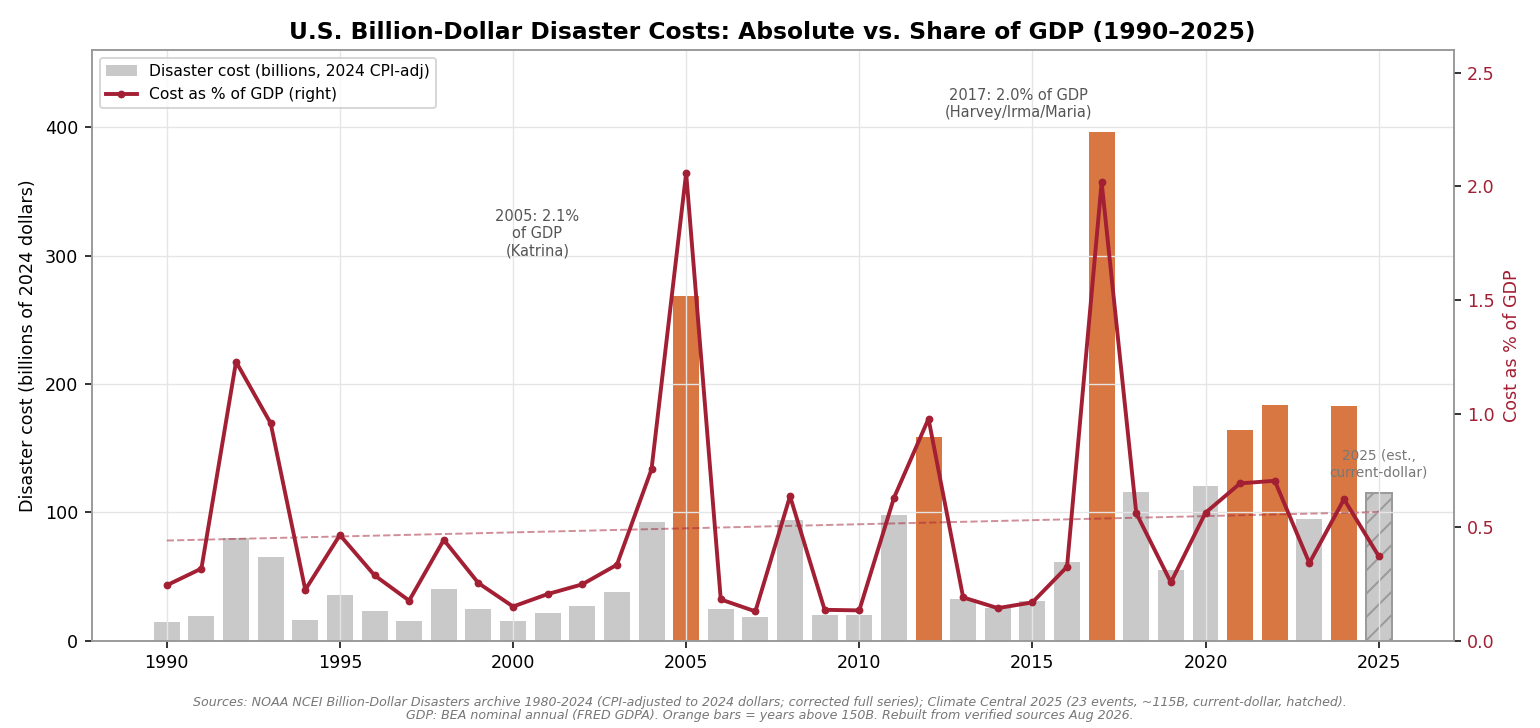
U.S. disaster costs: absolute dollars vs. share of GDP. This chart illustrates the moderate argument that while absolute costs have risen, disaster costs relative to economic output have not shown a clear upward trend. Critics note this framing understates risk by ignoring non-economic damages and tail-risk scenarios. Sources: NOAA NCEI Billion-Dollar Disasters archive, 1980–2024 (CPI-adjusted to 2024$; full corrected series); Climate Central continuation for 2025 (23 events, ~$115B, current-dollar); BEA nominal GDP. Chart shows 1990–2025.
The moderate position does not dispute that the climate is warming or that human activity is a primary driver. The disagreement is about magnitude, pace, and policy response. Global GDP under the UN’s own mid-range warming scenarios is estimated to be approximately 2–4% lower by 2100 than it would be without climate change - a meaningful drag, but occurring against a backdrop of continued economic growth that leaves future generations substantially wealthier than the present.[11] The argument is that this cost profile does not justify the trillions of dollars being directed at aggressive near-term emissions reduction, which could generate greater human welfare if allocated to poverty alleviation, disease prevention, clean water infrastructure, and green energy R&D.
On the science, moderates point to the significant divergence among climate models on regional impacts and decadal timing, and argue that natural variability - ocean cycles, volcanic activity, solar variation - is underappreciated in public discussion. They note that the IPCC itself expresses only “low confidence” in attributing observed trends in floods, droughts, and tropical cyclones to climate change, a more cautious position than media coverage typically conveys.[10] Rising disaster costs, when normalized for population growth and development in vulnerable areas, show no clear upward trend as a share of GDP.[12] The central claim is that climate change is a serious but solvable problem - not an existential one - and that alarmism distorts capital allocation and harms the poor disproportionately.
Climate realists also point to the ineffectiveness of commonly advocated policies from the climate urgency side: forced fossil fuel reduction and subsidized renewable energy production. Forced reduction in fossil fuel use is difficult to effectuate in the real world for two primary reasons: (1) developed economies need to maintain a certain level of energy for transportation, heating, electricity, etc. to function, so forced conservation necessarily means making choices between energy sources, a process which in turn becomes subject to political special interests over time, and (2) it is practically impossible (and inherently unfair) to force China, India, and other developing nations to forgo modern energy-intensive amenities like cars and air conditioning that we have enjoyed in the developed world for years. With respect to subsidized renewable energy production, the key argument is that this money should be spent on R&D instead to advance renewable efficiency and stability to a point where these energy sources can compete with fossil fuels without subsidies.
▸ Key voices on this side
Bjørn Lomborg - Political scientist, Copenhagen Consensus Center
- Accepts climate science but argues it is not existential - UN models estimate ~2–4% GDP loss by 2100 under moderate warming, not civilizational collapse
- Argues trillions spent on emissions reduction would do more good fighting poverty, disease, and malnutrition
- Key works: The Skeptical Environmentalist (2001); False Alarm (2020)
Roger Pielke Jr. - Science policy, U. of Colorado
- Central claim: rising disaster costs are driven primarily by population growth and development in vulnerable areas, not by worsening weather
- Notes the IPCC has only “low confidence” in attributing trends in floods, droughts, and tropical cyclones to climate change - more cautious than media portrayal
- Key work: The Rightful Place of Science: Disasters and Climate Change (2018)
Steven Koonin - Physicist, NYU; former DOE Under Secretary (Obama)
- Argues climate models diverge significantly on regional impacts and that natural variability is underappreciated
- Does not deny warming or human contribution but argues “the science is settled” framing shuts down legitimate debate
- Key work: Unsettled (2021)
Judith Curry - Former chair, Georgia Tech School of Earth & Atmospheric Sciences
- Argues natural variability (ocean oscillations) accounts for more observed warming than standard attribution acknowledges
- Left academia in 2017, citing an impossible environment for open scientific debate
- Key work: Climate Uncertainty and Risk (2023)
William Nordhaus - Economist, Yale (Nobel Prize 2018)
- Pioneer of climate economics; his DICE model integrates climate science with cost-benefit analysis
- Central finding: optimal policy is a gradually rising carbon tax, not aggressive near-term targets like 1.5°C or 2°C
- Criticized from both sides: urgency advocates say he underestimates tail risks; moderates cite him for still recommending intervention
Michael Shellenberger - Journalist/activist, Environmental Progress
- Argues “climate alarmism” is counterproductive and psychologically damaging, especially to young people
- Central policy argument: nuclear power is the most effective climate solution; environmental opposition to nuclear has done more harm than fossil fuel companies
- Key work: Apocalypse Never (2020)
Notes
[1] NASA Goddard Institute for Space Studies. GISTEMP v4 Global Temperature Analysis. data.giss.nasa.gov/gistemp ↩
[2] NOAA Global Monitoring Lab. Trends in Atmospheric CO₂. gml.noaa.gov/ccgg/trends ↩
[3] NASA-SSH (2025). Global Mean Sea Level from Simple Gridded Sea Surface Height, Version 1. PO.DAAC, doi:10.5067/NSIND-GMSV1; NASA JPL Sea Level Change Observations. sealevel.nasa.gov ↩
[4] NOAA National Centers for Environmental Information. Assessing the Global Climate in 2024. ncei.noaa.gov ↩
[5] NASA GRACE/GRACE-FO. Polar Ice Mass Loss. grace.jpl.nasa.gov; NOAA Arctic Report Card 2024. ↩
[6] EPA. Climate Change Indicators: Arctic Sea Ice. epa.gov/climate-indicators; NSIDC; NOAA Arctic Report Card 2025. ↩
[7] Hugelius, G. et al. (2014). “Estimated stocks of circumpolar permafrost carbon.” Biogeosciences, 11, 6573–6593. See also: NOAA Arctic Report Card, Permafrost section. ↩
[8] Boulton, C.A., Lenton, T.M. & Boers, N. (2022). “Pronounced loss of Amazon rainforest resilience since the early 2000s.” Nature Climate Change, 12, 271–278. ↩
[9] Stern, N. (2006). The Stern Review on the Economics of Climate Change. HM Treasury, U.K. Government. ↩
[10] IPCC. Sixth Assessment Report (AR6), Working Groups I–III (2021–2023). ipcc.ch/ar6 ↩
[11] Nordhaus, W. (2018). “Projections and Uncertainties about Climate Change in an Era of Minimal Climate Policies.” American Economic Journal: Economic Policy, 10(3), 333–360. DICE-2016R2 model. ↩
Companion workbook. climate-change-all-data.xlsx - rebuilt from verified primary sources (Aug 2026), with embedded charts - CO₂ and temperature data, sea level rise, Arctic ice, Greenland/Antarctic ice sheet mass, insurance premiums, high-tide flooding, Lake Mead water levels.
[12] Pielke, R. Jr. (2024). “Scientific integrity and U.S. ‘Billion Dollar Disasters.’” npj Natural Hazards. NOAA NCEI Billion-Dollar Disasters archive (1980–2024, retired 2025); Climate Central Billion-Dollar Disasters continuation (2025–); BEA GDP data. ↩