
U.S. Industrial Regional Analysis: Q2 2026
All data: CoStar, U.S. Industrial Market Data, all MSAs, as of Q2 2026 (quarter ended June 30, 2026). [1] [2]
Industrial Market Explorer: All 394 CoStar Metros (Q2 2026)
Narrow the table by inventory size and Census region, sort on any column, and tick one market or several to chart their deliveries, absorption, vacancy, and construction pipeline since 2016. The table opens on all 394 metros, largest first, with the three largest charted; the regional charts and commentary further down the page cover the 75 markets with 100M+ SF of inventory.
The charts below include all CoStar-defined MSAs with industrial inventory of at least 100M SF.
Industrial Deliveries by Census Region: Trailing 12 Months (Q2 2026)
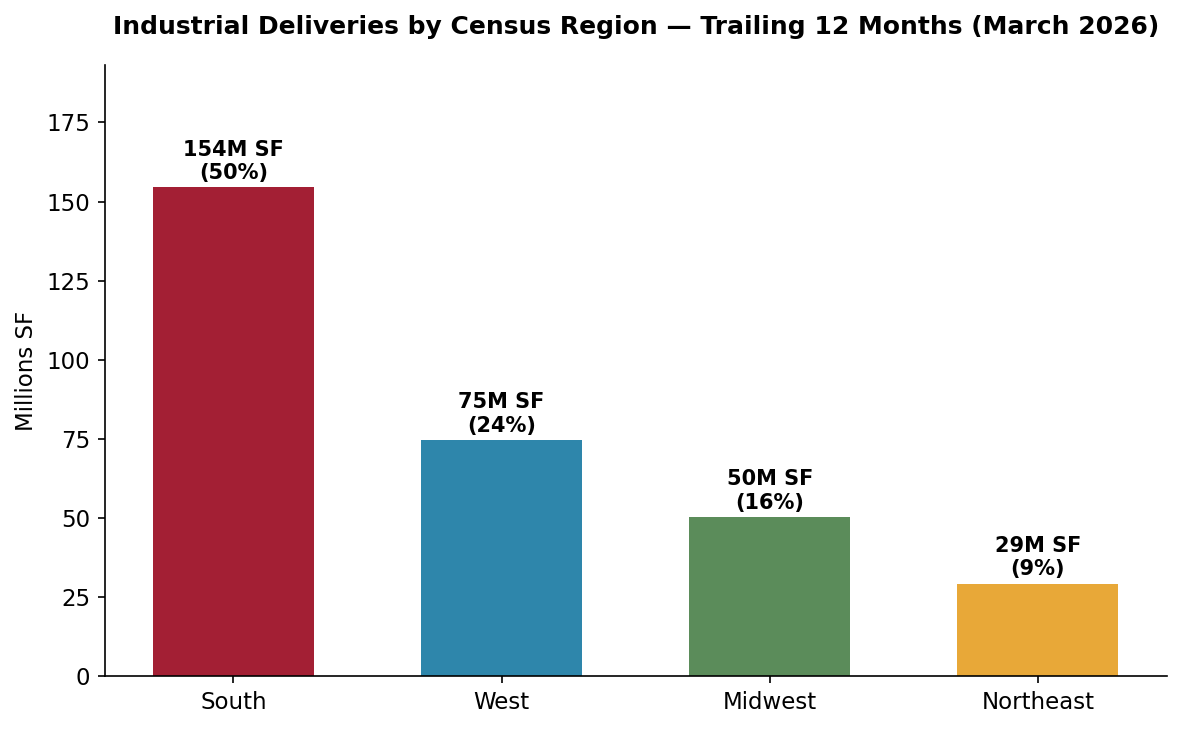
Source: CoStar, Q2 2026. 75 MSAs with 100M+ SF industrial inventory, grouped by Census region.
Industrial Vacancy Rate by Census Region: Inventory-Weighted (Q2 2026)
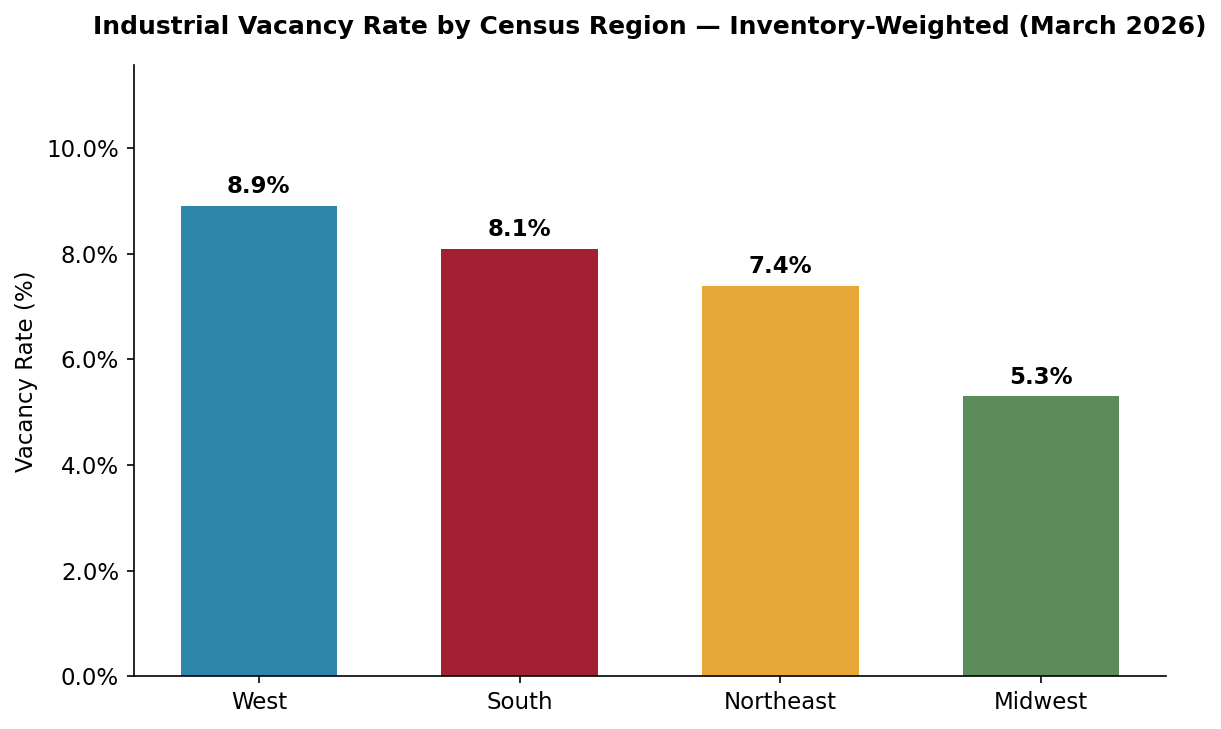
Source: CoStar, Q2 2026. Weighted by inventory SF across 75 MSAs with 100M+ SF industrial inventory.
Markets with Negative Rent Growth by Census Region (Q2 2026)
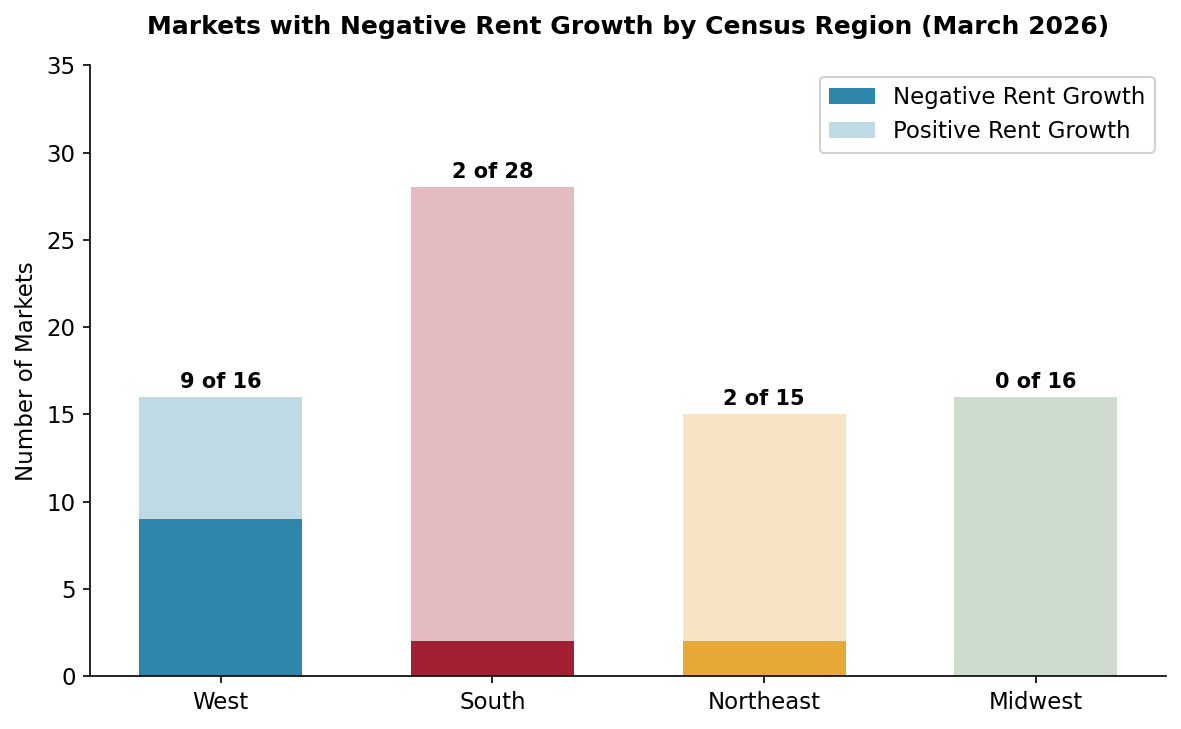
Source: CoStar, Q2 2026. 75 MSAs with 100M+ SF industrial inventory.
Key Observations
Context & Discussion
The E-Commerce Construction Wave and Its Aftermath
The pandemic-era surge in e-commerce penetration triggered the largest industrial construction boom in U.S. history. National industrial deliveries peaked above 500 million SF annually in 2023, driven by Amazon, third-party logistics providers, and speculative developers responding to warehouse demand that appeared insatiable. Southern and Western markets led the wave: Dallas–Fort Worth, Houston, Phoenix, and the Inland Empire each absorbed tens of millions of square feet annually during 2021–2022 while maintaining sub-5% vacancy rates.
2024–2026: E-commerce growth rates have normalized, Amazon has consolidated its logistics footprint after pandemic-era overexpansion (although recently began expanding again at a more measured pace than 2020–2023), and persistently elevated interest rates have reduced both speculative development and corporate capital expenditure plans. The 277.9 million SF delivered across the 75 markets in the twelve months through June 2026 represents a significant decline from the peak but remains elevated relative to pre-pandemic norms of approximately 200–250 million SF annually. Construction starts have fallen dramatically in most markets, although bolstered significantly if data centers are included in the statistics.
Western Region Correction
California’s industrial markets face a unique combination of over-supply and cost pressures. The Inland Empire, the nation’s largest logistics corridor, added more than 10 million SF in the trailing twelve months while posting 8.8% vacancy and –1.8% rent growth. Los Angeles, constrained by land scarcity and high development costs, nonetheless saw rents decline 3.9% year-over-year as tenants consolidated or relocated to lower-cost inland locations.
Beyond California, Denver (–2.1% rent growth, 9.2% vacancy) and Las Vegas (10.9% vacancy, flat rents) are absorbing significant speculative pipelines built during the boom. Reno (13.7% vacancy), Phoenix (10.5%), and Salt Lake City (8.4%) still carry elevated vacancy, although rent growth outside California has turned modestly positive again in most Western markets.
Midwest Supply Constraints
Midwestern industrial markets were not immune to the construction boom, but their pipelines were proportionally smaller and their demand fundamentals more durable. Chicago, the nation’s largest industrial market by inventory (1.38 billion SF), delivered 5.7 million SF while maintaining 5.4% vacancy and 4.6% rent growth. The region’s weighted average under-construction pipeline of 1.5% of inventory compares favorably to the South’s 3.1%.
Lower land and construction costs in the Midwest produce lower rents ($8.50/SF weighted average) that limit speculative overbuilding. Rents are generally lower in the Midwest, whereas construction costs remain high nationally, driven by labor and material constraints. We see a similar dynamic in multifamily in the Midwest, which has led (in both cases) to reduced supply in spite of gradually increasing demand (after years of decline) and consequently lower vacancy rates and rising rents.
The South: Volume Leader with Diverging Submarket Stories
The South’s 152.5 million SF in trailing-twelve-month deliveries masks significant variation across its 28 major markets. Dallas–Fort Worth and Houston together accounted for 46.6 million SF, 31% of the region’s total, and are absorbing new supply at varying rates. Austin stands out with 14.2% vacancy and 8.2% of inventory under construction, behind only Washington, D.C. and Richmond among all 75 markets (although this includes large owner-occupied projects including Tesla, Samsung, as well as data centers). At the other end, Tulsa (2.7% vacancy), Birmingham (4.3%), and Greensboro (4.3%) reflect tighter conditions in smaller, less speculative Southern markets.
What to Watch in 2026
The industrial regional divergence story will be shaped by several factors: the pace of Western rent correction (particularly in California), the trajectory of e-commerce demand growth, tariff and trade policy effects on port-proximate vs. inland distribution, and the continued buildout of nearshoring-driven manufacturing in the South and Midwest. The Inland Empire’s absorption rate, Austin’s pipeline digestion, and the Midwest’s ability to maintain sub-6% vacancy will be key indicators. We will continue to track deliveries, starts, absorption, and trade policy developments that may shift the geography of industrial demand.
Sources to Track U.S. Industrial Regional Dynamics in 2026:
| Source | Next Release | Date | Notes |
|---|---|---|---|
| CoStar | Quarterly MSA-level industrial update | Ongoing (subscription) | Vacancy, rents, deliveries, starts, and absorption for 395 MSAs |
| CBRE | U.S. Industrial & Logistics Figures | Quarterly | National and market-level vacancy, rent, and absorption trends |
| U.S. Census Bureau | New Residential & Nonresidential Construction | Monthly | Warehouse and manufacturing construction spending by region |
Notes
[1] CoStar. U.S. Industrial Market Data, All MSAs (as of Q2 2026; quarterly history 2016 Q1 through 2026 Q2, exported August 2026). costar.com. Includes trailing-twelve-month data for all 394 CoStar metros; the regional charts use the 75 MSAs with 100 million+ SF industrial inventory. Regional aggregations by CRE42 using Census region definitions (Northeast, Midwest, South, West). Vacancy rates are inventory-weighted. Washington, D.C. and Baltimore are classified as South per Census convention. ↩
[2] Flow figures on this page (deliveries, net absorption, construction starts) are trailing twelve months to June 30, 2026, unless a chart or table says otherwise; stocks and rates (inventory, vacancy, under construction, asking rent, occupancy, sale price) are the Q2 2026 quarter-end readings. ↩
Companion workbook. industrial-regional-divergence.xlsx: regional summary, 75-market detail, all 394 metros at Q2 2026, and the 2016–Q2 2026 annual history behind the market explorer. CoStar, Q2 2026.
Methodology & Data Notes
Data Source & Regional Classification
Market-level data sourced from CoStar’s U.S. Industrial dataset as of Q2 2026 (quarter ended June 30, 2026), the same vintage as the national supply cycle page. The dataset includes 394 metros; the regional charts filter to the 75 MSAs with industrial inventory of 100 million+ SF, while the market explorer carries all 394. Markets were assigned to Census regions (Northeast, Midwest, South, West) by CRE42 based on the primary state of each MSA. Washington, D.C. and Baltimore are classified as South per Census convention.
Market Explorer
Table values are CoStar figures at Q2 2026; “TTM” columns are the trailing twelve months to June 30, 2026. Net delivered SF is gross deliveries less demolitions. Under construction as a percentage of inventory is under-construction SF divided by inventory SF. The chart plots each calendar year 2016–2025 as the trailing twelve months to Q4 (so deliveries and absorption are full-year flows, and vacancy and the pipeline are year-end readings), plus the trailing twelve months to Q2 2026. When several markets are ticked, square-foot figures are summed and vacancy, occupancy and the pipeline share are recomputed on the combined inventory; asking rent is inventory-weighted. Both series and the chart’s inputs are on the All Metros Q2 2026 and Annual History tabs of the companion workbook.
Weighted Averages
Regional vacancy rates are calculated as inventory-weighted averages: the sum of (vacancy rate × inventory SF) for all markets in the region, divided by total regional inventory SF. Regional asking rents and sale prices are calculated using the same inventory-weighted approach. This methodology ensures that larger markets exert proportionally greater influence on regional averages.