
- Between 2007 and 2025 the United States added 40 million people, grew its real GDP by 42%, and more than doubled its nominal GDP (up 113%).[1][2][3]
- Supply and demand for commercial real estate varied dramatically by asset type and geography over this period.
- Supply matched, exceeded, or fell short of the economy’s needs, resulting in today’s vacancy, rent, and investment returns across sectors.
- The chart below compares cumulative inventory growth for office, industrial, retail, and multifamily against population and real GDP benchmarks, through the first half of 2026.
U.S. Real GDP, Population & CRE Inventory Growth (2007 = 100)
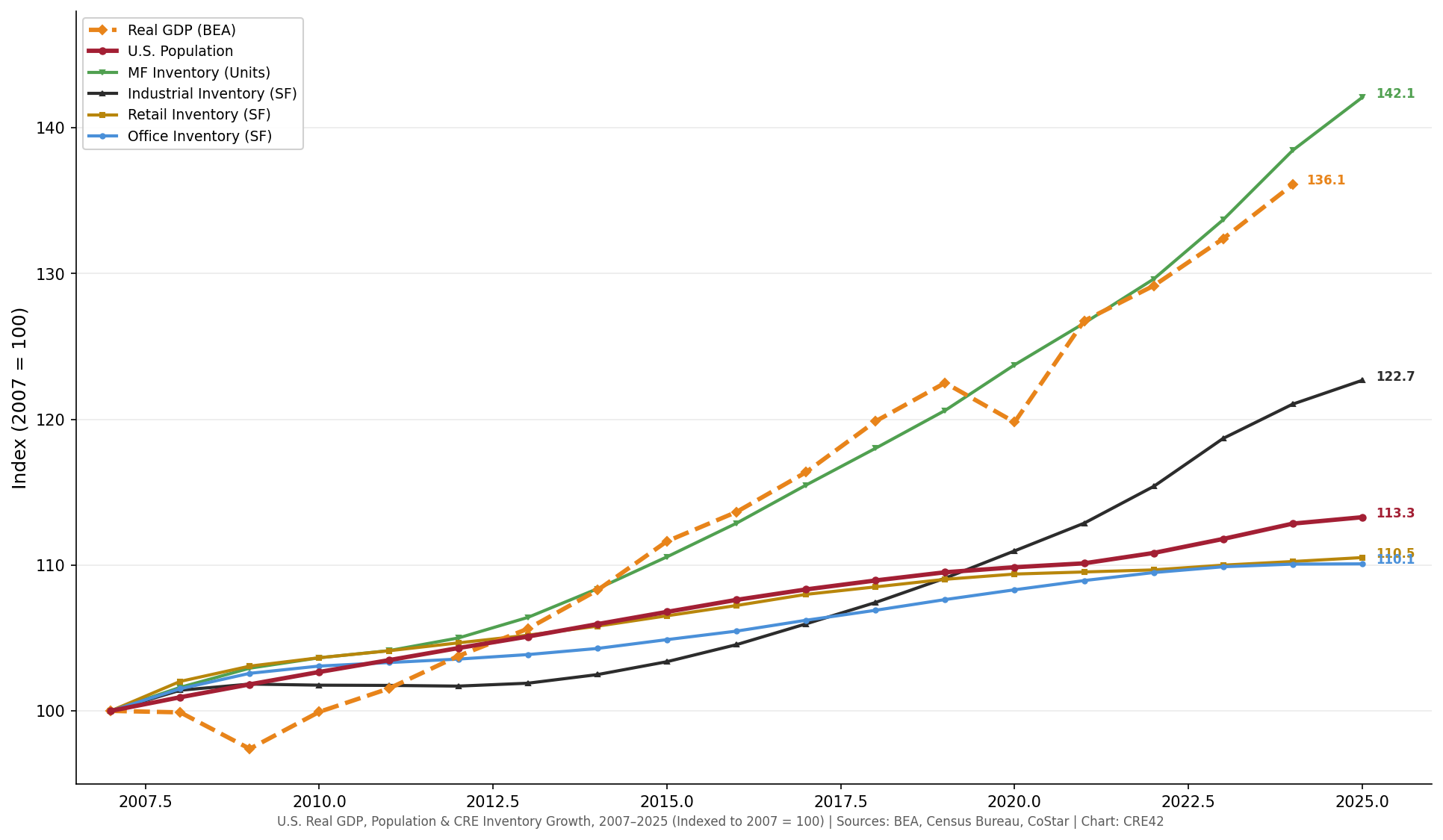
U.S. Real GDP, Population & CRE Inventory Growth, 2007 to H1 2026 (Indexed to 2007 = 100) | Sources: BEA (FRED: GDPCA), U.S. Census Bureau, CoStar | Chart: CRE42
Annual through 2025; the 2026 point is the Q2 2026 reading for inventory and population and the average of the first two quarters for real GDP. Multifamily is measured in units, all other inventories in square feet. Nominal GDP (index 222 at H1 2026) is omitted from the chart for scale.
Supply Growth vs. Vacancy by Asset Type (2018 to Q2 2026)
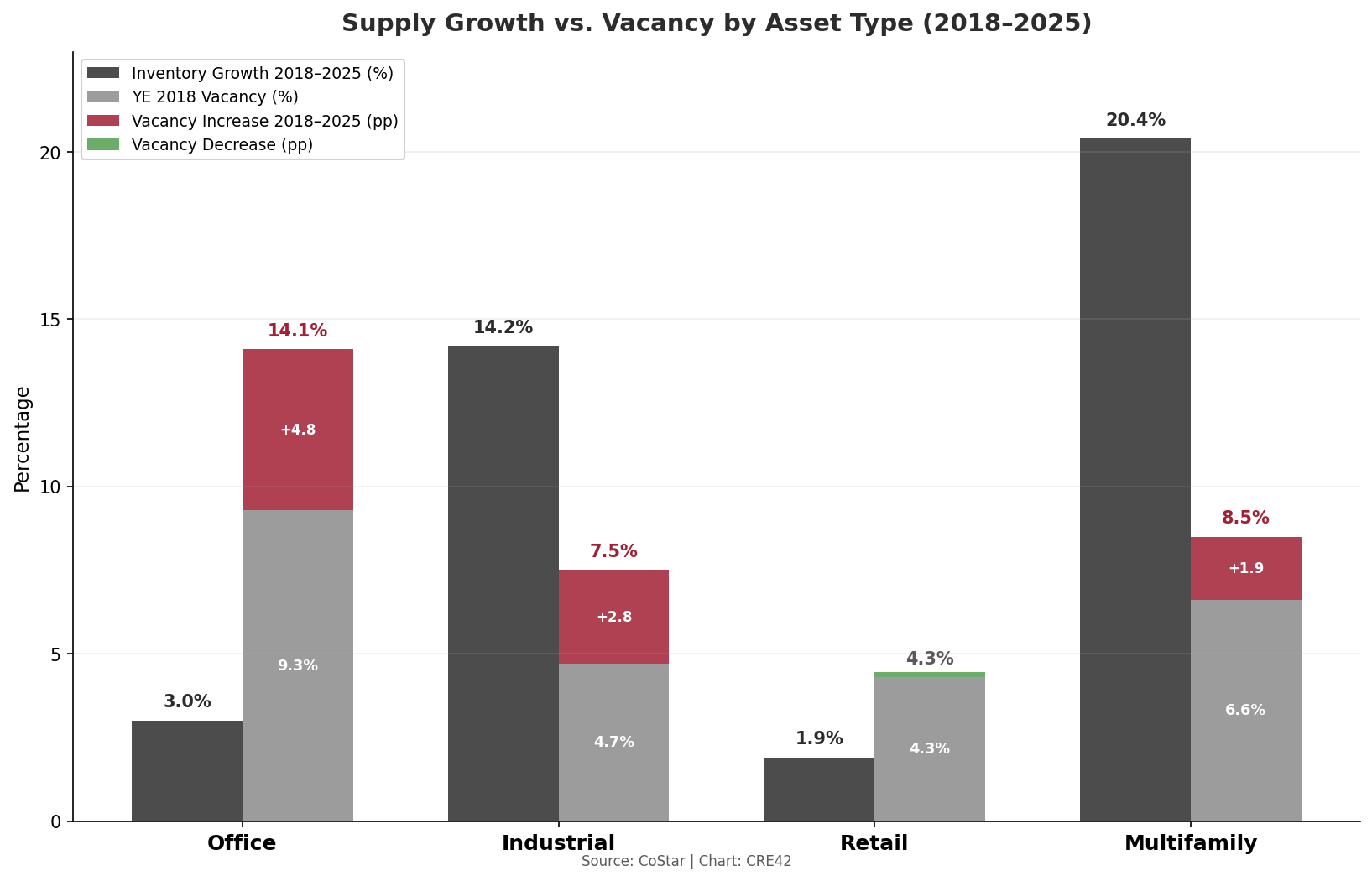
Inventory Growth vs. Vacancy Rate by Asset Type, Year-End 2018 to Q2 2026 | Source: CoStar | Chart: CRE42
Left bar: cumulative inventory growth. Right bar: stacked vacancy; the gray base is the year-end 2018 vacancy rate and the colored segment is the change to Q2 2026.
Key Observations
Context & Discussion
Multifamily: Supply boom overshoots, especially in growth markets
Multifamily inventory grew from 14.6 million units in 2007 to 20.7 million in 2025 (20.9 million at Q2 2026), a 42% increase driven by delayed homeownership, rising housing costs, Millennial and Gen-Z household formation, and sustained domestic migration to growth metros.[1][2] Vacancy fell from 7.1% in 2007 to a trough near 5% in 2021 as construction was delayed and demand surged in 2021 and 2022.[1] Annual rent growth exceeded 10% in many markets during this period, attracting an enormous wave of new construction starts.[1]
Net deliveries reached a record 696,000 units in 2024 and 532,000 in 2025, the highest levels in modern records.[1] This supply shock lifted the national vacancy rate from about 5% to 8.5% at the end of 2025, with rent growth decelerating to 0.5% nationally in 2025.[1] The first half of 2026 brought the first relief: 227,000 units delivered against 289,000 absorbed, vacancy back to 8.1%, and rent growth of 0.8%.[1] The national figures mask significant regional variation: growth metros like Austin, Nashville, Phoenix, Charlotte, and Dallas experienced extreme new levels of residential construction and are still working through oversupply, while mature coastal markets (New York, Boston, San Francisco) saw far less new construction and maintained tighter conditions.
Industrial: Post-GFC supply constraints lead to low vacancy, rising rents and new construction
Industrial inventory grew 23% from 15.7 billion SF in 2007 to 19.2 billion SF in 2025 (19.3 billion at Q2 2026), driven by e-commerce (which requires approximately three times the distribution space per dollar of sales compared to brick-and-mortar retail), pandemic-era supply chain restructuring that prioritized domestic inventory buffers over just-in-time efficiency, and early-stage nearshoring of manufacturing capacity enabled by federal industrial policy (CHIPS Act, IIJA, IRA).[1] Vacancy fell from 7.8% in 2007 to a record low of 3.9% in 2022 before rising to 7.4% in 2025 and 7.5% at Q2 2026.[1]
Industrial developers delivered 515 million SF in 2023 alone, two and a half times the 2015–2019 average of 206 million SF, only 11 years removed from a three-year period (2010–2012) in which national industrial deliveries went negative as obsolete industrial stock was demolished faster than new product was built.[1] As with multifamily, the supply wave was geographically concentrated in Sunbelt and inland-logistics metros where land was available and entitlement timelines were short. Coastal markets with constrained land supply (Northern New Jersey, the Inland Empire, South Florida) generally maintained lower vacancy throughout the cycle.[1] Deliveries have declined to 255 million SF in 2025 and 97 million SF in the first half of 2026 (an annualized pace of roughly 194 million SF), with many overbuilt growth metros hoping absorption will stabilize the market before the next round of development.[1]
Retail: Volatile sentiment and tenant demand vs. low levels of new supply
National retail inventory grew 10.5% from 2007 to 2025, the least of any major asset type and less than population growth.[1][2] Average annual deliveries collapsed from 80 million SF (2008–2019) to 26 million SF (2020–2025).[1] In 2025, the U.S. delivered 28 million SF of new retail space, 0.24% of existing inventory and about a third of the 2008–2019 average; only 2021 and 2022 (15 million SF each) were lower.[1] Vacancy fell from 5.7% in 2007 to 4.0% in 2023 and sits at 4.4% at Q2 2026, essentially unchanged from its 2018 level despite a pandemic, an estimated 15,000 store closures in 2025, and the continued growth of e-commerce from 3.2% of total retail sales in early 2007 to 17.1% in Q2 2026.[1][4][5]
The “retail apocalypse” narrative that dominated media and investor sentiment from roughly 2015 to 2019, anchored by high-profile mall closures, department store bankruptcies, and projections that a quarter of U.S. malls would close, effectively shut down new retail construction.[5] Lenders pulled back, developers pivoted to industrial and multifamily, and an estimated 400+ million SF of obsolete retail space has been demolished or converted over the past 15 years.[1] The surviving inventory is tighter, better located, and generating higher rents: asking rents rose 35% from $19.23/SF in 2007 to $26.00/SF in 2025, and $26.22/SF at Q2 2026.[1] Neighborhood and grocery-anchored centers are effectively full, while enclosed malls and certain big-box formats face continued obsolescence pressure. The national vacancy figure obscures this bifurcation.
Office: Demand reduction overrides reduced new supply
Office inventory grew 10.1% from 7.5 billion SF in 2007 to 8.3 billion SF in 2025, roughly in line with retail and below population.[1][2] Pre-pandemic, the office market was in late-cycle expansion: vacancy had compressed from 12.4% at the post-GFC peak in 2010 to 9.3% by 2018, rents were rising, and under-construction pipelines were modest relative to inventory.[1] Following the Covid-19 pandemic, remote and hybrid work patterns reduced office-using employment’s physical footprint, and vacancy rose to a peak of 14.2% in mid-2025 (13.9% at Q2 2026), a 4.6 percentage point increase on just 2.9% supply growth since 2018.[1] No other asset type experienced a vacancy increase of this magnitude.
Net supply turned negative in 2025 for the first time in modern records, as demolitions and conversions to residential, lab, and hotel uses exceeded new completions, and the contraction accelerated to 9.5 million SF in the first half of 2026.[1] New spec construction starts are now exceedingly rare across the country, while aggregate demand for office space remains one of the great uncertainties of the coming years; the first half of 2026 produced the first positive national net absorption since 2019.[1]
The Geographic Dimension
A pattern common to multifamily, industrial, and to a lesser extent retail is the geographic concentration of new construction in growth metros.[1] In addition to favorable demographic trends, builders tend to build where they can build.[2] Sunbelt and interior markets enjoy lower land costs, shorter entitlement timelines, fewer regulatory barriers, and pro-development local governments, and consequently attract a disproportionate share of new development. The result is a familiar cycle: growth metros experience supply surges which push vacancy above national averages, while supply-constrained coastal markets maintain lower vacancy and higher rents.[1] Metro-level data on multifamily, industrial, and office regional patterns explore this geographic dimension in detail.
Total Inventory & Net Deliveries by Asset Type (SF)
The charts below present total inventory and annual net deliveries in square feet for all four major CRE asset types. Multifamily units have been converted to estimated square feet using 900 SF per unit, the approximate national average apartment size from 2007 to 2024 per RentCafe/Yardi Matrix annual surveys.[6] This conversion enables direct cross-asset comparison of construction volume on a common scale.
Net Deliveries: 5-Year Period Totals
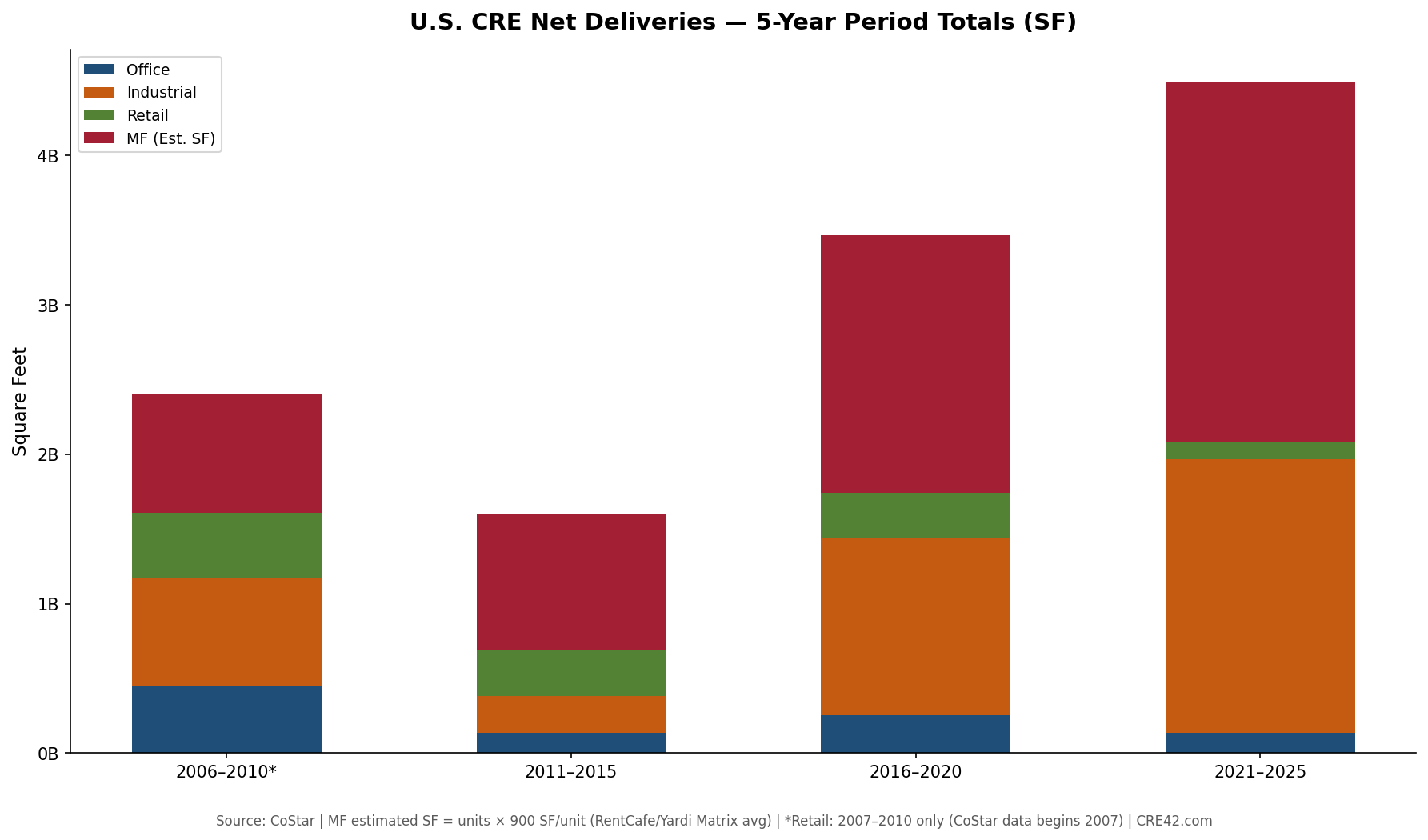
U.S. CRE Net Deliveries: 5-Year Period Totals (SF) | Source: CoStar, Q2 2026; MF estimated at 900 SF/unit | Chart: CRE42
Multifamily and industrial construction increasingly dominated U.S. CRE development, especially following the GFC and Covid-19 pandemic when retail and office supply (respectively) collapsed.
Net Deliveries: Annual Trend (2007–2026)
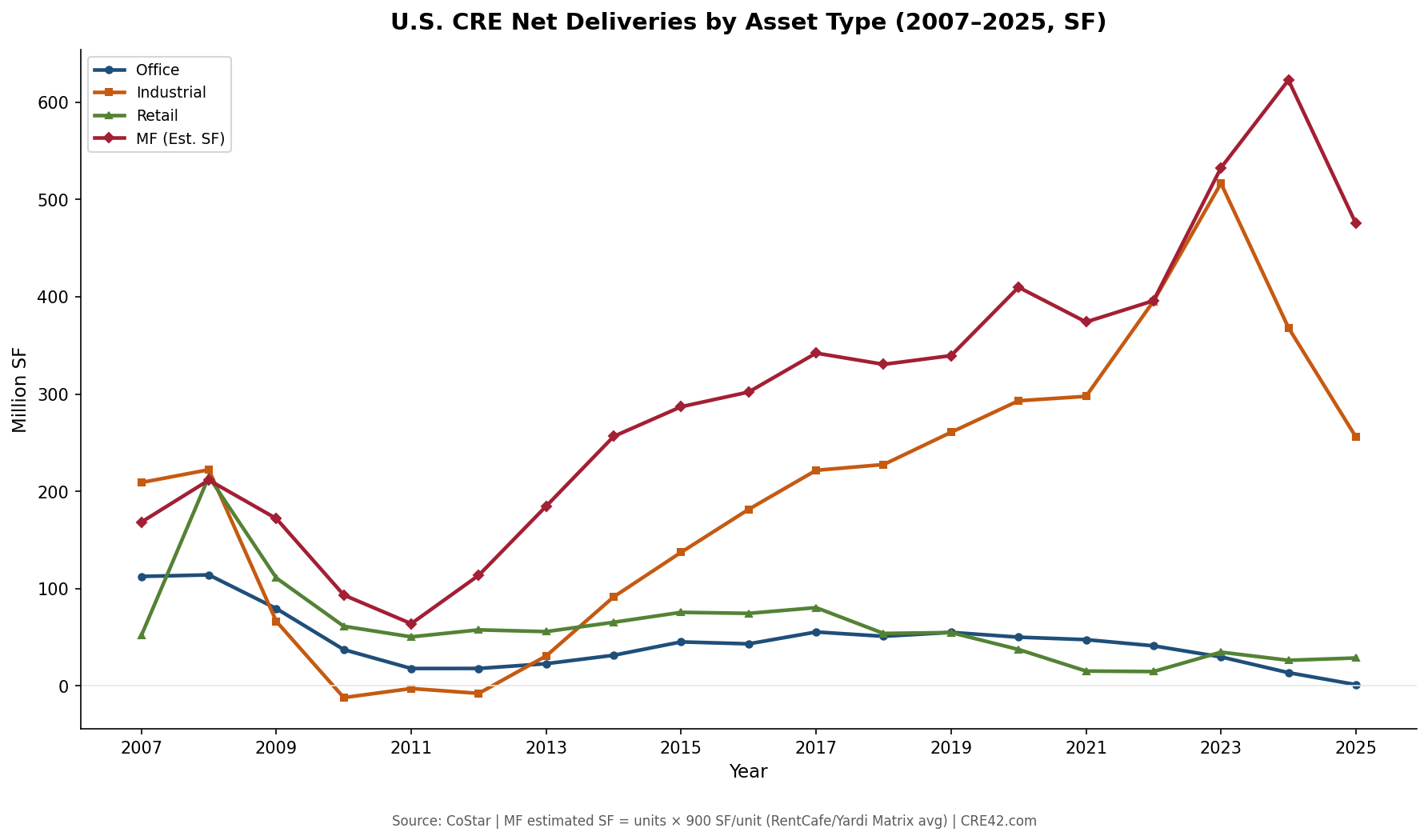
U.S. CRE Net Deliveries by Asset Type, 2007–2026 (SF) | Source: CoStar, Q2 2026; 2026 annualized from first-half figures; MF estimated at 900 SF/unit | Chart: CRE42
The post-GFC collapse in deliveries was broad-based, but the recovery was sector-specific: industrial and multifamily surged to record levels while office and retail never regained pre-recession construction volumes.
Total Inventory: Annual Trend (2007 to Q2 2026)
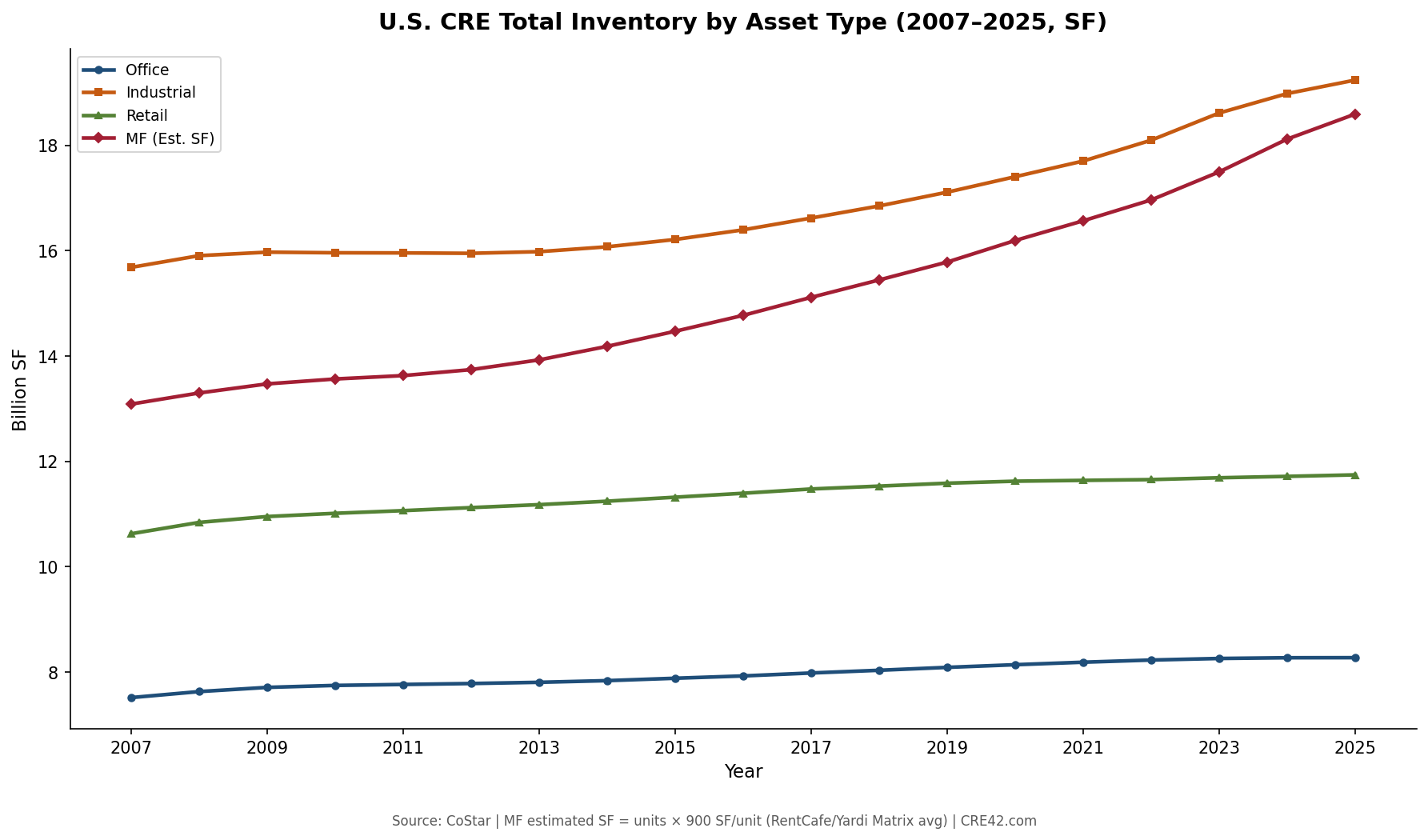
U.S. CRE Total Inventory by Asset Type, 2007 to Q2 2026 (SF) | Source: CoStar, Q2 2026; MF estimated at 900 SF/unit | Chart: CRE42
Industrial remains the largest CRE asset class by square footage, but multifamily, measured on a comparable SF basis, has been closing the gap steadily since the mid-2010s and now rivals industrial in total physical footprint.
Total Inventory: 5-Year Snapshots
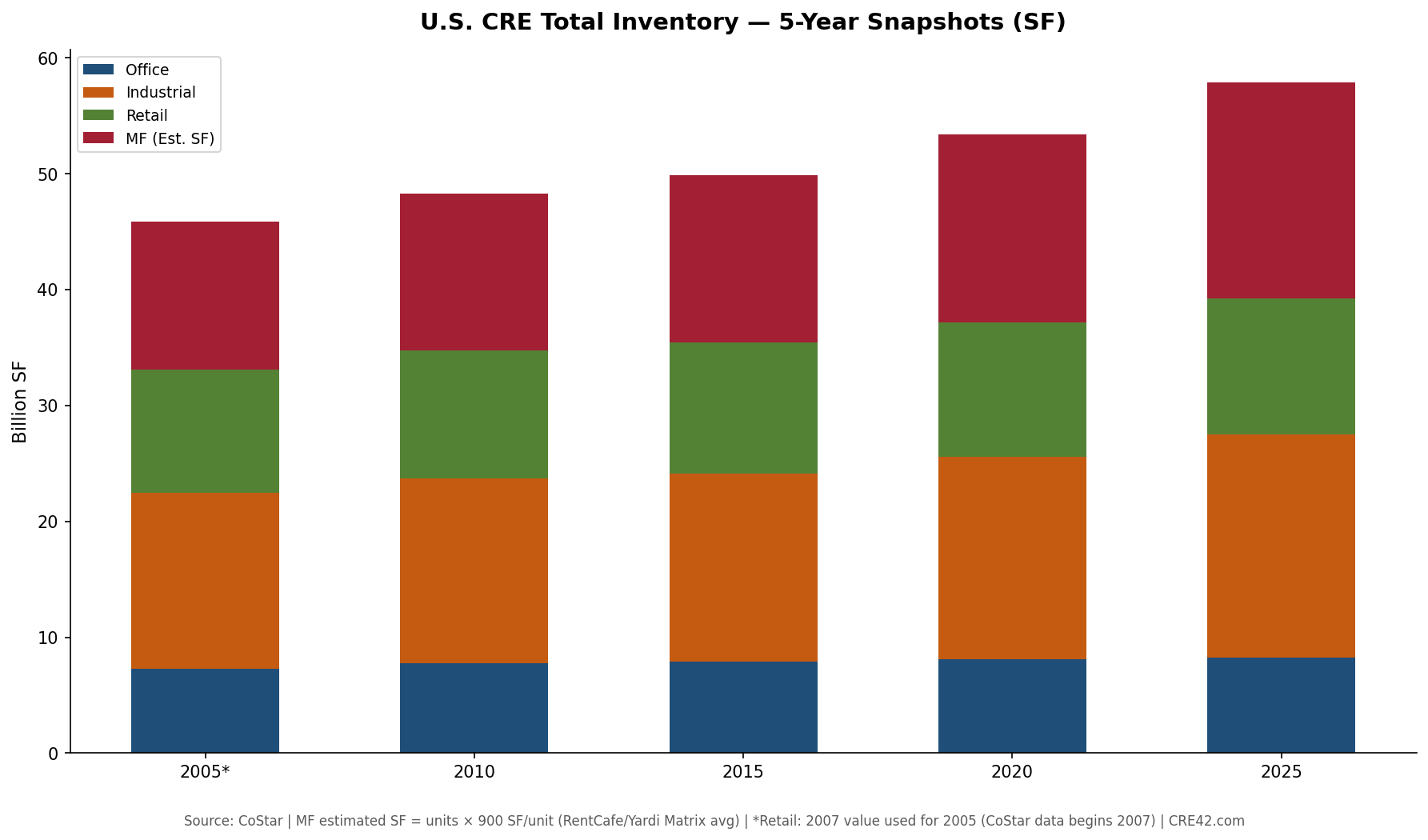
U.S. CRE Total Inventory: 5-Year Snapshots (SF) | Source: CoStar, Q2 2026; MF estimated at 900 SF/unit | Chart: CRE42
Total U.S. CRE inventory across the four major asset types grew from roughly 46 billion SF in 2005 to 58 billion SF in 2025, a 26% increase, with industrial and multifamily contributing virtually all of the net growth.[1][6]
What to Watch For in 2026 and Beyond
Sources to Track National CRE Supply in 2026:
| Source | Report / Series | Frequency | Notes |
|---|---|---|---|
| CoStar | National statistics: office, industrial, retail, multifamily | Quarterly | Inventory, deliveries, absorption, vacancy, rents and cap rates; the basis of every CRE series on this page |
| Bureau of Economic Analysis | Gross Domestic Product (real and nominal) | Quarterly; annual revision each September | The GDP benchmark in the indexed-growth chart; the September update revises the last several years |
| U.S. Census Bureau | Population Estimates Program | Annual, December (national and state); May (metros) | The population benchmark; CoStar embeds the national series in its exports |
| U.S. Census Bureau | Quarterly Retail E-Commerce Sales | Quarterly, about seven weeks after quarter end | E-commerce share of total retail sales, the demand-side backdrop to retail supply |
| Coresight Research | Store Tracker | Weekly, with annual reviews | U.S. store openings and closures by retailer |