
U.S. Industrial Supply & Demand Cycle: 2000–2026
All data: CoStar, U.S. Industrial National Historical Data, Q2 2026 (through June 30, 2026).
U.S. Industrial Net Delivered SF (2001–2026)
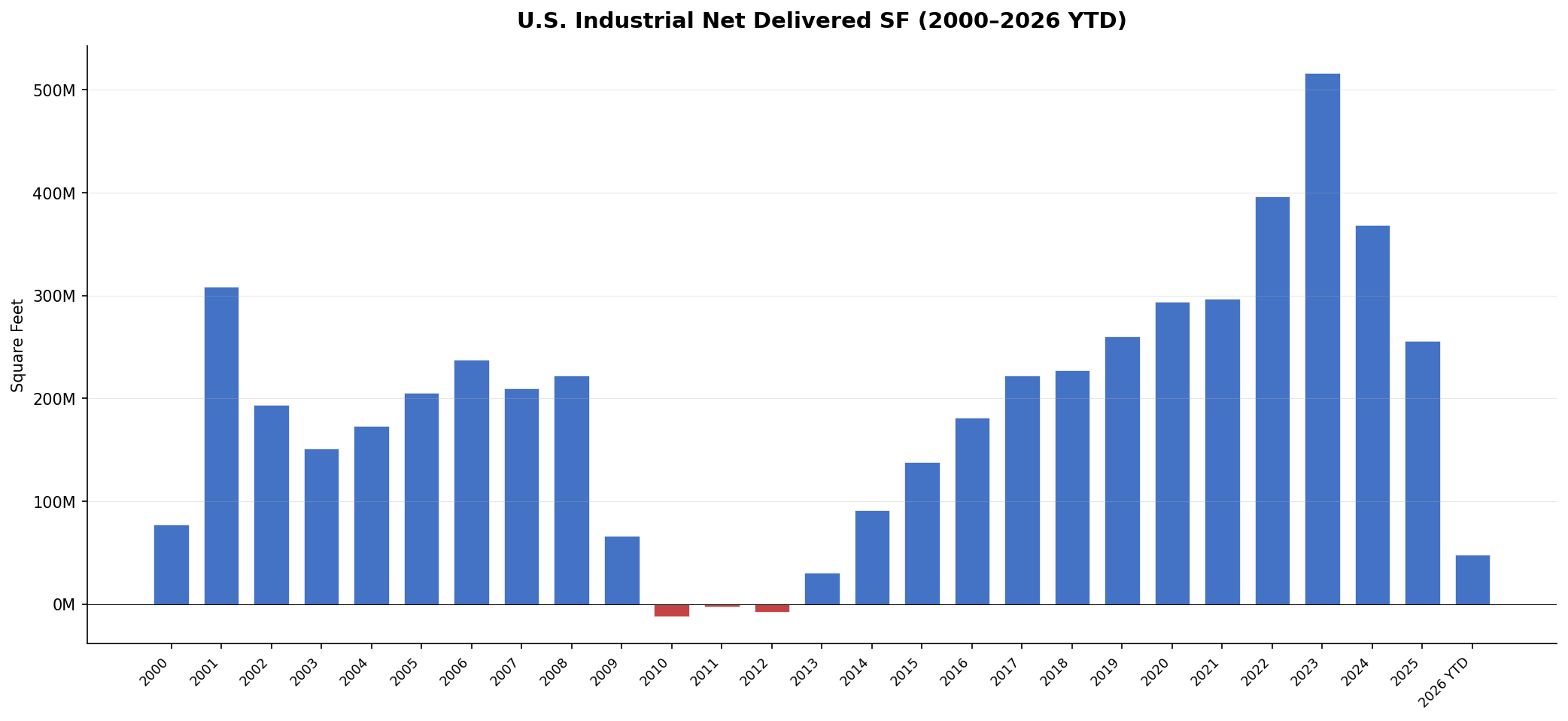
Source: CoStar, Q2 2026; 2026 annualized from first-half figures.
U.S. Industrial Deliveries, Absorption & Vacancy (2001–2026)
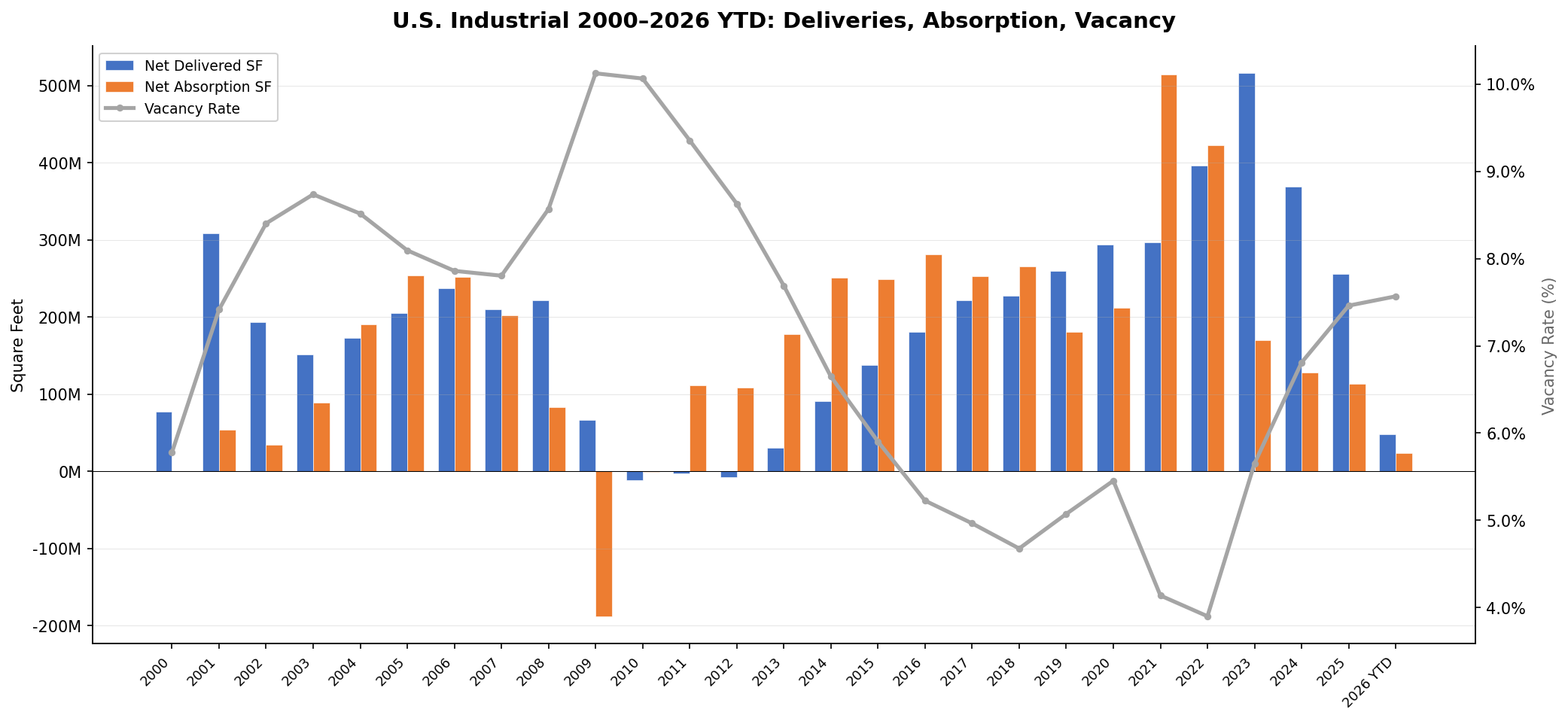
Source: CoStar, Q2 2026; 2026 deliveries and absorption annualized from first-half figures, vacancy as of Q2 2026.
U.S. Industrial Vacancy vs. Market Asking Rent (2001–2026)
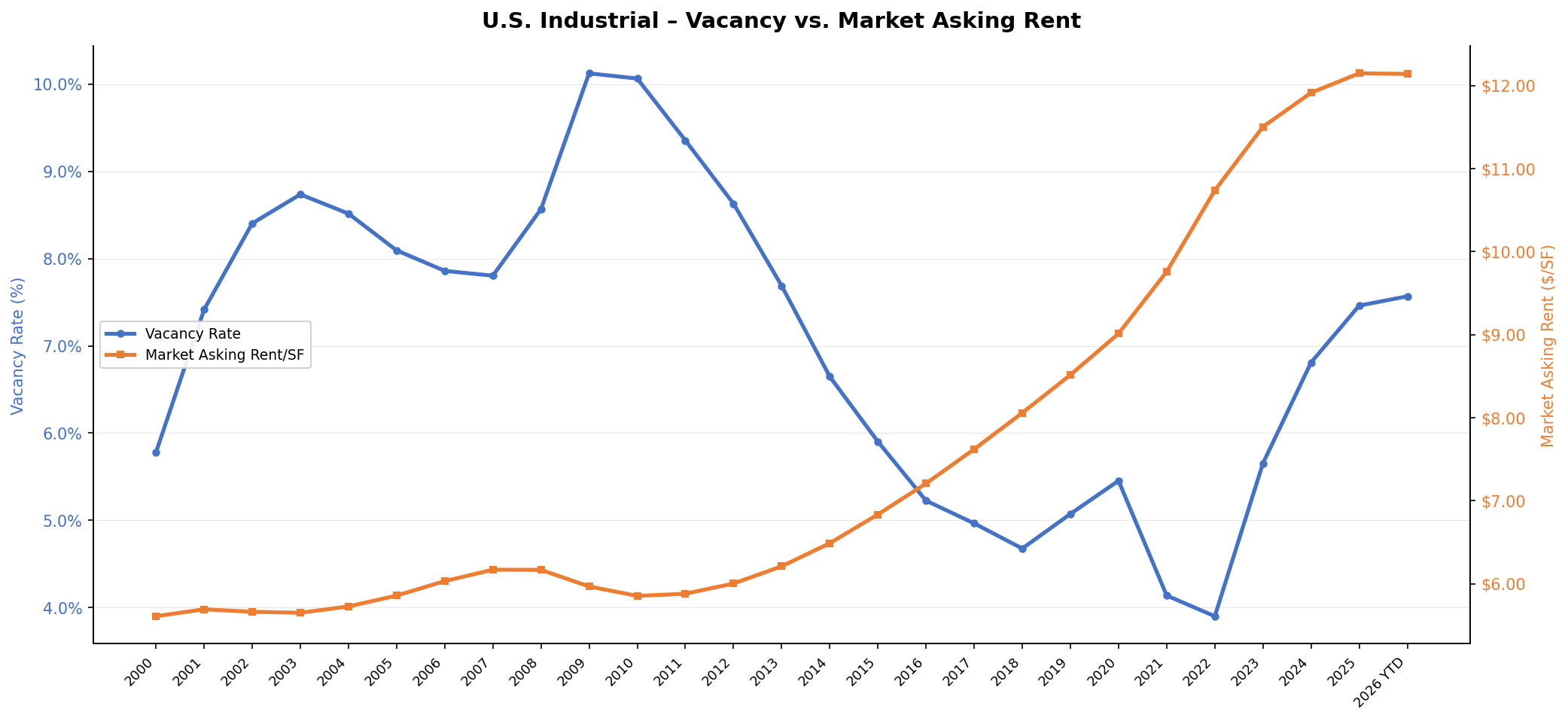
Source: CoStar, Q2 2026; the 2026 point is the Q2 2026 reading.
U.S. Industrial Deliveries vs. Construction Starts (Prior 2-Year Average)
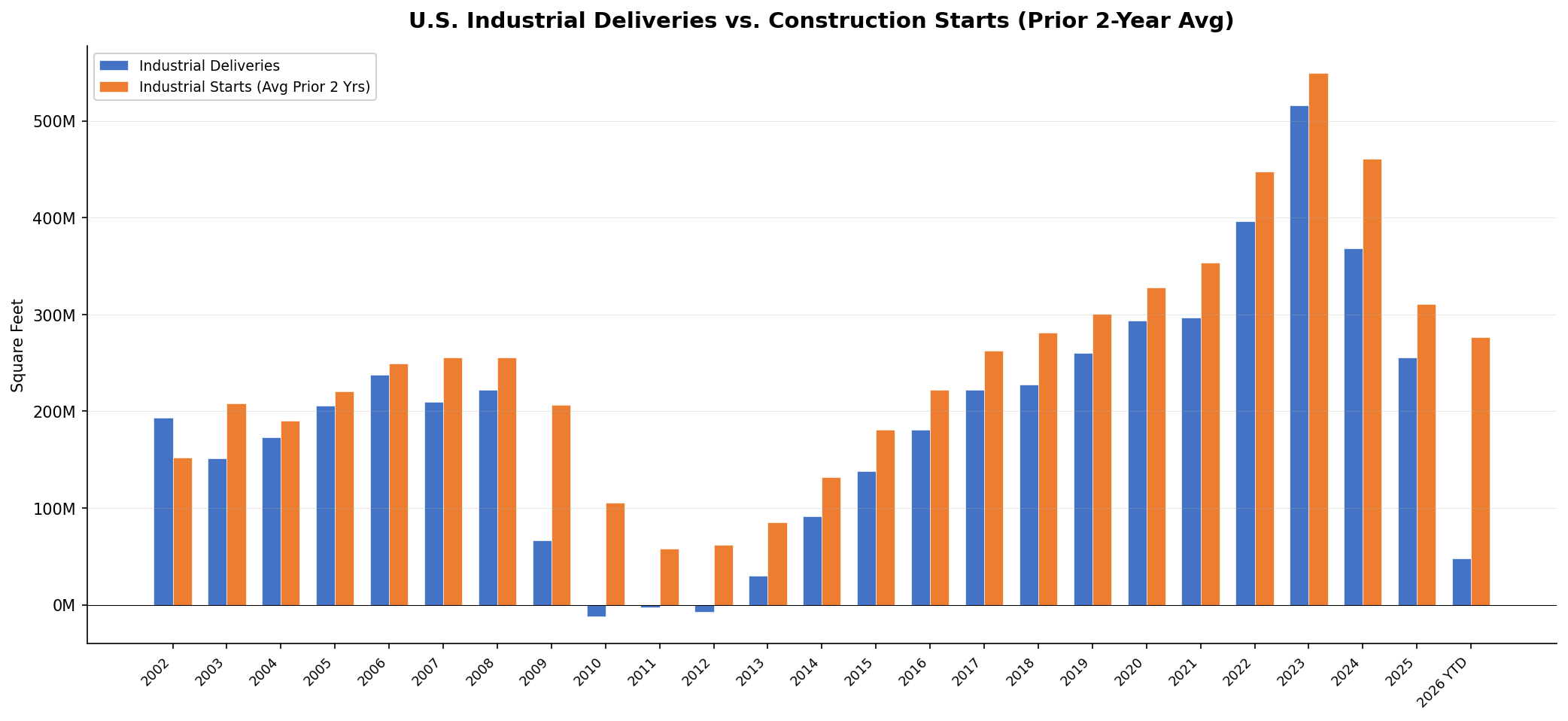
Source: CoStar, Q2 2026; 2026 annualized from first-half figures. Correlation between annual deliveries and prior 2-year average starts (2002–2025) ≈ 0.96.
Key Observations
Context & Discussion (Post-Pandemic Period)
Post-Pandemic Construction Boom
The 2020–2024 industrial construction boom was the largest sustained period of warehouse and distribution development in at least 25 years. From 2020 through 2024, U.S. builders delivered approximately 1.86 billion SF of net new industrial space, almost double the roughly 1.03 billion SF during the preceding five-year period (2015–2019). The boom was driven by ecommerce, expanding retailer and manufacturer inventories following the 2021–2022 supply-chain disruptions, historically attractive borrowing terms and interest rates, and a flood of capital coming out of office investment. Construction starts peaked at 576 million SF in 2022 and space under construction reached 661 million SF (3.7% of inventory), by far the highest proportion since at least 2000.
Demand Correction
Net absorption peaked at 515 million SF in 2021 before declining sharply to 116 million SF in 2025, as pandemic-era demand drivers faded and tenants absorbed existing commitments. The 2021 absorption spike reflected extraordinary conditions: retailers scrambled to stockpile inventory following supply-chain disruptions, e-commerce firms expanded fulfillment networks aggressively, and third-party logistics (3PL) providers leased speculative space in advance of anticipated demand. By 2023, much of this demand had been satisfied. 515 million SF was delivered in 2023 against only 170 million SF of absorption, pushing vacancy up 175 bps in a single year.
Rent Resilience Despite Rising Vacancy
Industrial asking rents have risen in every year since 2010, including during the current vacancy correction, reflecting a structural repricing of warehouse and distribution space. Market asking rent reached $12.15/SF in 2025, up 44% from $8.46 in 2019, and $12.21 at the end of Q2 2026. This pattern contrasts with the GFC period, when rents declined approximately 5% as vacancy rose from 7.8% to 10.1%. The current rent resilience reflects several factors: much of the new supply consists of modern, high-clear-height facilities commanding premium rents; construction pricing has outpaced general inflation since 2000 and remains significantly elevated; in-place rents signed during 2018–2021 are substantially below current market rates, limiting downward pressure as leases roll. Rent growth has, however, decelerated from 8–10% in 2021–2022 to 2.8% in 2025 and 1.7% year-over-year at Q2 2026.
Starts-to-Deliveries Pipeline
Starts averaged roughly 288 million SF annually in 2024–2025, down from 576 million SF in 2022. The pipeline points to deliveries normalizing toward 250–300 million SF annually by 2027, roughly in line with or slightly above the 2015–2019 average. Much of the recent and pending new supply is concentrated in southern growth metros, now racing to absorb new product before the next development cycle hits.
What to Watch in 2026
E-commerce growth trajectory and inventory-to-sales ratios are the most consequential near-term demand drivers. U.S. e-commerce penetration continues to rise, supporting structural demand for last-mile and regional distribution facilities. However, the pace of growth has normalized from the pandemic-era surge, and further upside depends on whether consumers continue shifting spending online at a rate sufficient to generate incremental warehouse demand beyond the capacity already built.
Nearshoring and tariff-driven supply-chain reconfiguration may generate a second wave of industrial demand. Reshoring and friend-shoring initiatives—accelerated by tariff policy and geopolitical risk—are driving new manufacturing and distribution facility construction, particularly in border markets (Laredo, El Paso), southeastern ports (Savannah, Charleston), and Midwest logistics hubs. The extent to which this demand offsets the post-pandemic absorption slowdown will be a key variable for vacancy trajectory through 2027.
Sources to Track U.S. Industrial Supply in 2026:
| Source | Report / Series | Frequency | Notes |
|---|---|---|---|
| CoStar | Quarterly national and MSA-level update | Quarterly | Most granular source for deliveries, starts, absorption, vacancy, and availability by submarket |
| CBRE | U.S. Industrial & Logistics Figures | Quarterly | National summary with metro-level detail; tracks net absorption, vacancy, rent growth, and investment volume |
| Prologis Research | Logistics Rent Index; Market Update | Quarterly | Largest global industrial REIT; proprietary data on effective rents, tenant demand, and utilization rates |
| U.S. Census Bureau | Construction Spending: Warehouse | Monthly | Dollar-denominated construction put in place for warehouse buildings; captures spending trajectory |
Notes
[1] CoStar. U.S. Industrial National Historical Data (Q2 2026, exported August 25, 2026). costar.com. Quarterly data for inventory, net delivered SF, construction starts, net absorption, vacancy rate, availability rate, asking rent/SF, rent growth, and under-construction SF for the U.S. industrial market, Q4 2000 through Q2 2026, rolled up to calendar years by CRE42. ↩
Companion workbook. industrial-national-supply-cycle.xlsx: CoStar quarterly data (Q4 2000 through Q2 2026), annual roll-up, deliveries-vs-starts analysis and native charts. CoStar, Q2 2026.
Methodology & Data Notes
Data Source & Period
All national industrial data sourced from CoStar’s U.S. Industrial National Historical dataset, exported August 25, 2026, with the series cut at Q2 2026 (June 30, 2026); CoStar’s partial-quarter and forecast rows are not used. CoStar reports quarterly; CRE42 rolls the quarters up to calendar years, taking year-end readings for inventory, vacancy, availability, rent, and under-construction figures and four-quarter sums for deliveries, starts, and absorption. The 2026 H1 figures quoted in the text are the first two quarters of 2026; the charts plot 2026 as an annualized point (first-half deliveries, starts, and absorption doubled, with vacancy, availability, rent, and pipeline as of Q2 2026), and the workbook carries both rows. CoStar’s series begins in Q4 2000, so the 2000 row in the workbook holds one quarter of flows and the charts start at 2001. “Net Delivered SF” subtracts demolished square footage from gross deliveries; negative values indicate net inventory contraction (as observed in 2010–2012). “Construction Starts” represents the square footage of industrial projects that broke ground in each calendar year. “Net Absorption” represents the change in occupied square footage over the period. Net absorption data begins in 2001.
Starts-to-Deliveries Correlation
The correlation of approximately 0.96 is calculated between annual net delivered SF and the simple average of construction starts from the two preceding calendar years (e.g., 2025 deliveries correlated with the average of 2023 and 2024 starts), for the full calendar years 2002 through 2025. The two-year lag reflects the typical construction timeline for industrial projects (18–24 months). Data begins in 2002 (earliest year with two prior years of starts data); the 2026 bar (annualized from the first half) is shown for continuity but excluded from the correlation.
Vacancy Rate vs. Availability Rate
Vacancy rate represents the percentage of total inventory that is physically vacant at period end. Availability rate is a broader measure that includes vacant space plus occupied space listed for sublease or anticipated to become available at lease expiration. Availability rate data begins in 2005 in the CoStar dataset. The gap between availability and vacancy stood at approximately 210 bps at the end of Q2 2026 (9.5% availability against 7.5% vacancy), reflecting sublease space entering the market as tenants right-size footprints.
Rent Data & Industrial Property Types
Market asking rent represents the CoStar-weighted average asking rent per SF across the full industrial inventory, including warehouse/distribution, flex/R&D, and manufacturing space. The U.S. industrial market tracked by CoStar totals approximately 19.3 billion SF as of Q2 2026. Rent growth data begins in 2001.