
The Consumer Price Index rolls dozens of categories into a single number. As of July 2026, that number was 3.4% year-over-year; strip out food and energy and it was 2.5%.[1] The single figure is useful shorthand, but it obscures the variability of the components. Post-pandemic inflation can be broadly characterized by three parallel dynamics: consistent services inflation driven by labor costs, volatile goods inflation, and episodic energy price swings driven by geopolitics and supply constraints. The 2026 re-acceleration is the third of these: energy prices rose 14.7% in the twelve months to July 2026 and gasoline 24.6%, while core goods rose 0.8% and shelter 3.2%.[1]
This page examines the primary inflation components. It leads with construction cost inflation, because for commercial real estate that is the category that matters most: it explains, together with the overhang from the 2022–2024 regional supply booms, why new construction remains weak in most property types even as rents and values have stabilized.
Construction Cost Inflation
Construction costs have risen substantially faster than consumer prices since 2019, and the gap widened again in 2026. The BLS Producer Price Index for new nonresidential building construction rose 42% from 2019 to 2025 on an annual-average basis, against 26% for CPI All Items. New industrial building construction rose 44%, new office building 48%, and construction materials 43%. By July 2026, with the energy shock feeding into materials, the cumulative increases had reached 49% (nonresidential building), 52% (industrial), 57% (office) and 59% (materials); materials alone were up 10.5% year-over-year.[2]
| Index | 2019 – 2025 | 2019 – Jul 2026 | Jul 2026 YoY |
|---|---|---|---|
| CPI All Items | +25.9% | +30.6% | +3.4% |
| PPI: New Nonresidential Building (WPU801) | +41.9% | +49.1% | +5.2% |
| PPI: New Industrial Building (WPU801104) | +44.0% | +52.0% | +5.3% |
| PPI: New Office Building (WPU801103) | +48.5% | +56.9% | +6.0% |
| PPI: New Warehouse Building (WPU801101) | +47.0% | +53.3% | +4.0% |
| PPI: Construction Materials (WPUSI012011) | +43.4% | +58.7% | +10.5% |
| Avg Hourly Earnings: Construction | +29.1% | +34.9% | +4.5% |
BLS PPI and CES via FRED. Columns 2 and 3 compare the 2025 annual mean and the July 2026 monthly value with the 2019 annual mean; the building PPIs step at quarterly survey months (Jan/Apr/Jul/Oct), and July 2026 is one such month.[2]
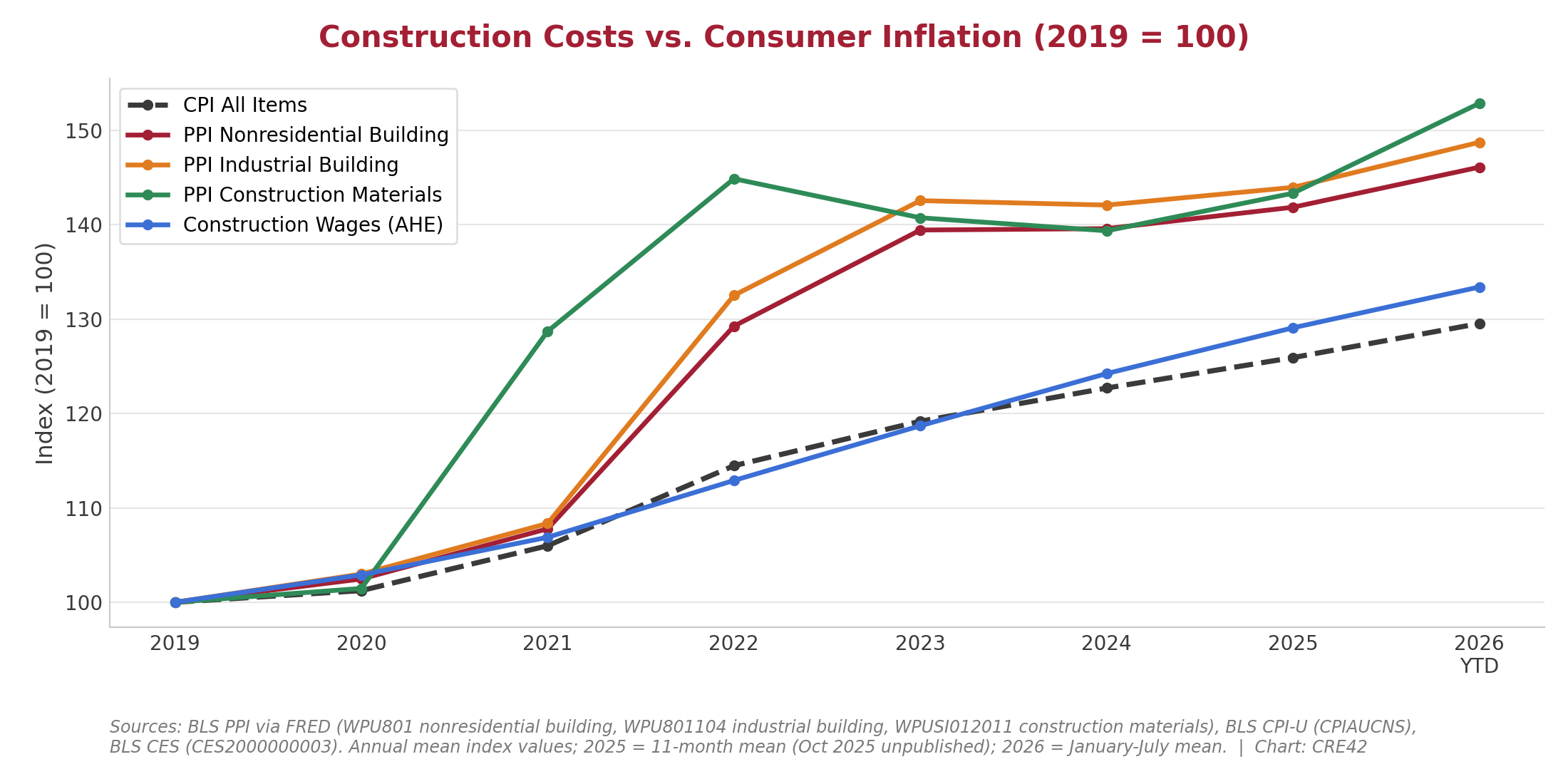
Construction Costs vs. Consumer Inflation (2019 = 100) | Source: BLS PPI & CES via FRED | Chart: CRE42
The composition of construction cost inflation has shifted twice. Materials prices spiked in 2021–2022 (lumber, steel and copper surged on supply-chain disruptions and record demand), gave back part of the gain in 2023–2024, and then re-accelerated: tariffs on steel, aluminum and imported components lifted the materials index through 2025, and the 2026 energy shock added the cost of fuel, asphalt, cement and resin on top. Labor costs, by contrast, have risen steadily throughout the period, driven in large part by the demographic trends described in the U.S. Demographics section. Construction average hourly earnings reached $41.03 in the first seven months of 2026 (from $30.76 in 2019), with the industry facing an estimated annual shortfall of roughly 500,000 workers according to Associated Builders and Contractors.[3] Median hourly wages for construction workers rose 21.1% from 2021 to 2024, more than double the 8.2% increase for all occupations over the same period.[4]
Development Economics Implications
Construction activity is down significantly in all major asset types except data centers (see Data Centers). Two forces are at work at once. The first is cost: profitable 2019 buildings now cost roughly 50% more to build. The rents the same buildings can command have risen by far less, so the yield on cost for most new projects sits below the cap rate at which the finished asset would trade, making many projects economically unfeasible. The second is supply overhang: the 2022–2024 delivery waves in Sunbelt multifamily and in big-box industrial, documented on the multifamily and industrial regional pages, are still being absorbed, holding effective rents flat in the markets that built the most. Add interest rates that have stayed higher for longer than the 2023 consensus expected, and most development does not make economic sense. Many developers with shovel-ready sites continue to wait and watch; the 2026 rise in materials costs pushes the break-even further out.
Services Inflation
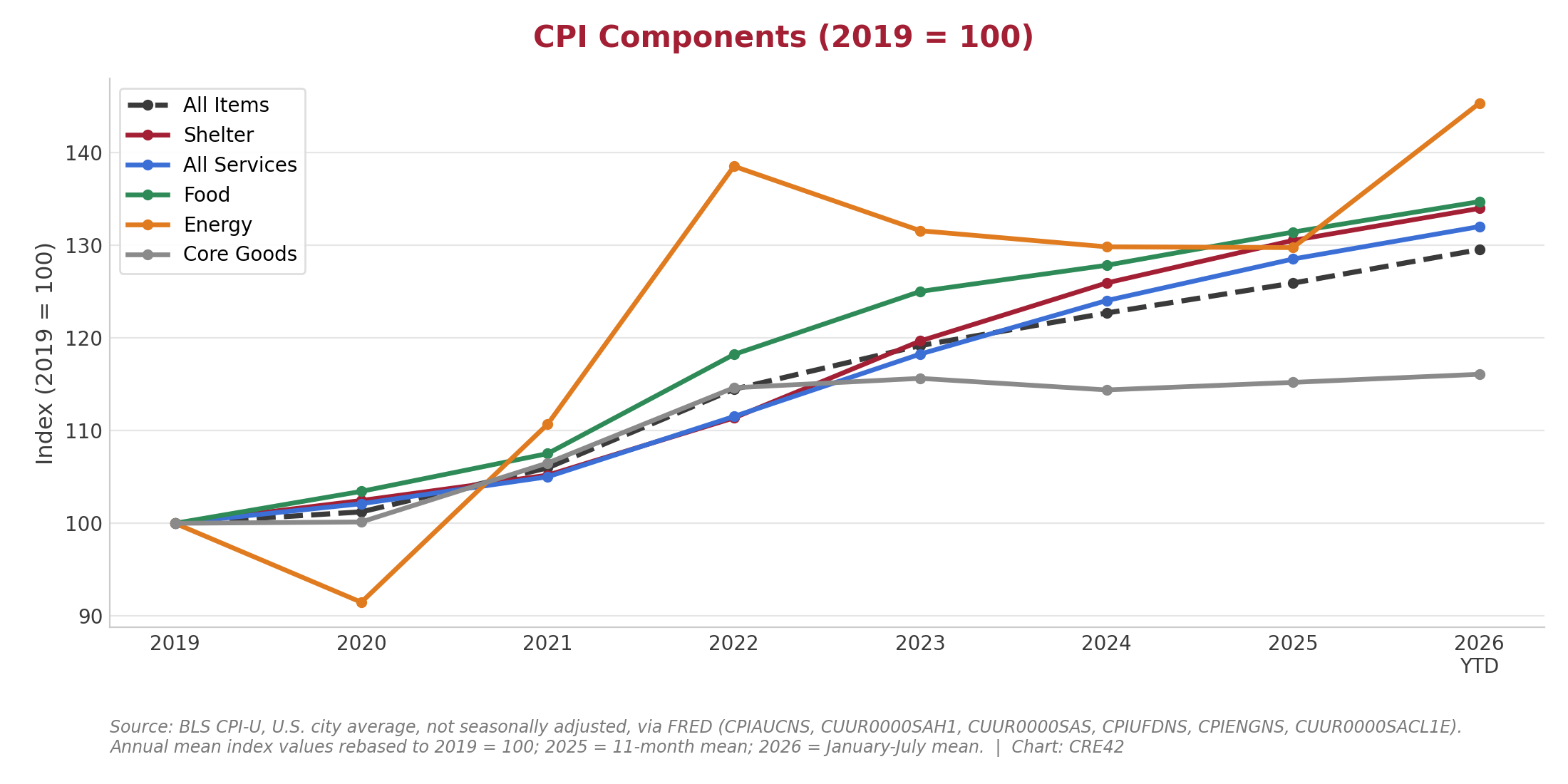
CPI Components (2019 = 100) | Source: BLS CPI-U via FRED | Chart: CRE42
Services account for roughly 61% of the CPI basket and have more than doubled since 2000 (+114%). Services are divided into two parts: shelter (about 36% of CPI, discussed separately below) and non-shelter services (healthcare, food away from home, motor vehicle repair, education, recreation), which rose 112% over the same period.[5]
The common thread is labor intensity. These categories cannot be imported and are difficult to automate. A hospital stay, a restaurant meal, a haircut, and a roof repair all require a physical person in a specific location. When the labor pool for those roles tightens, wages rise and pass through to consumer prices.
| CPI Service Category | 2022 | 2023 | 2024 | 2025 | Jul 2026 YoY |
|---|---|---|---|---|---|
| Hospital & Related Services | 4.6% | 5.6% | 4.0% | 6.7% | 5.4% |
| Food Away from Home | 8.3% | 5.2% | 3.6% | 4.1% | 3.4% |
| Motor Vehicle Insurance | 14.2% | 20.3% | 11.3% | 2.8% | -4.5% |
| Motor Vehicle Maintenance & Repair | 13.0% | 7.1% | 6.2% | 5.4% | 6.6% |
| Other Recreation Services | 5.7% | 5.2% | 2.8% | 3.1% | 1.0% |
BLS CPI-U, December-over-December, not seasonally adjusted; final column July 2026 over July 2025. Hospital services in 2025 was the largest annual increase since 2010.[6]
Motor vehicle insurance is classified as a service even though it is associated with a goods purchase. The double-digit increases of 2022–2024 reflected the cost of repair labor, replacement parts and medical claims, all of which are themselves labor-intensive. That repricing has now run its course: insurance premiums were up 2.8% in 2025 and were falling year-over-year by mid-2026, even as the repair index itself kept rising.
The Shelter Lag and the OER Debate
Shelter is the single largest CPI component at 36% of headline CPI. Owners’ Equivalent Rent (OER), which accounts for 26% of headline CPI alone, is constructed from a BLS survey asking homeowners what they believe their home would rent for, not from transaction data.[7]
CPI shelter carries a well-documented lag relative to market rent indices. Brookings Institution and Richmond Fed research place the lag at 12–18 months, reflecting the slow turnover of the existing lease stock (most leases are 12-month terms) and the tendency of landlords to smooth rent increases for continuing tenants. CPI shelter stayed above 3% year-over-year for 53 consecutive months through February 2026 (per Zelman & Associates), long after private new-lease indices showed rent growth near or below pre-pandemic norms in many markets.[8] By July 2026 the lag had largely worked through: shelter CPI was at 3.2% year-over-year, OER at 3.2% and rent of primary residence at 2.9%, against a shelter peak of 7.5% December-over-December in 2022.[6]
Industry figures including Walker & Dunlop CEO Willy Walker and economist Peter Linneman argued that OER and the CPI shelter methodology overstated actual shelter inflation through 2024–2025, particularly in Sunbelt markets where effective rents (net of concessions) were flat or declining. The BLS samples smaller, tertiary rental markets more heavily than large institutional-grade assets, further widening the gap between official statistics and what multifamily operators observe.[9]
At the end of 2025 the shelter lag was still the whole story: CPI All Items less shelter ran at 2.4% year-over-year in December 2025, rising to 2.7% with shelter included. By July 2026 the order had reversed: 3.5% excluding shelter, 3.4% including it.[6] The 2026 inflation impulse came from energy and, to a lesser degree, goods, not from housing. CPI shelter is a lagging indicator; it decelerated in actual markets at least a year before the official series reflected it, consistent with past cycles, and it is now the component pulling headline CPI down rather than holding it up.
Goods Inflation
Core goods (commodities less food and energy) rose about 15% in total from 2000 to 2025, and only 0.8% in the twelve months to July 2026.[10] For two decades, globalization and technology held traded-goods inflation near zero, before pandemic-related trade disruptions created rapid price moves for all kinds of goods. Used cars spiked 37% in 2021 alone, furniture rose 14%, and consumer goods broadly surged. Most have since returned to trend or deflated in a kind of bounce-back supply recovery, and the tariff increases of 2025–2026 have so far shown up in individual categories (apparel +3.9% year-over-year in July 2026, furniture +3.6% in 2025) rather than in the core goods aggregate.
| Category | 2020 | 2021 | 2022 | 2023 | 2024 | 2025 | Jul 2026 YoY |
|---|---|---|---|---|---|---|---|
| Used Cars & Trucks | +10.0% | +37.3% | -8.8% | -1.3% | -3.3% | +1.6% | -1.9% |
| Eggs | -1.5% | +11.1% | +59.9% | -23.8% | +36.8% | -20.9% | -25.7% |
| Gasoline | -15.2% | +49.6% | -1.5% | -1.9% | -3.4% | -3.4% | +24.6% |
| Furniture & Bedding | +2.2% | +13.8% | +4.7% | -4.3% | -1.5% | +3.6% | +0.5% |
| Apparel | -3.9% | +5.8% | +2.9% | +1.0% | +1.2% | +0.6% | +3.9% |
BLS CPI-U, December-over-December, not seasonally adjusted; final column July 2026 over July 2025.[10]
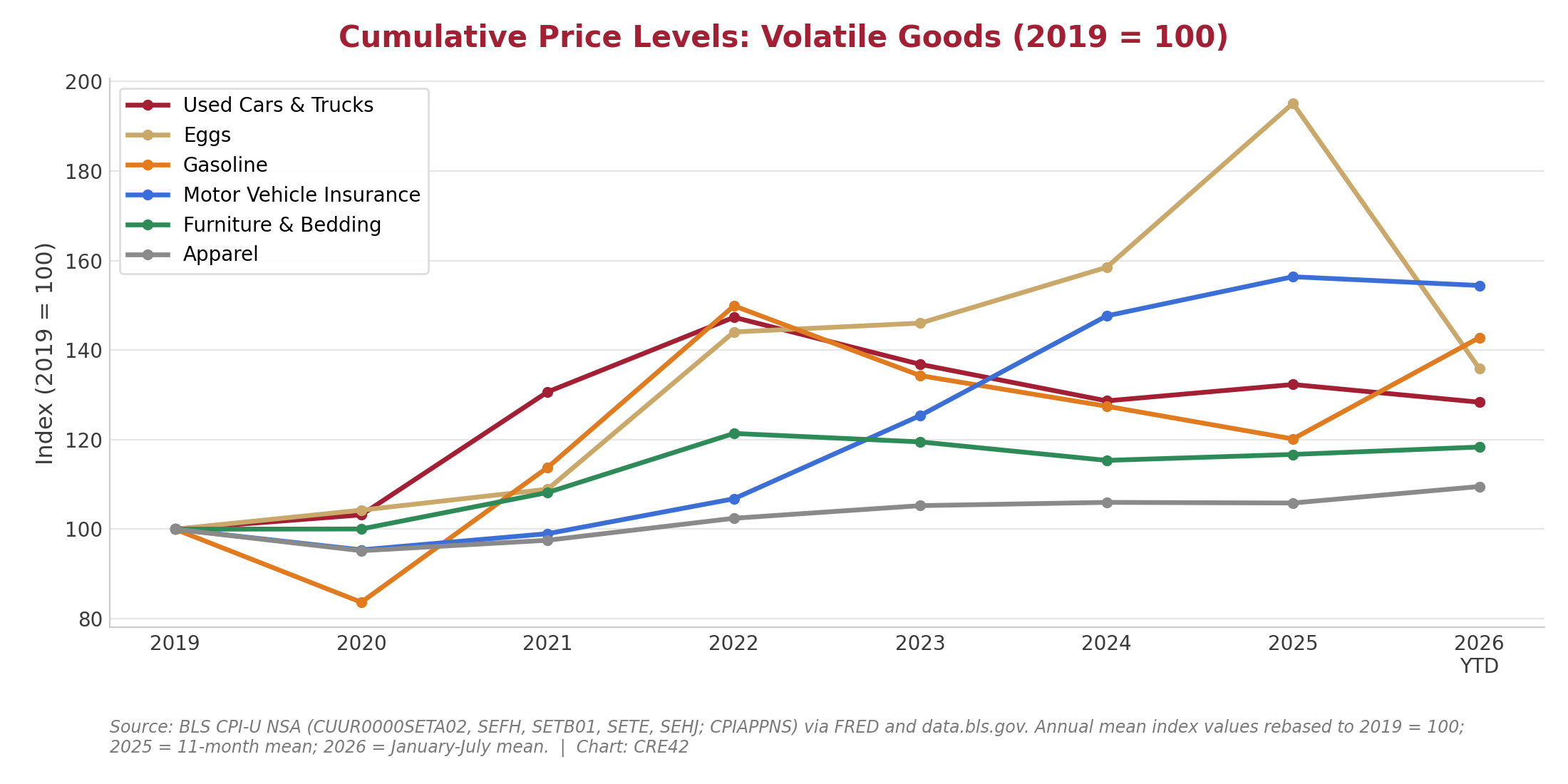
Cumulative Price Levels: Volatile Goods (2019 = 100) | Source: BLS CPI-U | Chart: CRE42
Energy
Energy carries only about 6% direct weight in the CPI, but its indirect effects are disproportionate. Petroleum is an input to a wide array of demand-inelastic goods and services, including transportation, fertilizer production, plastics, chemicals, and construction materials. Oil and gas tend to be very inelastic in the short term on both the supply and demand sides (changing production or consumption is difficult in the short term), creating significant price volatility which can last for extended periods of time. However, markets do adjust over time and tend to revert to stable. WTI crude monthly average prices have been within the $40–$80 per barrel range 74% of the time over the last 10 years.[11]
WTI averaged $58 to $65 a barrel from December 2025 through February 2026, then jumped to $91 in March, $100 in April and $102 in May after the outbreak of conflict in the Middle East constrained oil supplies, before easing to $80–$84 by July and August.[11] That three-month spike is what carried headline CPI from 2.4% in February to 4.2% in May; the Federal Reserve's July 2026 Monetary Policy Report attributes the first-half rise to the energy supply shock first, with earlier tariff increases and AI-related demand for high-tech goods as secondary factors.[12] For commercial real estate the pass-through runs two ways: directly into building operating expenses (electricity +4.2% and natural gas +4.3% year-over-year in July 2026), and into construction materials, where energy-intensive inputs such as asphalt, cement, steel and resins are behind much of the 10.5% materials increase noted above.[1]
Services Inflation and the Labor Connection
The persistence of services inflation connects directly to labor market dynamics; and those dynamics connect to the demographic trends covered in the U.S. Demographics section of this site.
Wage Growth by Sector
| Sector | AHE* 2019 | AHE* 2025 | AHE* 2026 (Jan–Jul) | Change 2019–2025 |
|---|---|---|---|---|
| Food Services & Drinking Places | $15.12 | $21.25 | $21.88 | +40.5% |
| Leisure & Hospitality | $16.56 | $22.84 | $23.51 | +37.9% |
| Retail Trade | $19.67 | $25.46 | $26.20 | +29.5% |
| Construction | $30.76 | $39.70 | $41.03 | +29.1% |
| Health Care & Social Assistance | $27.84 | $35.78 | $36.49 | +28.5% |
| Total Private (reference) | $28.00 | $36.44 | $37.42 | +30.2% |
* AHE: Average Hourly Earnings, a BLS measure of gross hourly pay (including overtime and shift premiums, excluding benefits and bonuses) from the Current Employment Statistics establishment survey. All employees, seasonally adjusted, annual means; 2026 is the January–July mean.[13]
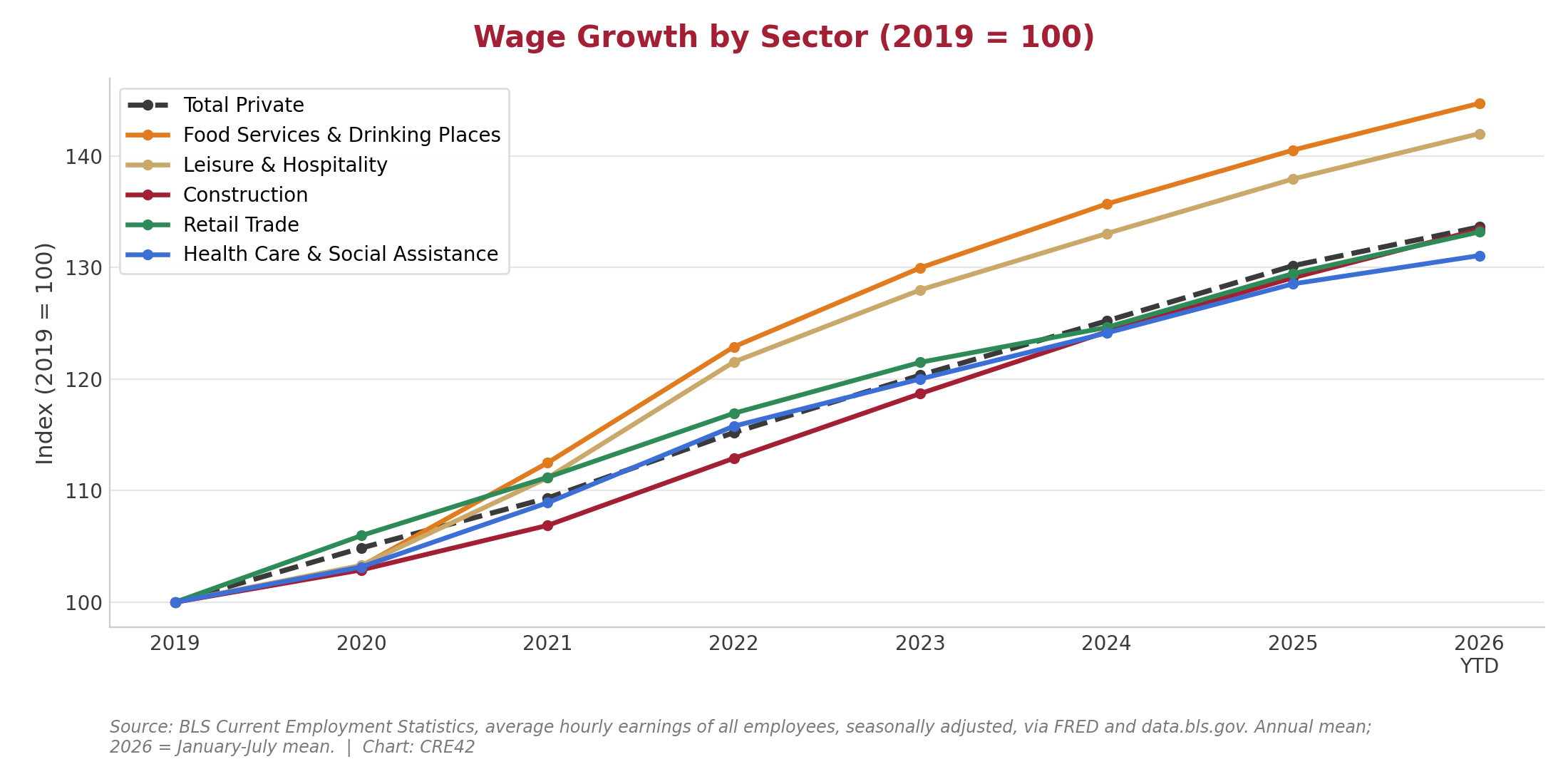
Wage Growth by Sector (2019 = 100) | Source: BLS CES | Chart: CRE42
The sectors with the largest post-2019 wage acceleration (food services, leisure & hospitality) share common characteristics: high physical-presence requirements, historically heavy reliance on younger and immigrant workers, and limited near-term automation potential. Construction and health care have tracked the private-sector average in percentage terms, but from a higher base in construction's case, and both remain short of workers.
Between December 1997 and July 2021, wage growth in leisure and hospitality occupations was almost always below the all-occupations benchmark. Post-pandemic, it flipped to consistently above average, and has not reverted.[14]
Blue Collar vs. White Collar
An emerging pattern complicates the picture. While physical-service and trades labor remains scarce, young college graduates face their most difficult job market in years. The Federal Reserve Bank of New York reported that the unemployment rate for recent college graduates (ages 22–27) reached 5.8% in Q1 2025, the highest since 2021, with an underemployment rate above 40%.[15] The Cleveland Fed (Nov 2025) documented that the unemployment gap between young high school and college workers has narrowed to near its all-time low: a reversal of a decades-long pattern in which college graduates consistently had lower unemployment.[16]
Researchers point to three potential factors: general economic uncertainty (including tariff-driven hiring freezes), the automation of entry-level white-collar tasks by generative AI, and a reaction to post-pandemic over-hiring (similar to the bounce-back goods prices described above). The actual AI effect on the labor market is currently a debated topic, one which is examined further in the Technology & AI section.
What to Watch For in 2026 and Beyond
Sources to Track Inflation by Category in 2026:
| Source | Report or Series | Frequency | Notes |
|---|---|---|---|
| U.S. Bureau of Labor Statistics | Producer Price Index: new building construction (WPU801 family) and construction materials (WPUSI012011) | Monthly; building indices step in Jan/Apr/Jul/Oct | The October 2026 survey month will show whether the energy pass-through into materials is still running; materials were +10.5% YoY in July 2026 |
| U.S. Bureau of Labor Statistics | Consumer Price Index release, shelter, OER and energy components | Monthly, about the second week for the prior month | Shelter at 3.2% is now below headline; watch whether it keeps decelerating toward the 2–3% range private rent indices imply, and whether energy fades as the March–May 2026 base effects roll off in spring 2027 |
| U.S. Bureau of Labor Statistics | Current Employment Statistics, average hourly earnings by sector | Monthly, first Friday | Construction and food-services wage growth against total private; a narrowing gap would signal easing labor scarcity in the trades |
| FRED (St. Louis Fed) | WTI crude oil, monthly average (MCOILWTICO) | Monthly | Back inside the $40–$80 band at $80–$84 in July and August 2026 after the March–May spike; a return above $90 would reopen the energy channel |
| Federal Reserve Board | Monetary Policy Report and FOMC statements | Semiannual; eight meetings per year | The Fed's own attribution of inflation across energy, tariffs and demand, and whether the July 2026 dissents in favor of a hike gain support |
Notes
[1] BLS, Consumer Price Index, July 2026 release (August 12, 2026). 12-month percent changes, not seasonally adjusted: all items 3.4%, all items less food and energy 2.5%, energy 14.7%, gasoline 24.6%, commodities less food and energy commodities 0.8%, shelter 3.2%, services less energy services 3.0%, electricity 4.2%, natural gas 4.3%. ↩
[2] BLS PPI via FRED: New Nonresidential Building Construction (WPU801), New Industrial Building Construction (WPU801104), New Office Building Construction (WPU801103), New Warehouse Building Construction (WPU801101), Construction Materials (WPUSI012011); BLS CPI-U (CPIAUCNS); BLS CES average hourly earnings, construction (CES2000000003). Annual means of the monthly index, 2019 and 2025 (2025 is an 11-month mean; October 2025 was not published); July 2026 is the monthly value. The building PPIs are surveyed quarterly and step in January, April, July and October. ↩
[3] Associated Builders and Contractors (ABC), 2025 construction workforce shortage estimates. Wage levels: BLS CES2000000003, annual means. ↩
[4] LendingTree analysis of BLS Occupational Employment and Wage Statistics (OEWS) data, published July 2025. ↩
[5] BLS CPI-U via FRED, not seasonally adjusted: All Services (CUUR0000SAS) and Services less Rent of Shelter (CUUR0000SASL2RS), annual mean index values, 2000 vs. 2025. Weights: BLS, Relative importance of components in the Consumer Price Indexes, U.S. city average, December 2025 (services less energy services 60.7%, shelter 35.6%, owners' equivalent rent 26.2%, energy 6.4%). ↩
[6] BLS CPI-U, not seasonally adjusted, December-over-December and July 2026 over July 2025: CUUR0000SEMD (hospital and related services), SEFV (food away from home), SETE (motor vehicle insurance), SETD (motor vehicle maintenance and repair), SERF (other recreation services), SAH1 (shelter), SEHC (owners' equivalent rent), SEHA (rent of primary residence), SA0L2 (all items less shelter). Hospital services 2025: BLS, Consumer Price Index: 2025 in Review, The Economics Daily (January 2026), the largest annual increase since 2010. ↩
[7] BLS, Measuring Price Change in the CPI: Rent and Rental Equivalence (factsheet). OER is derived from a survey question asking homeowners what they believe their home would rent for, then reweighted using Consumer Expenditure Survey data. Weights per note 5. ↩
[8] Zelman & Associates, “Housing CPI Versus Reality,” March 2026 (the 53-month count is as of February 2026). Brookings Institution, “How Does the Consumer Price Index Account for the Cost of Housing?” January 2024. Federal Reserve Bank of Richmond, Macro Minute on the OER lag, April 2023. ↩
[9] CRE Daily, “Multifamily Rents Disputed in CPI Reports,” February 2026, summarizing Walker/Linneman webinar discussion. ↩
[10] BLS CPI-U via FRED, not seasonally adjusted: Commodities less food and energy commodities (CUUR0000SACL1E), annual mean 144.9 (2000) to 166.3 (2025), +14.8%; July 2026 over July 2025, +0.8%. Table series: CUUR0000SETA02 (used cars and trucks), SEFH (eggs), SETB01 (gasoline, all types), SEHJ (furniture and bedding), CPIAPPNS (apparel). ↩
[11] U.S. Energy Information Administration via FRED (MCOILWTICO), monthly average WTI crude oil spot price. September 2016 through August 2026: 89 of 120 months (74%) fell within the $40–$80/bbl range. Monthly averages 2026: $60.04 (Jan), $64.51 (Feb), $91.38 (Mar), $100.32 (Apr), $102.13 (May), $84.81 (Jun), $80.46 (Jul), $83.90 (Aug). ↩
[12] Federal Reserve Board, Monetary Policy Report, July 2026, summary; FOMC statement, July 29, 2026 (target range maintained at 3.50–3.75%, three dissents in favor of a 25 bp increase). Headline CPI path per BLS CPI-U (CPIAUCNS): 2.4% February 2026, 4.2% May 2026. ↩
[13] BLS Current Employment Statistics, average hourly earnings of all employees, seasonally adjusted: CES0500000003 (total private), CES2000000003 (construction), CES7000000003 (leisure and hospitality), CES6562000003 (health care and social assistance), CES4200000003 (retail trade), CES7072200003 (food services and drinking places). Annual means; 2026 is the January–July mean. ↩
[14] FRED Blog, “Above-Average Wage Growth in the Leisure and Hospitality Industry,” September 2023. Underlying data from the Atlanta Fed Wage Growth Tracker. ↩
[15] Federal Reserve Bank of New York, Labor Market for Recent College Graduates, Q1 2025 data. Year-end 2025 underemployment rate: 42.5%. ↩
[16] Cline, Alexander, and Baris Kaymak. “Are Young College Graduates Losing Their Edge in the Job Market?” Federal Reserve Bank of Cleveland, Economic Commentary 2025-14 (November 2025). ↩
Sources
1. U.S. Bureau of Labor Statistics. Consumer Price Index (CPI-U), including the July 2026 release and the December 2025 relative importance table. bls.gov/cpi
2. U.S. Bureau of Labor Statistics. Producer Price Index (PPI). bls.gov/ppi
3. U.S. Bureau of Labor Statistics. Current Employment Statistics (CES). bls.gov/ces
4. Federal Reserve Bank of St. Louis (FRED). CPI, PPI, AHE and WTI crude oil series. fred.stlouisfed.org
5. U.S. Energy Information Administration. WTI crude oil spot price, monthly average (via FRED, MCOILWTICO).
6. Federal Reserve Board. Monetary Policy Report, July 2026; FOMC statement, July 29, 2026. federalreserve.gov
7. Federal Reserve Bank of New York. Labor Market for Recent College Graduates. newyorkfed.org
8. Federal Reserve Bank of Cleveland. Economic Commentary 2025-14 (November 2025).
9. Brookings Institution. “How Does the CPI Account for Housing?” January 2024.
10. Federal Reserve Bank of Richmond. Macro Minute on the OER lag, April 2023.
11. Zelman & Associates. “Housing CPI Versus Reality,” March 2026.
12. CRE Daily. “Multifamily Rents Disputed in CPI Reports,” February 2026.
13. Associated Builders and Contractors (ABC). 2025 construction workforce estimates.
14. LendingTree. Analysis of BLS OEWS data on construction wage growth, July 2025.
15. CRE42 companion workbook. inflation-by-category.xlsx: CPI component, services and goods breakdowns, construction costs and wage growth by sector, 2000 to July 2026; rebuilt September 2026.