
U.S. Office Supply Cycle: 2000–2026
▸ THE STATISTICS BELOW ARE BASED ON COSTAR AND MAY DIFFER SIGNIFICANTLY FROM METRICS PUBLISHED IN BROKERAGE FIRM REPORTS
U.S. Office Net Delivered SF (2000–2026)
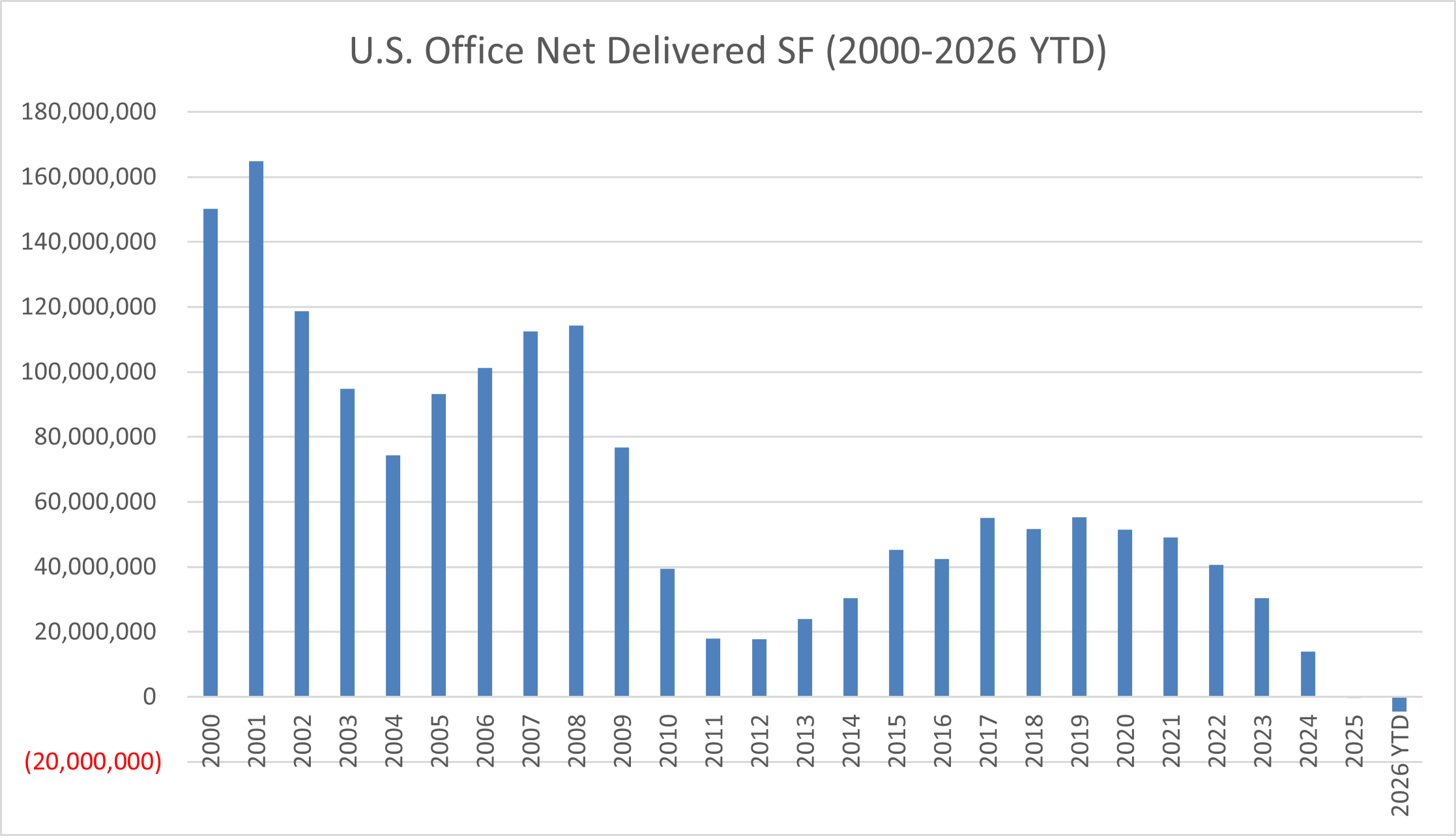
Source: CoStar, Q2 2026; 2026 annualized from first-half figures.
U.S. Office Deliveries, Absorption & Vacancy (2000–2026)
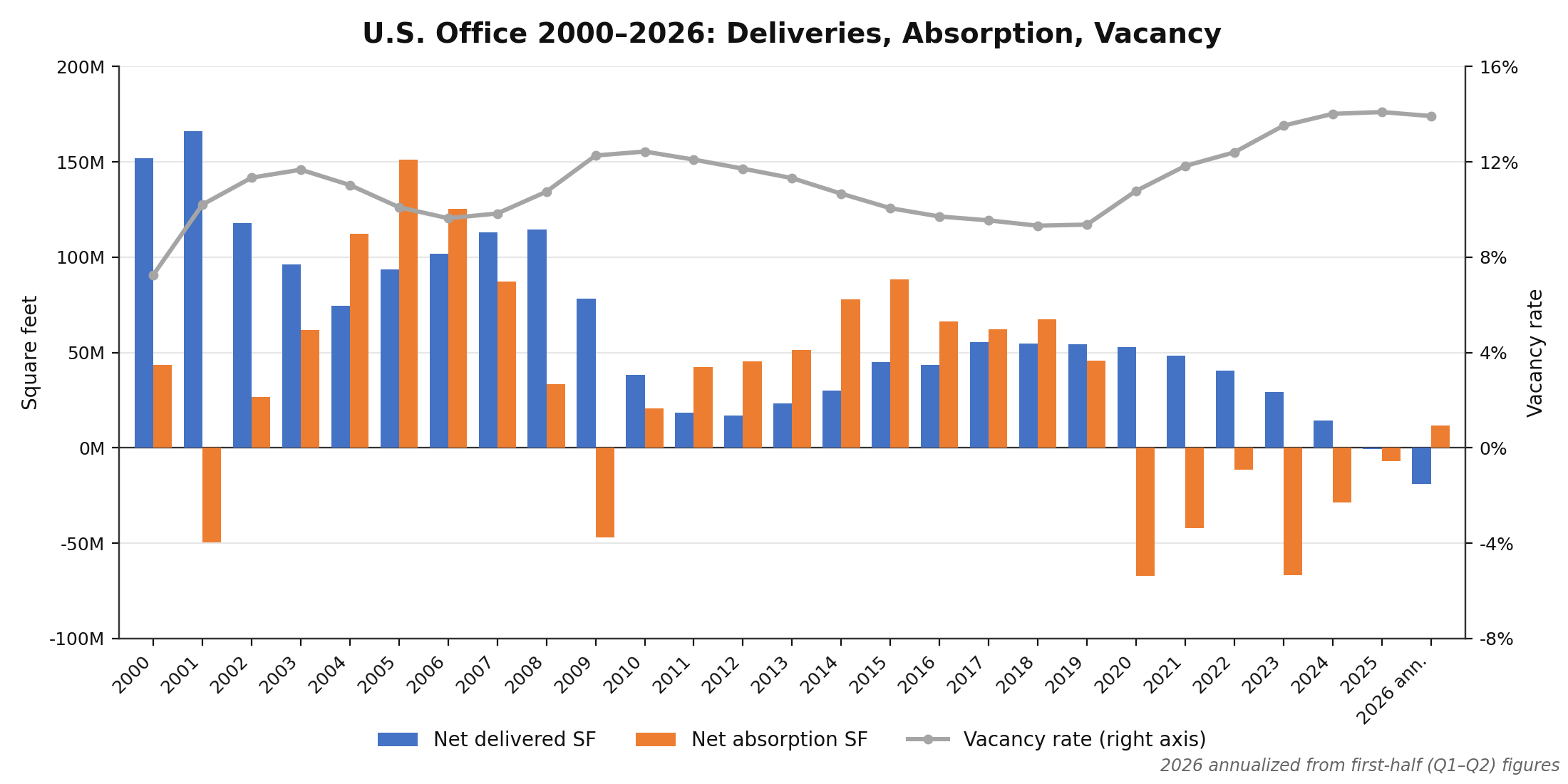
Source: CoStar, Q2 2026; 2026 deliveries and absorption annualized from first-half figures, vacancy as of Q2 2026.
U.S. Office Vacancy vs. Market Asking Rent (2000–2026)
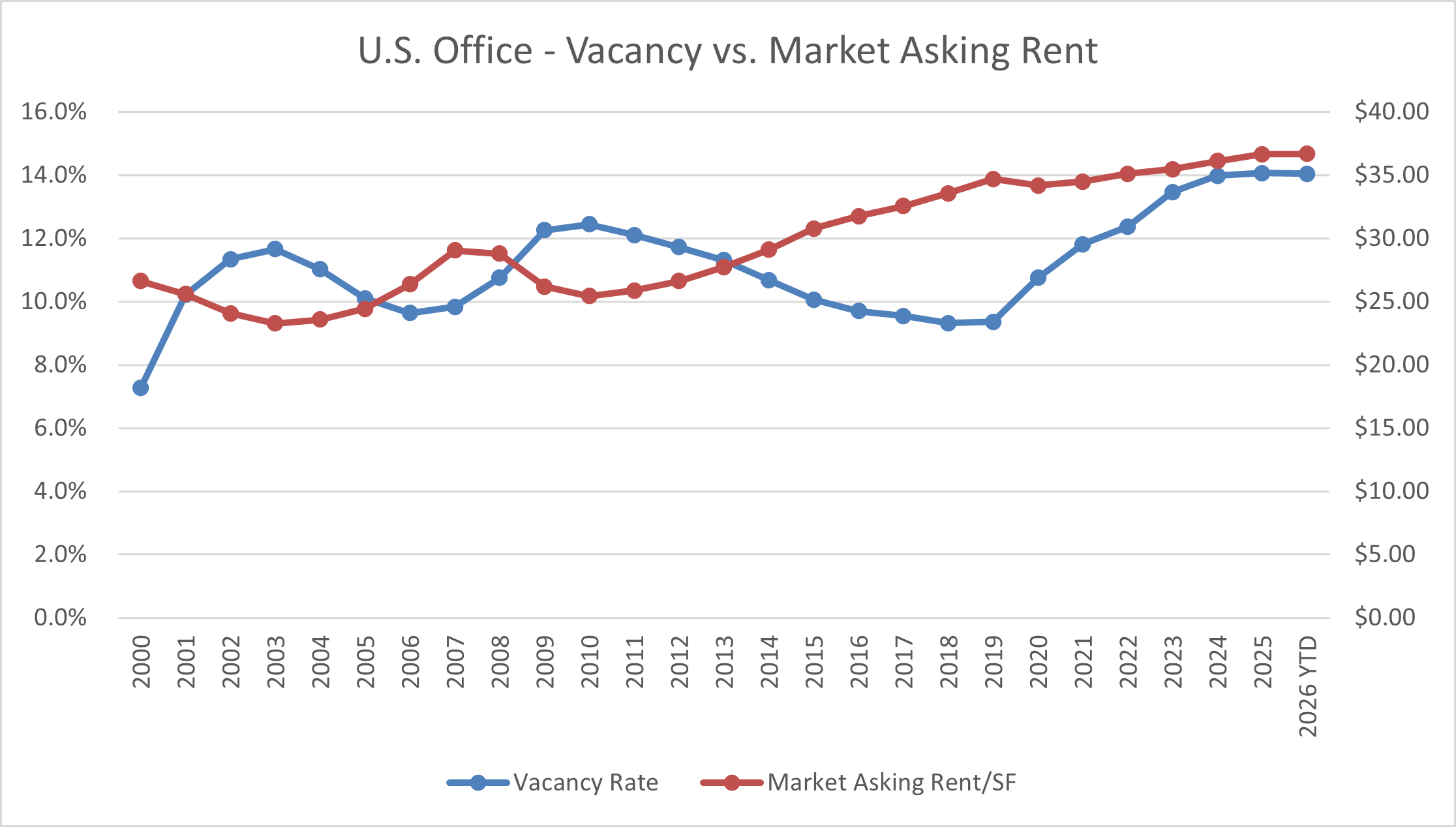
Source: CoStar, Q2 2026; the 2026 point is the Q2 2026 reading.
U.S. Office Deliveries vs. Construction Starts (Prior 2-Year Average)
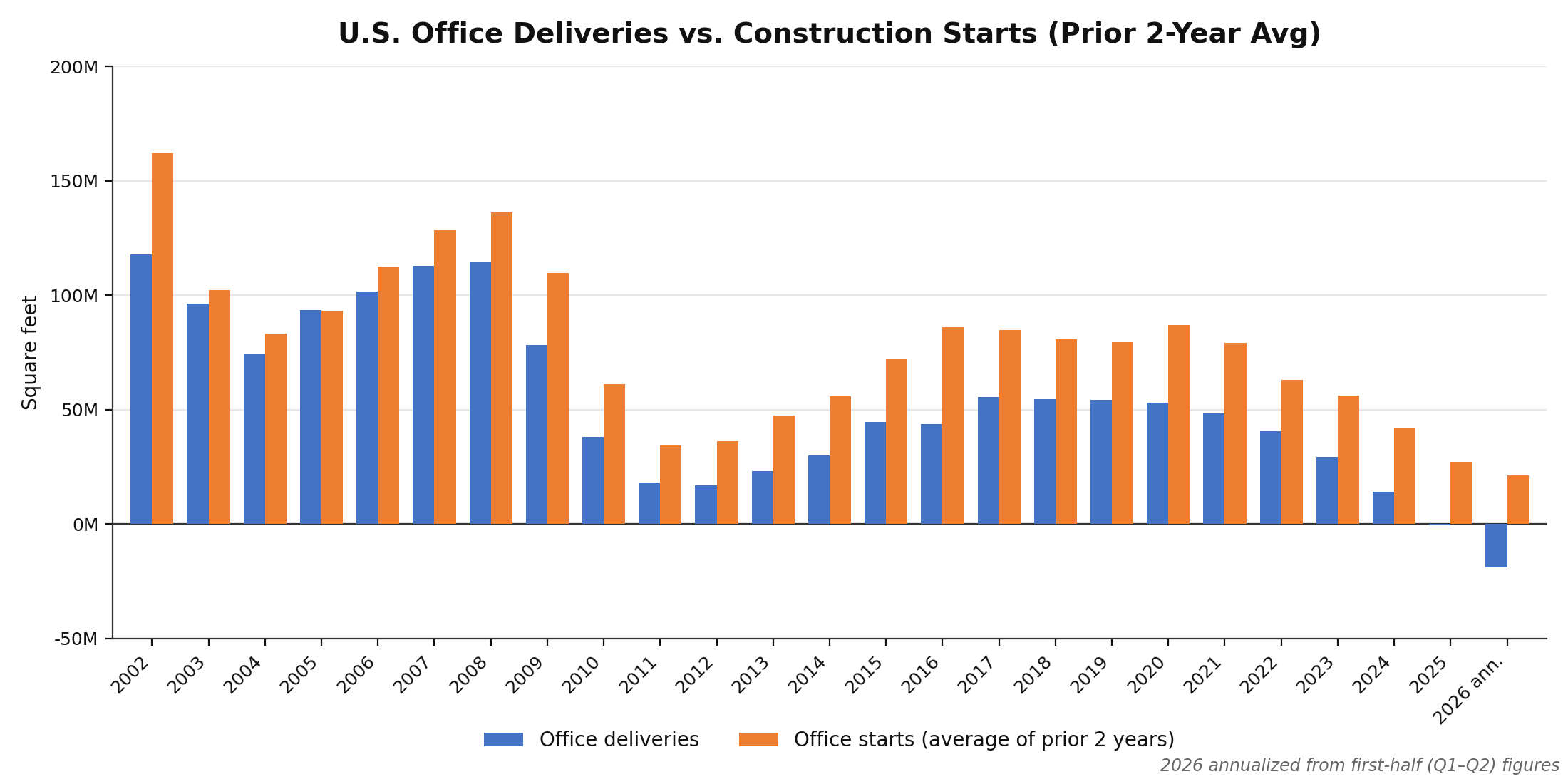
Source: CoStar, Q2 2026; 2026 annualized from first-half figures. Correlation between annual deliveries and prior 2-year average starts (2002–2025) ≈ 0.95.
Key Observations
Context & Discussion
Quantifying the Demand Reduction from Covid-19, WFH and Hybrid Work
Net absorption turned sharply negative in 2020 (negative 67 million SF) and stayed negative in every year through 2025.[1] The cumulative loss of approximately 223 million SF of occupied office space from 2020 through 2025 is without precedent in the modern dataset. For context, the dot-com bust produced only one year of negative absorption (2001: negative 50 million SF), and absorption recovered within two years. The first half of 2026 posted positive net absorption of 5.8 million SF, the first positive reading since 2019; one half-year does not make a recovery, but the trajectory (losses of 29 million SF in 2024 and 7 million SF in 2025, then a gain) is consistent with a market that has found its floor. The availability rate, which includes both vacant and soon-to-be-vacant space, peaked at 16.3% at the end of 2023 and has since fallen to 15.3% as of Q2 2026, indicating that the pipeline of pending occupancy losses is shrinking rather than growing.[1]
Flight to Quality
Market asking rents have risen 39% from $26.53/SF in 2000 to $36.91/SF in 2025, despite vacancy nearly doubling over the same period.[1] This counterintuitive outcome reflects a structural shift in the composition of occupied office space. Tenants are consolidating footprints and migrating to Class A and trophy buildings with modern amenities, while older Class B and C buildings experience disproportionate vacancy. As lower-quality space empties and higher-quality space commands premium rents, the average asking rent across the remaining leased inventory rises even in a weakening demand environment.
Supply-Side Response: Near-Zero Starts and Inventory Contraction
The supply side has responded to the demand crisis with a near-complete shutdown of new office construction. Construction starts fell from 94 million SF in 2019 to 22 million SF in 2025, and 10.5 million SF in the first half of 2026 (annualized: roughly 21 million SF). Starts have tracked deliveries closely through the cycle: the correlation between annual deliveries and the prior two-year average of starts is 0.95 (2002–2025), so the near-zero starts of 2024–2026 point to negligible completions through at least 2028.[1] Space under construction has dropped from 157 million SF in 2019 (1.9% of inventory) to 49 million SF (0.6%) as of Q2 2026. Net deliveries turned negative in 2025 for the first time in the dataset, meaning the total U.S. office inventory is now shrinking as demolitions and office-to-residential conversions outpace the small volume of remaining completions.
What to Watch in the Second Half of 2026
Whether the first-half absorption gain holds is the most consequential near-term variable. Several major employers (Amazon, JPMorgan Chase, Goldman Sachs) mandated five-day in-office return policies in late 2024 and early 2025, and additional firms have followed. The first half of 2026 delivered the first positive net absorption since 2019; the question for the second half is whether that reflects durable demand from these mandates and a stabilizing tenant base, or a pause between rounds of lease-expiration downsizing. A full year of positive absorption, combined with a shrinking inventory, would mark the end of the post-pandemic contraction.
Office-to-residential conversion activity continues to accelerate as municipalities expand incentive programs. Cities including New York, Chicago, Washington D.C., and Calgary have introduced tax abatements, zoning flexibility, and direct subsidies for office-to-residential conversion projects. While total conversion volumes remain small relative to the inventory of functionally obsolete office space, these programs provide a market-clearing mechanism that permanently removes surplus supply and supports long-term vacancy normalization.
Sources to Track U.S. Office Supply in 2026:
| Source | Report / Series | Frequency | Notes |
|---|---|---|---|
| CoStar | Quarterly national and MSA-level update | Quarterly | Most granular source for deliveries, starts, absorption, vacancy, and availability by submarket |
| CBRE | U.S. Office Figures | Quarterly | National summary with metro-level detail; tracks net absorption, vacancy, rent growth, and investment volume |
| JLL | U.S. Office Outlook | Quarterly | Tracks availability, leasing velocity, and sublease trends; good for flight-to-quality analysis |
| U.S. Census Bureau | Construction Spending: Office | Monthly | Dollar-denominated construction put in place; captures spending trajectory even when unit starts data is limited |
Notes
[1] CoStar. U.S. Office National Historical Data (Q2 2026, exported August 26, 2026). costar.com. Quarterly data for inventory, net delivered SF, construction starts, net absorption, vacancy rate, availability rate, asking rent/SF, rent growth, and under-construction SF for the U.S. office market, Q1 2000 through Q2 2026, rolled up to calendar years by CRE42. Figures for 2026 are the first half (Q1–Q2) unless marked annualized. ↩
Companion workbook. office-national-supply-cycle.xlsx: quarterly CoStar data (Q1 2000–Q2 2026), the calendar-year roll-up with the 2026 first-half and annualized rows, the deliveries-vs-starts correlation, and native charts. CoStar, Q2 2026.
Methodology & Data Notes
Data Source & Period
All national office data sourced from CoStar’s U.S. Office National Historical dataset, exported August 26, 2026, with the series cut at Q2 2026 (June 30, 2026); CoStar’s partial-quarter and forecast rows are not used. CoStar reports quarterly; CRE42 rolls the quarters up to calendar years, taking year-end readings for inventory, vacancy, availability, rent, and under-construction figures and four-quarter sums for deliveries, starts, and absorption. The 2026 first-half figures quoted in the text are the first two quarters of 2026; the charts plot 2026 as an annualized point (first-half deliveries, starts, and absorption doubled, with vacancy, availability, rent, and pipeline as of Q2 2026), and the workbook carries both rows. CoStar’s office series begins in Q1 2000, so 2000 is a full year and the charts start there. “Net Delivered SF” subtracts demolished and converted square footage from gross deliveries. “Construction Starts” represents the square footage of office projects that broke ground in each calendar year. “Net Absorption” represents the change in occupied square footage over the period.
Starts-to-Deliveries Correlation
The correlation of approximately 0.95 is calculated between annual net delivered SF and the simple average of construction starts from the two preceding calendar years (e.g., 2025 deliveries correlated with the average of 2023 and 2024 starts), for the full calendar years 2002 through 2025. The two-year lag reflects the typical construction timeline for office projects. Data begins in 2002 (earliest year with two prior years of starts data); the 2026 bar (annualized from the first half) is shown for continuity but excluded from the correlation.
Vacancy Rate vs. Availability Rate
Vacancy rate represents the percentage of total inventory that is physically vacant at period end. Availability rate is a broader measure that includes vacant space plus occupied space that has been listed for sublease or will become available at lease expiration. Availability rate data begins in 2005 in the CoStar dataset. The gap between availability and vacancy (approximately 140 bps at Q2 2026, 15.3% against 13.9%, down from roughly 280 bps at the end of 2023) reflects the volume of “shadow” supply that will flow into direct vacancy as leases expire; its narrowing is one of the clearer signs that the contraction is running its course.
Rent Growth & Flight to Quality
Market asking rent represents the CoStar-weighted average asking rent per SF across the full office inventory. Because the metric is calculated across all tracked space, compositional shifts—specifically, the outperformance of Class A rents and the exit of lower-quality space from the leased inventory—can drive the average upward even in periods of aggregate demand decline. Rent growth data begins in 2001.