
U.S. Office Regional Divergence: Elevated Vacancy, Minimal New Supply
▸ THE STATISTICS BELOW ARE BASED ON COSTAR AND MAY DIFFER SIGNIFICANTLY FROM METRICS PUBLISHED IN BROKERAGE FIRM REPORTS
This analysis covers all 37 U.S. metropolitan areas with office inventory exceeding 100 million SF each. MSAs located in the Northeast region (see list of MSAs: office-regional-divergence.xlsx, Market Detail tab) accounted for 35% (11.3 million of 32.3 million SF) of gross office space delivered in the trailing twelve months through June 2026 (Q2 2026), with the South close behind at 34% (11.0 million SF). Net of demolitions and conversions, the 37 markets together lost 4.4 million SF of office inventory over the same period.[1] The South’s inventory-weighted vacancy rate now stands at 15.5%, compared to 12.8% in the Northeast, 12.6% in the Midwest, and 15.9% in the West. Total vacancy among this data set is 14.4%, more than double the 6–7% level generally considered “equilibrium” for office product.[1]
Multifamily and industrial divergence stories (multifamily regional divergence, industrial regional divergence) have been driven by a supply wave in growth markets, primarily in the South. In office, vacancy remains elevated in every region, driven by remote and hybrid work adoption.
However, only 2 of 37 major markets experienced (small) negative rent growth in the last 12 months. With effectively zero new supply entering the market (under-construction SF represents just 0.6% of inventory across these markets), continued removal of older obsolete product from the supply base, and net absorption now positive in three of the four regions, the office market appears to be stabilizing in the current cycle.[1]
Office Market Explorer: All 394 CoStar Metros (Q2 2026)
Narrow the table by inventory size and Census region, sort on any column, and tick one market or several to chart their deliveries, absorption, vacancy, and construction pipeline since 2016, combined or side by side. The table opens on all 394 metros, largest first, with the three largest charted; the regional charts and commentary below cover the 37 markets with 100M+ SF of inventory. Net delivered SF is negative wherever demolitions and conversions exceeded completions, which is now the case in many office markets.[3]
Office Gross Deliveries by Census Region: Trailing 12 Months (Q2 2026)
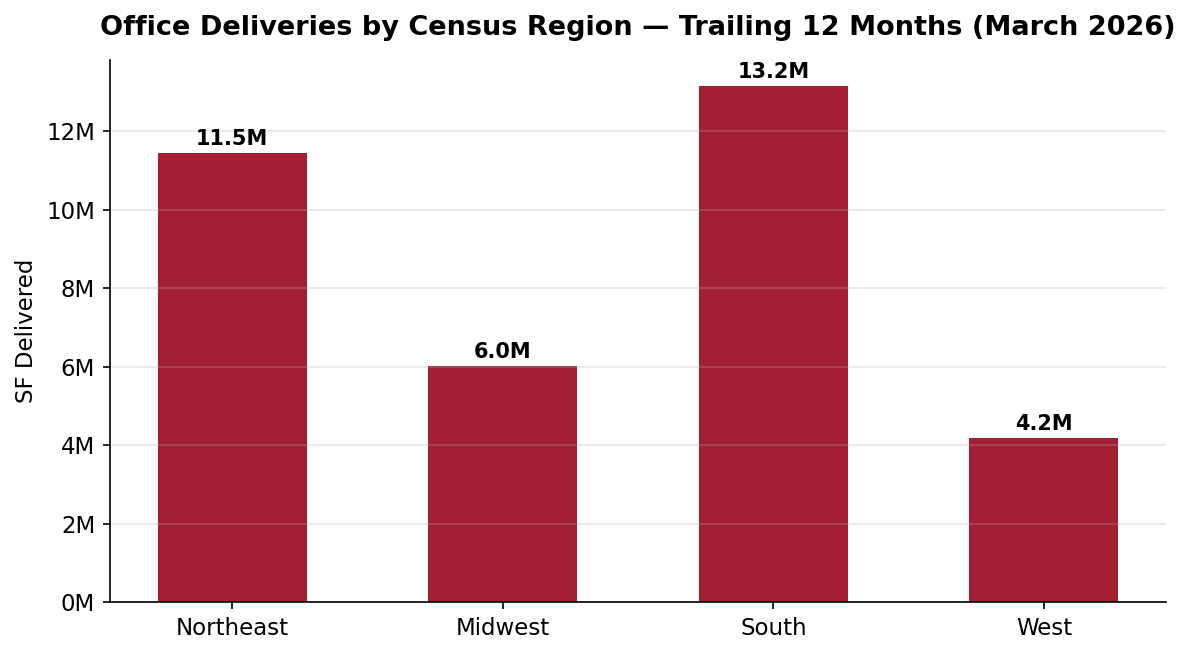
Source: CoStar, Q2 2026. Gross deliveries (completions) across 37 MSAs with 100M+ SF office inventory, grouped by Census region. Net of demolitions and conversions, the 37 markets lost 4.4 million SF.
Office Vacancy Rate by Census Region: Inventory-Weighted (Q2 2026)
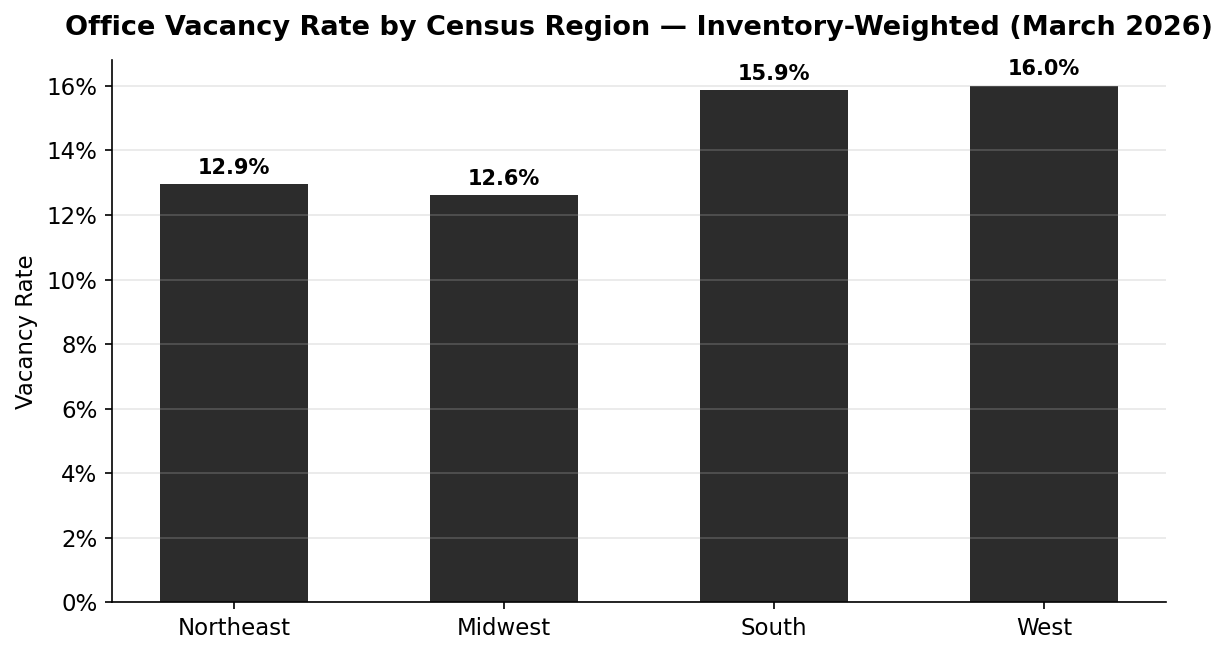
Source: CoStar, Q2 2026. Weighted by inventory SF across 37 MSAs with 100M+ SF office inventory.
Key Observations
Office Availability Change, 15 Largest Markets: Year to Q2 2025 vs. Year to Q2 2026
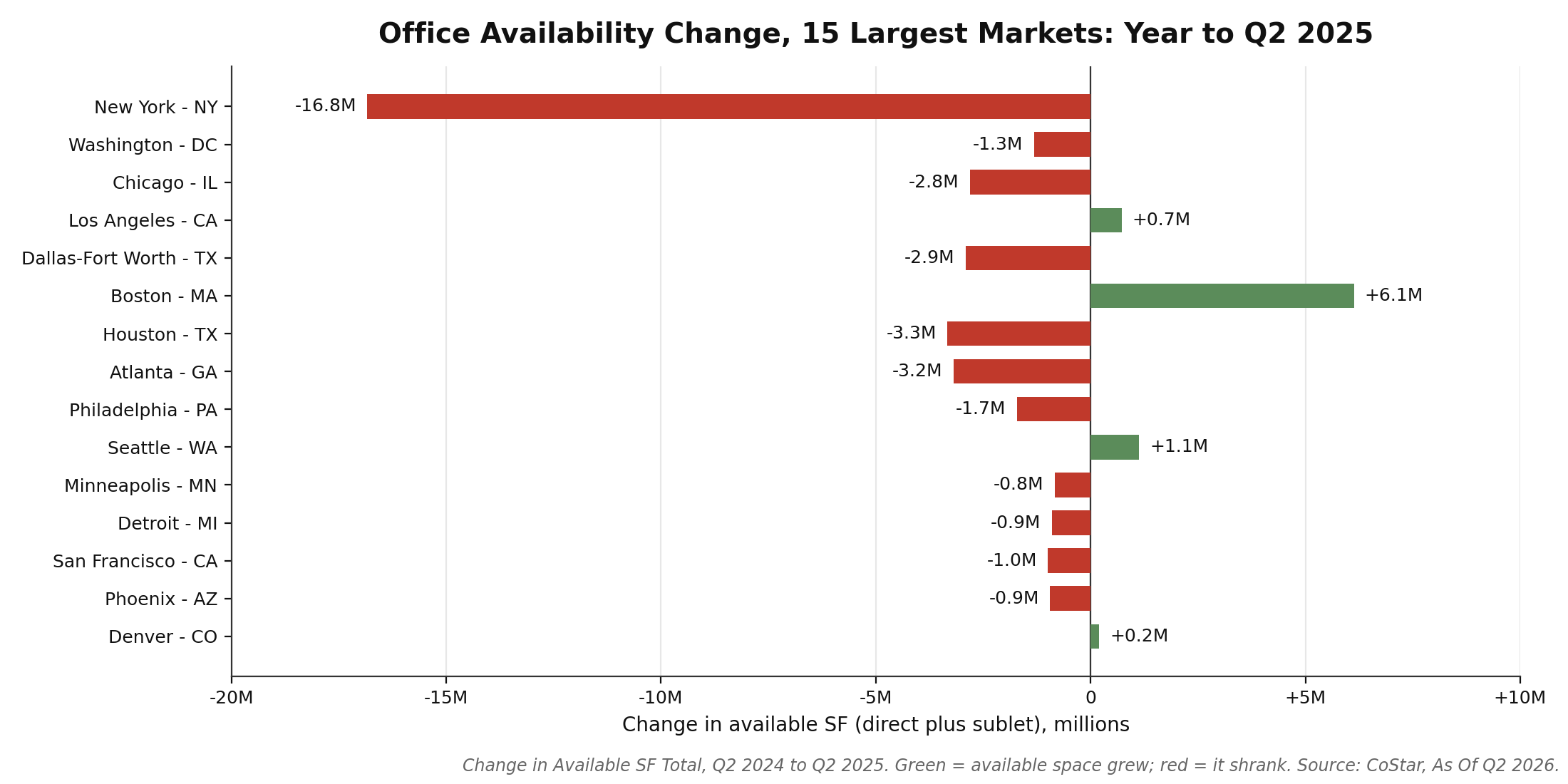
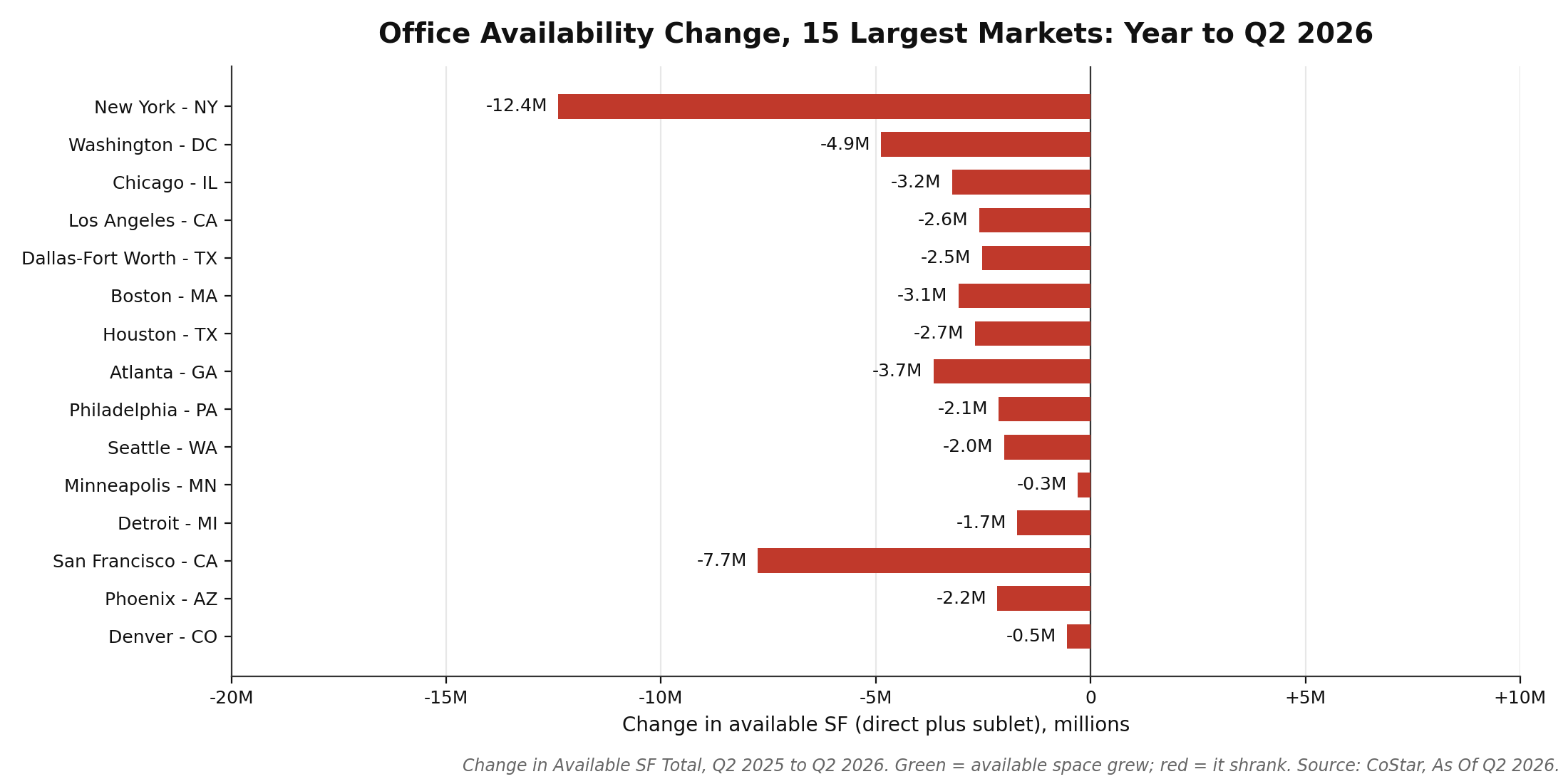
Source: CoStar, Q2 2026. Year-over-year change in available SF (direct plus sublet) for the 15 largest office markets; see the Availability Change tab of the companion workbook.
Office rents and vacancy statistics move more slowly than other asset types due to longer lease periods driven by high transaction costs (tenant improvement allowance, leasing commissions, logistical moving challenges). But after six years of contraction, the national office market finally appears to be finding its footing, as shown in the charts above. In the year to Q2 2025, four of the 15 largest markets (Boston, Seattle, Los Angeles, and Denver) still posted growing availability (green bars). In the year to Q2 2026, every one of the 15 shrank, and available space across all 37 markets fell by 72 million SF, versus 41 million SF the year before. The improvement is broadest in the coastal “gateway” markets that endured the most severe demand shocks following the COVID-19 pandemic: New York’s available space fell 12.4 million SF over the year and San Francisco’s 7.7 million SF, taking San Francisco’s availability rate from 25.8% to 21.8%. San Francisco is notable because it shares the unusual dual distinction of leading the major markets in both current vacancy (20.9%) and availability (21.8%) as well as annual rent growth (+6.2%) (see office-regional-divergence.xlsx, Market Detail tab).[1]
U.S. Office Occupancy Recovery: Kastle 10-City Weekly Average
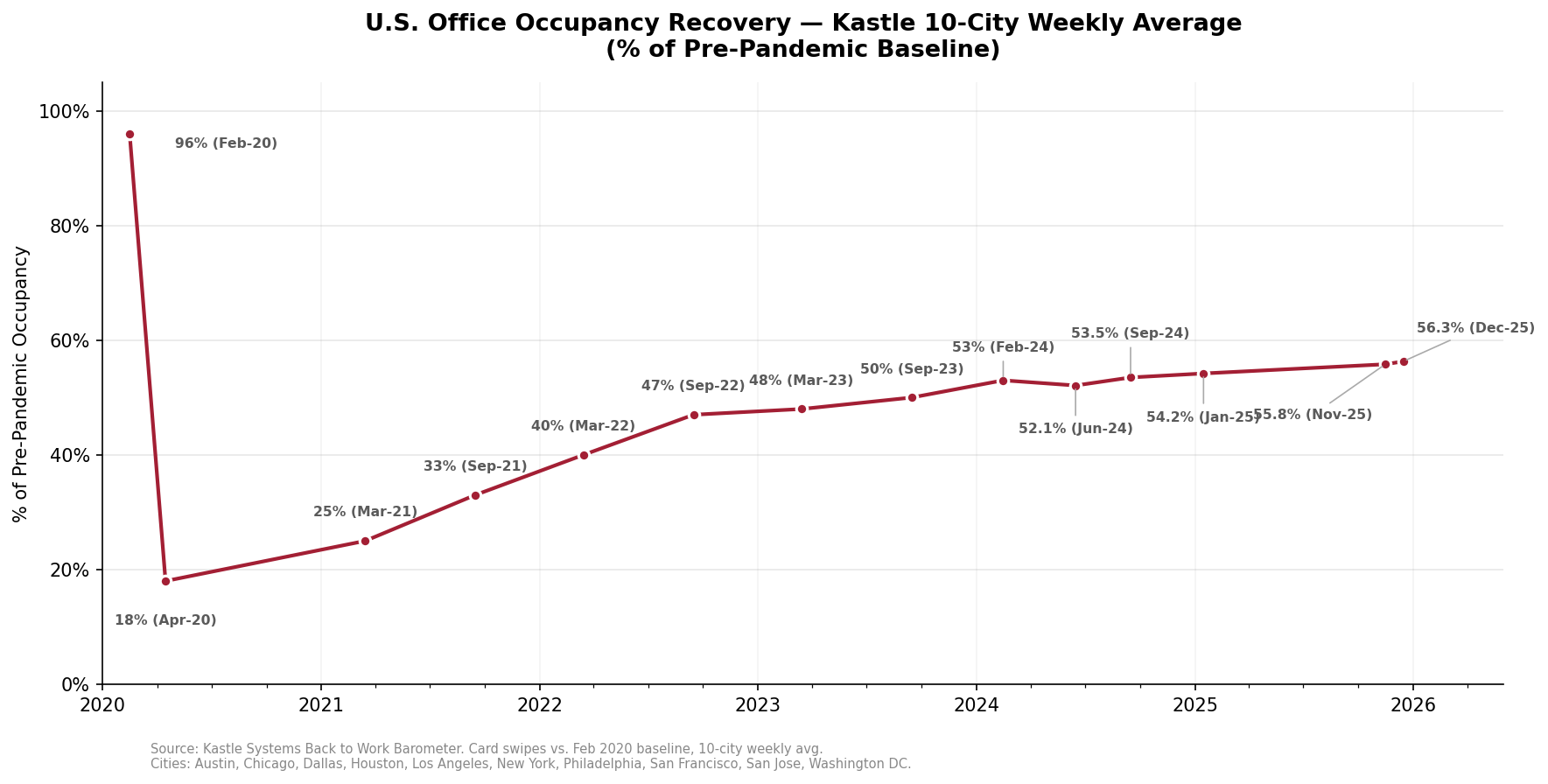
Source: Kastle Systems Back to Work Barometer. Card swipes vs. Feb 2020 baseline, 10-city weekly average; selected weeks through August 5, 2026.
Kastle Occupancy Data
The Kastle Back to Work Barometer tracks daily access card swipes across approximately 2,600 office buildings in 10 major U.S. metros. The resulting percentages represent daily office attendance as a percentage of a pre-pandemic February 2020 baseline (not the percentage of current employees).[2] It is important to note that this measure uses a five day baseline and likely understates the effective occupancy in a three-day hybrid environment. The 10-city weekly average often hovers around 55%, but mid-week peaks (Tuesday through Thursday) are typically running closer to 65% and Mondays and (especially) Fridays have become low-attendance days for the majority of companies and markets.
Kastle occupancy has climbed from a trough of 18% in April 2020 to a post-pandemic high of 56.3% in December 2025. The most recent reading, 54.4% for the week of July 30 to August 5, 2026 (with a peak day of 64.4%), is a seasonal summer figure and sits above the same week a year earlier: weekly occupancy continues to improve year over year, but it appears to be stabilizing at a level well below the pre-pandemic baseline, having added roughly 6 percentage points over the past two years compared to 30+ points in the first two years of recovery. Texas cities consistently lead the 10-city panel, reflecting lower remote-work adoption and employer-friendly regulatory environments, while San Francisco and San Jose lag the average, consistent with their elevated CoStar vacancy rates and concentration of tech-sector tenants who have been the most aggressive adopters of permanent remote work. Among the most striking findings: Class A+ buildings (CoStar 4–5 star, built after 2010) averaged 78.8% weekly occupancy in December 2025 with peak-day readings above 95%, and 74.4% (peak day 91.4%) in the summer 2026 reading, underscoring the widening quality bifurcation between premium and commodity office space.[2]
What to Watch in the Second Half of 2026
The office market recovery trajectory will depend on the pace of obsolete supply removal, the evolution of return-to-office mandates, and the widening quality bifurcation between Class A trophy product and everything else. Several large employers, including Amazon, JPMorgan Chase, and Goldman Sachs, have announced full five-day return-to-office requirements, and others have followed. Net absorption is now positive in three of four regions and available space is shrinking in every one of the 15 largest markets; the question is whether that holds through a second year. At the same time, the conversion pipeline (office-to-residential, office-to-lab, office-to-data center) remains a potential accelerant for supply removal, though regulatory and structural hurdles limit the pace. We will continue to track national supply cycle data, Kastle Systems utilization metrics, conversion activity, and Class A vs. Class B/C rent spreads to monitor recovery signals.
Sources to Track U.S. Office Regional Dynamics in 2026:
| Source | Next Release | Date | Notes |
|---|---|---|---|
| CoStar | Quarterly MSA-level office update | Ongoing (subscription) | Vacancy, rents, deliveries, starts, and absorption for 394 MSAs |
| Kastle Systems | Weekly Back to Work Barometer | Weekly | Office building access card swipe data for 10 major U.S. metros |
| CBRE Research | U.S. Office Figures | Quarterly | National and metro-level office fundamentals, cap rates, and investment activity |
Notes
[1] CoStar. U.S. Office Market Data, All MSAs (as of Q2 2026; quarterly history 2016 Q1 through 2026 Q2, exported August 2026). costar.com. Includes trailing-twelve-month data for all 394 CoStar metros; the regional charts use the 37 MSAs with 100 million+ SF office inventory. Regional aggregations by CRE42 using Census region definitions (Northeast, Midwest, South, West). Vacancy and availability rates are inventory-weighted. Washington, D.C. and Baltimore are classified as South per Census convention. ↩
[2] Kastle Systems. Back to Work Barometer (weekly, ongoing). kastle.com. Tracks aggregate office building access card swipe data across 10 major U.S. metropolitan areas. Readings cited are from Kastle’s published weekly reports through the week of July 30 to August 5, 2026 (report dated August 10, 2026); the series is on the Kastle Occupancy Time Series tab of the companion workbook. ↩
[3] Flow figures on this page (deliveries, net absorption, construction starts) are trailing twelve months to June 30, 2026, unless a chart or table says otherwise; stocks and rates (inventory, vacancy, availability, under construction, asking rent, occupancy, sale price) are the Q2 2026 quarter-end readings. Gross deliveries are completions; net deliveries subtract demolished and converted SF. ↩
Companion workbook. office-regional-divergence.xlsx: regional summary, 37-market detail (vacancy, availability, rents, gross and net deliveries, sale prices), the availability-change series, the Kastle series, all 394 metros at Q2 2026, and the 2016–Q2 2026 annual history behind the market explorer. CoStar, Q2 2026; Kastle, August 2026.
Methodology & Data Notes
Data Source & Regional Classification
Market-level data sourced from CoStar’s U.S. Office dataset as of Q2 2026 (quarter ended June 30, 2026), the same vintage as the national supply cycle page. The dataset includes 394 metros; the regional charts filter to the 37 MSAs with office inventory of 100 million+ SF each (the same 37 as in March 2026), representing approximately 8.1 billion SF of the national total of 8.3 billion SF, while the market explorer carries all 394. Markets were assigned to Census regions (Northeast, Midwest, South, West) by CRE42 based on the primary state of each MSA. Washington, D.C. and Baltimore are classified as South per Census convention.
Weighted Averages
Regional vacancy and availability rates are calculated as inventory-weighted averages: the sum of (rate × inventory SF) for all markets in the region, divided by total regional inventory SF. Regional rents and sale prices are calculated using the same inventory-weighted approach. This methodology ensures that larger markets exert proportionally greater influence on regional averages.
Gross vs. Net Deliveries
The deliveries-by-region chart plots gross deliveries (completions) over the trailing twelve months, as the March 2026 version did. CoStar’s net delivered SF subtracts demolished and converted space; across the 37 markets, 36.8 million SF was removed against 32.3 million SF completed, so net deliveries were –4.4 million SF and negative in every region except the Northeast. The explorer table and chart use net delivered SF. Both series are on the Market Detail and Quarterly Deliveries tabs of the companion workbook.
Availability Change Charts
The two availability charts plot the year-over-year change in CoStar’s Available SF Total (direct plus sublet) for the 15 largest office markets: Q2 2024 to Q2 2025 and Q2 2025 to Q2 2026. They replace the CoStar quarterly-change screenshots used in the March 2026 version; the trailing-year change is used because single-quarter readings are noisy and were restated by CoStar in this export. Green bars mark markets where available space grew, red where it shrank. The inputs for all 37 markets are on the Availability Change tab of the companion workbook.
Market Explorer
Table values are CoStar figures at Q2 2026; “TTM” columns are the trailing twelve months to June 30, 2026. Net delivered SF is gross deliveries less demolitions and conversions. Under construction as a percentage of inventory is under-construction SF divided by inventory SF. The chart plots each calendar year 2016–2025 as the trailing twelve months to Q4 (so deliveries and absorption are full-year flows, and vacancy and the pipeline are year-end readings), plus the trailing twelve months to Q2 2026. The aggregate chart combines ticked markets by summing square feet and recomputing vacancy, occupancy, and the pipeline share on the combined inventory, with asking rent inventory-weighted; the comparison chart draws one line per market, up to five, on the chosen metric. Both series and the chart’s inputs are on the All Metros Q2 2026 and Annual History tabs of the companion workbook.
Office vs. Multifamily Comparison
Comparisons to multifamily regional divergence throughout this page reference data from U.S. Multifamily Regional Divergence, which covers 75 MSAs with 50,000+ multifamily units using the same CoStar dataset vintage (Q2 2026) and the same Census region classification methodology.